

Best Books for D.Pharm Students: Subject-Wise Guide for 1st and 2nd Year (ER-2020)

admin
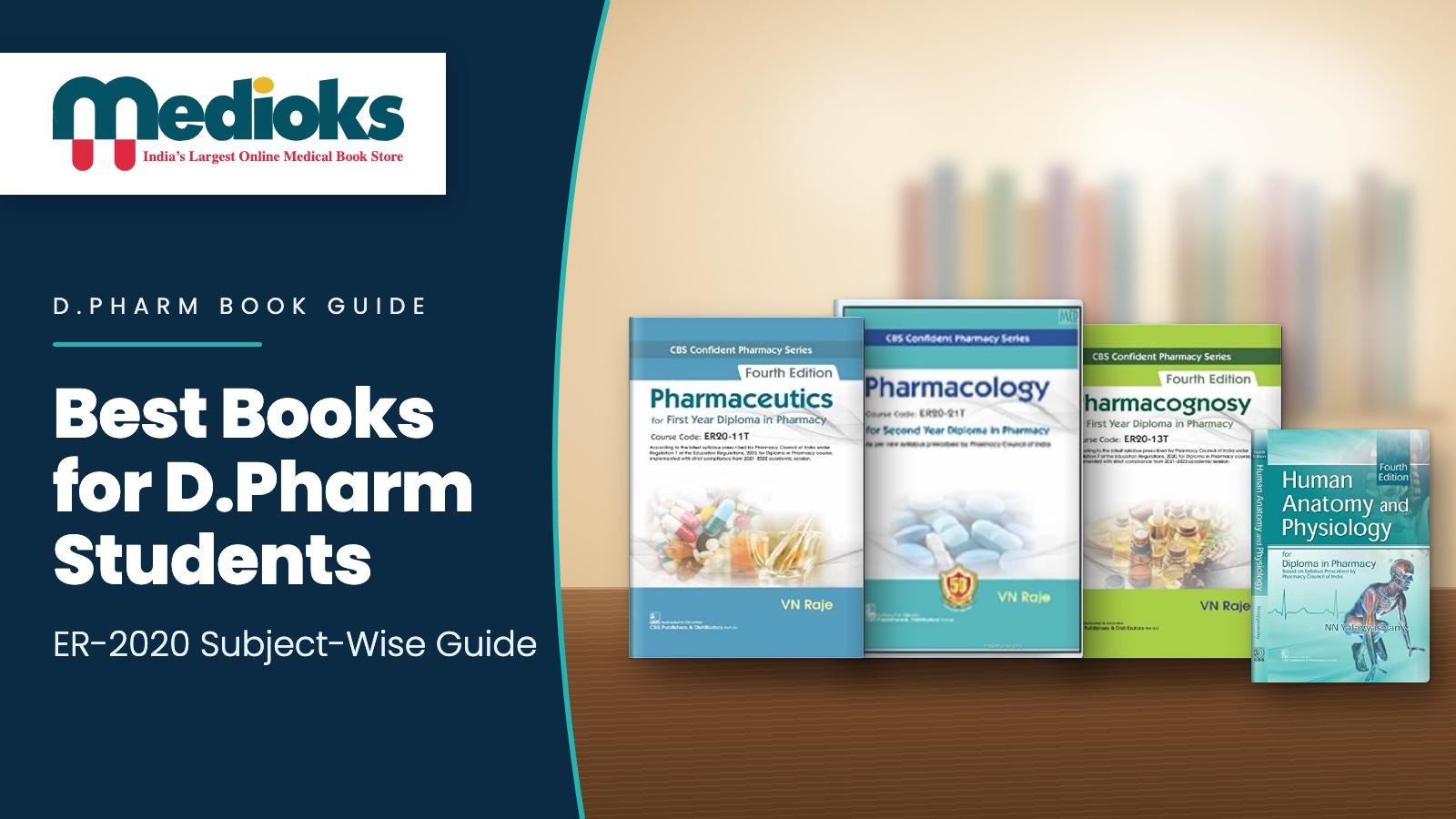
D.Pharm students do best with one book per subject written for the Pharmacy Council of India’s ER-2020 syllabus, plus the practical notebooks your college requires. V.N. Raje’s series covers most first- and second-year subjects, and several other Indian authors write D.Pharm-specific books. Make sure any book you buy says “ER-2020” or “as per PCI syllabus”.
The two-year Diploma in Pharmacy follows the PCI’s Education Regulations 2020 (ER-2020). This guide lists the subjects in each year and suggests books for each, all available on Medioks.
Quick answer
- First year: Pharmaceutics, Pharmaceutical Chemistry, Pharmacognosy, Human Anatomy & Physiology, and Social Pharmacy.
- Second year: Pharmacology, Community Pharmacy & Management, Biochemistry & Clinical Pathology, Pharmacotherapeutics, Hospital & Clinical Pharmacy, and Pharmacy Law & Ethics.
- Simplest approach: one ER-2020 book per subject (V.N. Raje’s series covers most), plus your college’s practical notebooks.
- Before buying: check for “ER-2020” on the cover or product page.
D.Pharm subjects under ER-2020
| First year | Second year |
|---|---|
| Pharmaceutics | Pharmacology |
| Pharmaceutical Chemistry | Community Pharmacy & Management |
| Pharmacognosy | Biochemistry & Clinical Pathology |
| Human Anatomy & Physiology | Pharmacotherapeutics |
| Social Pharmacy | Hospital & Clinical Pharmacy |
| Pharmacy Law & Ethics |
First-year books
| Subject | Suggested book | Author |
|---|---|---|
| Pharmaceutics | Pharmaceutics for First Year Diploma in Pharmacy | V.N. Raje |
| Pharmaceutical Chemistry | Pharmaceutical Chemistry for First Year Diploma in Pharmacy | V.N. Raje |
| Pharmacognosy | Pharmacognosy for First Year Diploma in Pharmacy | V.N. Raje |
| Human Anatomy & Physiology | Human Anatomy and Physiology for Diploma in Pharmacy | N.N. Yalayyaswamy |
| Social Pharmacy | Social Pharmacy for First Year Diploma in Pharmacy | N.K. Jain, Shelly Khurana |
For pharmacognosy in more depth, Pharmacognosy by C.K. Kokate and S.B. Gokhale is a classic reference used in both D.Pharm and B.Pharm.
Second-year books
| Subject | Suggested book | Author |
|---|---|---|
| Pharmacology | Pharmacology for Second Year Diploma in Pharmacy | V.N. Raje |
| Community Pharmacy & Management | Community Pharmacy and Management for Second Year Diploma in Pharmacy | V.N. Raje |
| Biochemistry & Clinical Pathology | Biochemistry and Clinical Pathology: Theory and Practical for Diploma in Pharmacy | S.P. Singh |
| Pharmacotherapeutics | Pharmacotherapeutics: Theory and Practical for Second Year Diploma in Pharmacy | Mayank Patel, Shilpi Agarwal, Gaurav Agarwal |
| Hospital & Clinical Pharmacy | Hospital and Clinical Pharmacy for Second Year Diploma in Pharmacy | V.N. Raje |
| Pharmacy Law & Ethics | Pharmacy Law and Ethics for Second Year Diploma in Pharmacy | Vishal Suresh Bagul and others |
For a second view of pharmacology, Textbook of Pharmacology for Diploma in Pharmacy Students (CH K.V.L.S.N. Anjana Male and Grandhi Surendra) is another D.Pharm-specific book.
Practical notebooks and lab manuals
Practicals are a big part of D.Pharm assessment. Many colleges use printed practical notebooks. Medioks stocks several, including:
- Pharmacognosy Practical Notebook for First Year Diploma in Pharmacy (Varun Dutt Sharma)
- Pharmaceutical Chemistry Laboratory Manual for First Year Diploma in Pharmacy (Amrita Parle)
- Practical Manual of Pharmacology for Second Year Diploma in Pharmacy
Check which notebooks your college prescribes before buying, because formats vary.
How to choose and use D.Pharm books
- Look for “ER-2020” or “as per PCI syllabus” on the book or product page. Older syllabus books may cover different topics.
- Buy one book per subject. A book matched to the syllabus is better than a big reference you won’t finish.
- Keep practical records up to date through the year. They count in internal assessment.
- Make drug tables for pharmacology and pharmacotherapeutics: drug class, examples, uses, side effects and counselling points.
- Think ahead to your career. If you plan to move to B.Pharm, a reference like Kokate’s Pharmacognosy will keep being useful.
What the D.Pharm course prepares you for
The Diploma in Pharmacy is a two-year course regulated by the Pharmacy Council of India (PCI). It’s followed by practical training as required by the regulations. After completing the course and the required training, graduates can register as pharmacists with their State Pharmacy Council, which allows them to work in community pharmacies, hospital pharmacies and other pharmacy settings. Check the current PCI and state council rules for the exact requirements.
Because D.Pharm leads directly to practice, the syllabus combines science subjects with practical subjects like dispensing, community pharmacy, hospital pharmacy and pharmacy law.
Subject-by-subject study tips
| Subject | What to focus on |
|---|---|
| Pharmaceutics | Dosage forms, calculations, prescriptions and dispensing. Practise calculations regularly |
| Pharmaceutical Chemistry | Drug classes, structures at the level your syllabus needs, and lab tests. Make tables by drug class |
| Pharmacognosy | Crude drugs, their sources, constituents and uses. Use diagrams and practical identification |
| Human Anatomy & Physiology | Body systems as a base for pharmacology. Diagrams help a lot |
| Social Pharmacy | Public health, national health programmes and the pharmacist’s role in the community |
| Pharmacology | Drug classes, mechanisms, uses, side effects and interactions |
| Community Pharmacy & Management | Running a pharmacy, patient counselling, over-the-counter medicines and inventory |
| Biochemistry & Clinical Pathology | Biomolecules, metabolism basics and common lab tests |
| Pharmacotherapeutics | Common diseases and their drug treatment, and the counselling points |
| Hospital & Clinical Pharmacy | Hospital pharmacy organisation, drug distribution and clinical pharmacy services |
| Pharmacy Law & Ethics | The main laws governing drugs and pharmacy practice in India, and professional ethics |
Doing well in practicals
- Prepare before each practical by reading the experiment in your lab manual.
- Write up records the same day, while observations are fresh.
- Learn the principle behind each experiment, not just the steps. Viva questions usually ask why.
- Practise prescription reading and labelling carefully in dispensing practicals.
- Handle chemicals safely and follow lab rules strictly.
Preparing for D.Pharm exams
- Cover the syllabus once during the year with your main book.
- Make short notes and tables, especially for drug classes and pharmacognosy.
- Solve previous papers from your board or university to learn the question pattern.
- Revise twice before the exam, using your notes for the second revision.
The Diploma in Pharmacy Exit Examination
The PCI has introduced regulations for a Diploma in Pharmacy Exit Examination (DPEE), linked to registration as a pharmacist. Its implementation and details have been subject to updates and announcements. If you’re a D.Pharm student, follow official PCI notices for the current status, eligibility and syllabus. The subject knowledge in your D.Pharm books is the foundation for any such exam.
Career paths after D.Pharm
- Community pharmacist in a retail pharmacy, or running your own pharmacy once eligible.
- Hospital pharmacist in government or private hospitals.
- Roles in the pharmaceutical industry, such as production, quality control, sales or distribution, depending on the role’s requirements.
- Further study: many students move on to B.Pharm through lateral entry, where available, and then to M.Pharm or other courses.
If you plan to continue to B.Pharm, keep your D.Pharm books and notes. Subjects like pharmacology, pharmaceutics and pharmacognosy carry forward, and references such as Kokate’s Pharmacognosy stay useful.
Patient counselling: a key pharmacist skill
Several D.Pharm subjects, especially community pharmacy and pharmacotherapeutics, focus on counselling patients about their medicines. Good counselling covers how and when to take a medicine, what to avoid, common side effects, and when to see a doctor. Practise explaining medicines in simple language, in the languages your patients speak. It’s one of the most valuable skills you can take from the course into practice.
Making pharmacology easier
Pharmacology is the heart of D.Pharm’s second year, and it connects to pharmacotherapeutics, hospital pharmacy and community pharmacy. A few habits make it much easier:
- Learn by drug class. Understand the class first: its mechanism, common uses and typical side effects. Then add the individual drugs.
- Make one table per system, for example cardiovascular, respiratory or central nervous system drugs.
- Link drugs to diseases. When you study a drug class, note which conditions it treats in pharmacotherapeutics.
- Add counselling points. For each common drug, note what you’d tell a patient: timing, food, side effects and warnings.
- Revise often. Short, regular revision works better than long sessions just before exams.
First year vs second year at a glance
The first year builds the foundations: how medicines are made and tested, where natural drugs come from, the chemistry of drugs, and how the body works. The second year applies that knowledge: how drugs act and treat disease, how pharmacies and hospitals manage medicines, and the laws and ethics of pharmacy practice. Keeping your first-year notes organised pays off in the second year, when you’ll use them again.
Buying D.Pharm books: practical tips
- Check the syllabus version. Look for “ER-2020” or “as per PCI syllabus” on the cover or product page.
- Check the edition. Newer editions often update drug information and fix errors.
- Buy subject by subject as each year begins, rather than everything at once.
- Keep practical notebooks separate from theory books, and buy the ones your college prescribes.
- Buy genuine copies. Pirated copies often have missing pages, unclear diagrams and errors in drug data, which matter in pharmacy.
All the books listed in this guide are available on Medioks. If you can’t find a title your college recommends, you can request it through the Medioks website.
Studying with others
Many D.Pharm students find study groups helpful, especially for pharmacology and pharmacognosy, where testing each other on drug classes and crude drugs makes revision faster. Share notes and tables, quiz each other before practicals, and explain topics to each other. Teaching a topic is one of the quickest ways to find out whether you really understand it.
Frequently asked questions
Which books are best for D.Pharm first year?
Choose one ER-2020 book each for Pharmaceutics, Pharmaceutical Chemistry, Pharmacognosy, Human Anatomy & Physiology and Social Pharmacy. V.N. Raje’s series covers most of these.
What does ER-2020 mean?
It refers to the Pharmacy Council of India’s Education Regulations 2020, which set the current D.Pharm syllabus.
Are B.Pharm books suitable for D.Pharm?
Some references, such as Kokate’s Pharmacognosy, are useful, but D.Pharm-specific books match the syllabus and exam depth better.
Do I need practical notebooks?
Most colleges require them for practicals. Check which ones your college prescribes.
Is D.Pharm a two-year course?
Yes. The D.Pharm course is two years, followed by practical training as required by the PCI regulations. Check your institution’s scheme for details.
Do D.Pharm books differ between universities?
Most D.Pharm books follow the common PCI ER-2020 syllabus, so they suit most institutions. Your college may still recommend specific authors.
Which D.Pharm subject is the hardest?
It varies by student. Many find pharmaceutical chemistry and pharmacology challenging at first, because they involve many drugs and structures. Regular revision with tables helps.
Can I use B.Pharm books for D.Pharm?
Some B.Pharm references are useful for depth, but D.Pharm books match the syllabus and exam level more closely.
What’s the difference between ER-1991 and ER-2020 books?
ER-2020 is the newer syllabus, with different subjects and content. Make sure your books follow ER-2020 unless your institution tells you otherwise.
Do I need practical notebooks for every subject?
Practical subjects usually need record books or notebooks. Your college will tell you which ones to use.
Which publisher’s D.Pharm books are most popular?
Several publishers produce D.Pharm books for the PCI syllabus, including series such as V.N. Raje’s books. Popularity varies by region and college, so ask your teachers which authors they recommend.
Are D.Pharm practicals assessed separately?
Usually, yes. Practical exams and internal assessment are typically separate from theory papers. Check your board’s or university’s scheme for the exact marks distribution.
Can I become a pharmacist with only D.Pharm?
D.Pharm is the minimum qualification for registration as a pharmacist in India, subject to completing the course, required training and any exams or conditions set by the PCI and your State Pharmacy Council. Check current rules with your state council.
The bottom line
For D.Pharm, buy one ER-2020 book per subject, use your college’s practical notebooks, and keep your records and drug tables up to date. That’s enough to cover both years without overspending.
Syllabus details can vary by institution. Always confirm with your college’s official scheme. Book recommendations are general guidance, and editions and availability change. Facts checked on 26 November 2026.