

Best ENT Books for MBBS Students: Dhingra, Bansal, Logan Turner and More

admin
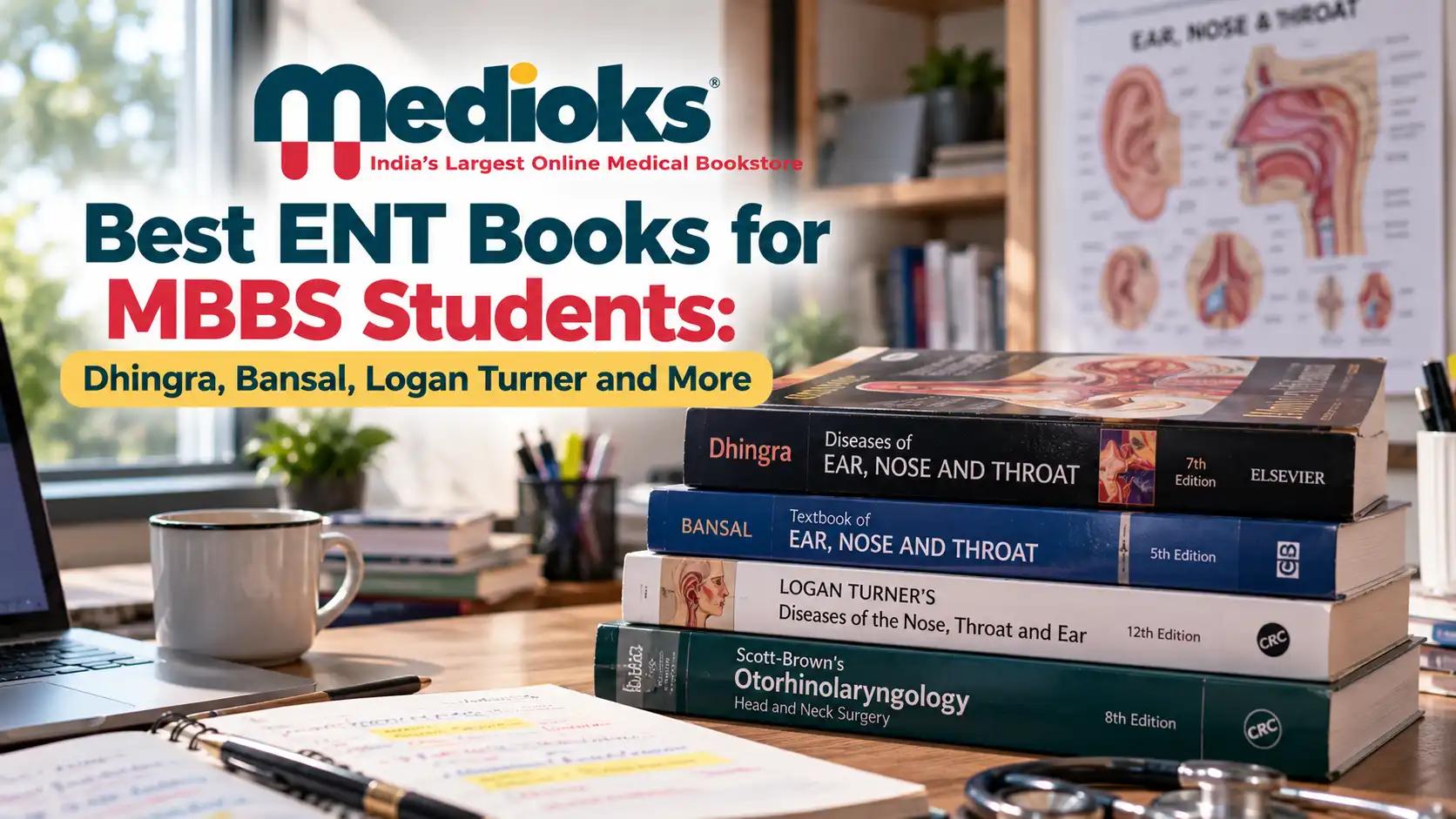
For MBBS ENT (otorhinolaryngology), most Indian students use one main textbook, usually Dhingra’s Diseases of Ear, Nose and Throat & Head and Neck Surgery or Mohan Bansal’s Diseases of Ear, Nose and Throat, along with a logbook or practical guide for clinical postings. International books like Logan Turner’s are good additions for concepts but aren’t essential.
ENT is a short subject with a lot of clinical content: tuning fork tests, examination of the ear, nose and throat, instruments, X-rays and common emergencies. The right book helps you prepare for both theory and the clinical and viva exams. This guide compares the main options.
Quick answer
- Most popular main book: Dhingra, by P.L. Dhingra and Shruti Dhingra. Medioks lists the 9th edition (2026), packaged with a manual of clinical cases.
- Strong alternative: Mohan Bansal’s Diseases of Ear, Nose and Throat, with his shorter Essentials of ENT for revision.
- Clinical postings: a competency-based ENT logbook, such as Mohan Bansal’s, plus practice with a 512 Hz tuning fork.
- Extra reading: Logan Turner’s Diseases of the Nose, Throat and Ear (12th edition, 2025) or Hall & Colman’s.
- PG reference only: Scott-Brown’s Otorhinolaryngology.
ENT books compared
| Book | Author(s) | Type | Best for |
| Diseases of Ear, Nose and Throat & Head and Neck Surgery | P.L. Dhingra, Shruti Dhingra | Main textbook | Concise, exam-oriented coverage. Widely used in Indian colleges |
| Diseases of Ear, Nose and Throat | Mohan Bansal | Main textbook | A detailed alternative with a clinical approach |
| Essentials of Ear, Nose & Throat | Mohan Bansal | Short book | Revision |
| Textbook of Ear, Nose, Throat and Head & Neck Surgery: Clinical and Practical | P. Hazarika | Main textbook | Clinical and practical emphasis |
| Textbook of Ear, Nose and Throat Diseases | Maqbool | Main textbook | A long-standing alternative |
| Logan Turner’s Diseases of the Nose, Throat and Ear | Musheer Hussain, Quentin Gardiner (eds) | International textbook | Conceptual reading. 12th edition (2025) is listed |
| Competency Based Logbook in ENT for MBBS | Mohan Bansal | Logbook | Recording clinical competencies |
All books listed are available on Medioks. Check the product page for the current edition before you buy.
Dhingra: the most common choice
Dhingra’s Diseases of Ear, Nose and Throat & Head and Neck Surgery is probably the most widely used ENT book among Indian MBBS students. Its chapters are compact and organised in a way that’s easy to turn into exam answers.
- Strengths: concise, well illustrated, covers the undergraduate syllabus, and widely followed in question papers.
- Limitations: because it’s concise, some topics, such as the physiology of hearing or the details of head and neck oncology, may need a second source if you want depth.
- Tip: the 9th edition (2026) listed on Medioks comes with a manual of clinical cases, which is useful before your clinical exam.
Mohan Bansal’s ENT books
Mohan Bansal has written several books that work together:
- Diseases of Ear, Nose and Throat is a full main textbook, more detailed than Dhingra in places.
- Essentials of Ear, Nose & Throat is a shorter book for revision.
- Competency Based Logbook in ENT for MBBS helps you document the competencies you’re assessed on during postings.
Other Indian textbooks
Hazarika’s Textbook of ENT and Head & Neck Surgery: Clinical and Practical and Maqbool’s Textbook of Ear, Nose and Throat Diseases are other main books used in some colleges. If your ENT faculty recommends one of them, follow that advice. Otherwise, you don’t need more than one main Indian textbook.
International books
International textbooks explain concepts well but are less closely matched to Indian question papers:
- Logan Turner’s Diseases of the Nose, Throat and Ear (12th edition, 2025) is a well-regarded concise text.
- Hall & Colman’s Diseases of the Ear, Nose and Throat (Martin Burton) is a short introductory text.
- Scott-Brown’s Otorhinolaryngology is a multi-volume postgraduate reference. Undergraduates don’t need it.
Books and tools for clinical postings
ENT clinical exams usually test history-taking, examination of the ear, nose, throat and neck, tuning fork tests, instruments and X-rays. To prepare:
- Practise tuning fork tests (Rinne, Weber and absolute bone conduction) until you can perform and interpret them confidently. A 512 Hz fork is the one generally used. A tuning fork set lets you practise at home.
- Learn instruments with their uses, and be ready to explain how and when each is used.
- Study common X-rays and scans, such as the paranasal sinus views and soft-tissue neck films your department uses.
- Keep your logbook updated after each posting rather than completing it the week before exams.
How to study ENT in limited time
- Start with anatomy and physiology of the ear, because hearing tests and ear diseases make sense only after that.
- Prioritise common conditions: otitis media and its complications, hearing loss, epistaxis, sinusitis, tonsillitis, deviated nasal septum, and head and neck tumours.
- Use diagrams. ENT answers score better with a labelled diagram, such as the middle ear, the lateral wall of the nose or the larynx.
- Revise emergencies separately: airway obstruction, tracheostomy, foreign bodies and epistaxis management.
- Read one main book fully before reaching for a second one.
Studying community medicine and ophthalmology in the same year? See our guides to MBBS 3rd year books and the Final Professional Part I book list.
Frequently asked questions
Which is the best ENT book for MBBS?
Dhingra’s Diseases of Ear, Nose and Throat & Head and Neck Surgery is the most common choice. Mohan Bansal’s Diseases of Ear, Nose and Throat is a strong alternative if you want more detail.
Is Dhingra enough for ENT university exams?
For most students, yes, when combined with clinical postings, a logbook and previous question papers.
Should I buy Logan Turner as well?
It’s optional. Logan Turner is useful for understanding concepts, but most students do well with one Indian main textbook.
Which tuning fork is used for ENT tests?
A 512 Hz tuning fork is generally used for Rinne and Weber tests. Lower frequencies, such as 128 Hz, are more commonly used for vibration sense in neurological examination.
Do I need Scott-Brown’s as an MBBS student?
No. It’s a postgraduate reference. Use your library copy if you need it.
The bottom line
Choose one main ENT textbook, Dhingra or Mohan Bansal, and use your clinical postings and logbook well. Practise tuning fork tests and instruments, and draw diagrams in your answers. Add an international book only if you want deeper concepts.
Book recommendations are general guidance. Always follow your college’s syllabus and your faculty’s advice. Editions and availability change, so check the product page for the latest edition. Facts checked on 29 October 2026.
Written by: Medioks Editorial Team. Medioks has served the medical community for 54 years through bookstores in Chandigarh, Amritsar and Rohtak, and now online as a direct distributor of major medical publishers, supplying books for medical, dental, nursing, Ayurveda and physiotherapy courses.
Disclosure: Medioks sells the books and equipment mentioned in this article.