

Best Forensic Medicine Books for MBBS: Narayan Reddy vs Krishan Vij (2026 Guide)

admin
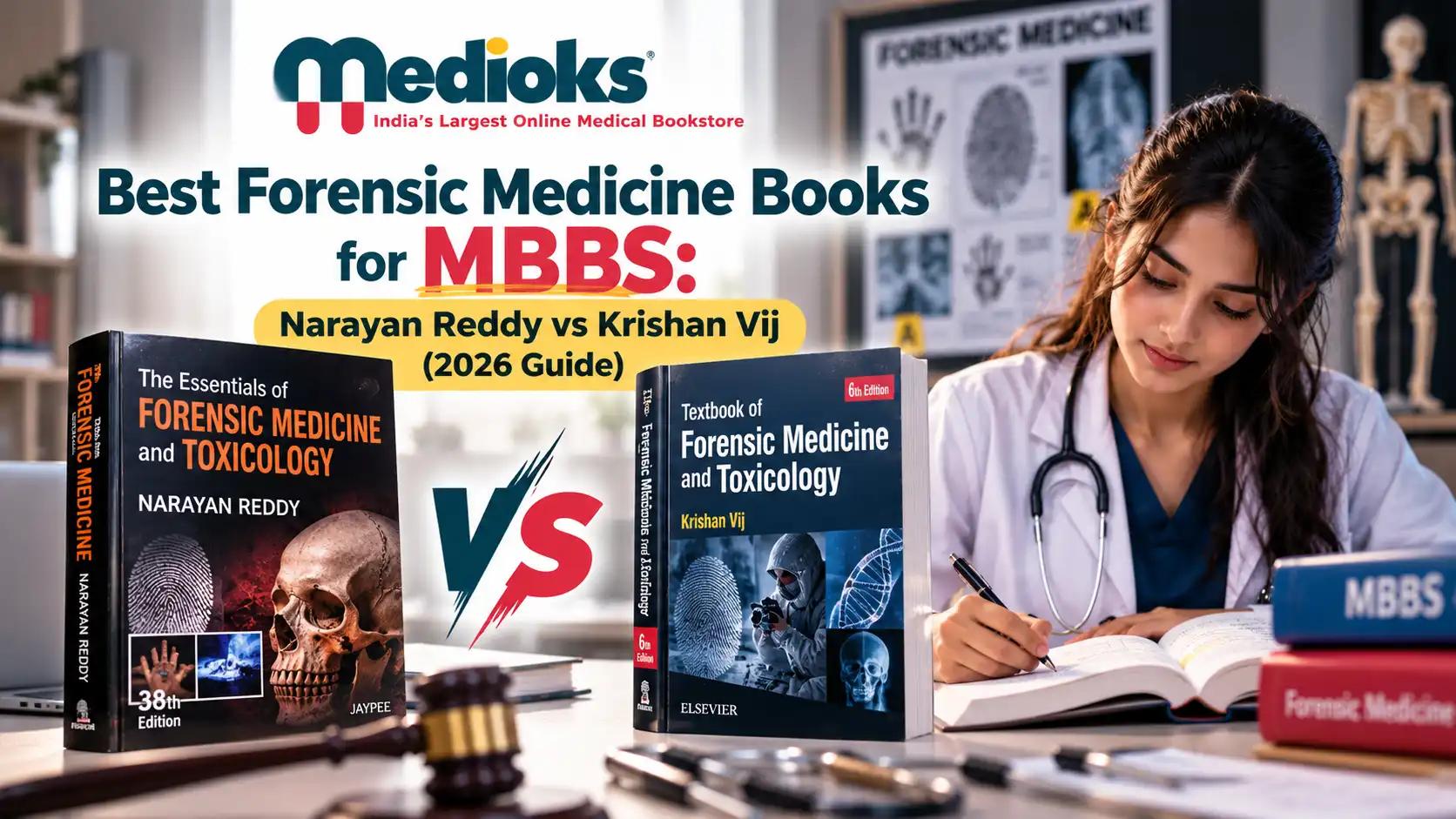
The two most widely used forensic medicine and toxicology (FMT) textbooks in India are K.S. Narayan Reddy’s The Essentials of Forensic Medicine & Toxicology and Krishan Vij’s Textbook of Forensic Medicine and Toxicology: Principles and Practice. One of these, plus a practical or record book, is enough for most MBBS students.
There’s one thing to check before you buy any FMT book in 2026: whether it covers India’s new criminal laws. On 1 July 2024, the Bharatiya Nyaya Sanhita (BNS), Bharatiya Nagarik Suraksha Sanhita (BNSS) and Bharatiya Sakshya Adhiniyam (BSA) replaced the Indian Penal Code, the Code of Criminal Procedure and the Indian Evidence Act. Much of FMT’s medicolegal content refers to these laws, so an older edition can teach you section numbers that no longer apply.
Quick answer
- Main textbook, the most common choice:S. Narayan Reddy’s The Essentials of Forensic Medicine & Toxicology.
- Main textbook, the alternative: Krishan Vij’s Textbook of Forensic Medicine and Toxicology: Principles and Practice. Medioks stocks the 7th edition (2025).
- Quick revision: a concise or synopsis version of Reddy.
- Practicals: your department’s practical or postmortem record book, plus a colour atlas if you learn visually.
- Before buying: check that the edition covers BNS, BNSS and BSA.
Why FMT deserves proper attention
Students often treat forensic medicine as a “short subject”, but it covers knowledge every doctor uses: certifying death, examining injury and sexual assault cases, recognising poisoning, writing medicolegal reports, consent, and medical ethics and negligence. In most universities it is examined in the Third Professional Part 1 year. Check your own university’s scheme.
FMT books compared
| Book | Author / editor | Type | Best for |
| The Essentials of Forensic Medicine & Toxicology | K.S. Narayan Reddy (current editions edited by Dharmaraya Ingale and Dileep Kumar K.B.) | Main textbook | Comprehensive coverage and a long track record in Indian colleges |
| Textbook of Forensic Medicine and Toxicology: Principles and Practice | Krishan Vij, Senthil Kumaran | Main textbook | Clear structure and readable explanations. 7th edition (2025) is listed on Medioks |
| Textbook / Essentials of Forensic Medicine and Toxicology | Anil Aggrawal | Main textbook | An alternative main book |
| Concise Forensic Medicine & Toxicology | K.S. Narayan Reddy | Short book | Fast revision before exams |
| The Synopsis of Forensic Medicine & Toxicology | Based on K.S. Narayan Reddy (Manu Johns Chowallur) | Synopsis | Last-minute revision |
| Parikh’s Colour Atlas of Medicolegal Postmortems and Forensic Pathology | O.P. Murthy | Atlas | Visual learning for injuries and postmortem findings |
All books listed are available on Medioks. Check the product page for the current edition before you buy.
Main textbooks
K.S. Narayan Reddy’s The Essentials of Forensic Medicine & Toxicology
Narayan Reddy is the book many FMT departments are built around. It covers forensic pathology, clinical forensic medicine, toxicology, and the legal and ethical side of practice in detail.
- Strengths: comprehensive, with detailed toxicology and medicolegal procedure. Many university questions follow its scope.
- Limitations: it’s dense, so some students find it slow to read for a subject with limited teaching hours.
- Best for: students who want one complete book and are willing to read it properly.
Krishan Vij’s Textbook of Forensic Medicine and Toxicology
Krishan Vij’s Principles and Practice (7th edition, 2025, with Senthil Kumaran) is a popular alternative. Students often find its explanations and layout easy to follow.
- Strengths: readable, well organised, and a recent edition.
- Limitations: if your faculty sets questions around Reddy, compare important topics against Reddy too.
- Best for: students who want a clear main book in a recent edition.
Anil Aggrawal’s textbooks
Anil Aggrawal’s Textbook of Forensic Medicine and Toxicology is another full textbook from an author also known for his work in toxicology. It works well if a senior or teacher you trust recommends it, but you don’t need it alongside Reddy or Vij.
Revision, atlas and practical books
- Short revision: Concise Forensic Medicine & Toxicology or The Synopsis of Forensic Medicine & Toxicology work best after you’ve read the main book once.
- Atlas: Parikh’s Colour Atlas helps you recognise injuries and postmortem changes, which are asked about constantly in practicals and viva.
- Practicals: use your department’s practical or postmortem record book. Practicals usually include age estimation from bones and X-rays, weapons, poisons, specimens, and writing certificates and reports.
New criminal laws: what to check in your book
Since 1 July 2024, medicolegal sections refer to the BNS, BNSS and BSA instead of the IPC, CrPC and Evidence Act. When choosing an FMT book or edition:
- Check the product description or preface for BNS, BNSS and BSA coverage.
- Look at a familiar topic, such as hurt, dying declarations or inquest, and see which law it cites.
- If you already own an older edition, update your notes with the new section numbers from your faculty’s handouts.
- Expect question papers to use the new laws. Check with your department how they are handling the transition.
How to study FMT efficiently
- Split the subject into blocks: forensic pathology (death, injuries, postmortem), clinical forensic medicine (age, sexual offences, identification), toxicology, and medical law and ethics.
- Use tables for toxicology. Compare poisons by agent, signs, fatal dose, treatment and postmortem findings.
- Practise writing certificates and reports. Practical exams reward correct format as much as content.
- Attend postmortems and court-related teaching when your department offers them. They make the theory memorable.
- Revise from your own notes, then use a concise book for the final pass.
For your other third-year subjects, see our MBBS 3rd year book guide.
Frequently asked questions
Which is the best forensic medicine book for MBBS?
K.S. Narayan Reddy’s The Essentials of Forensic Medicine & Toxicology is the most widely used. Krishan Vij’s Textbook of Forensic Medicine and Toxicology is a strong alternative. Choose one as your main book.
Reddy or Krishan Vij: which is better?
Reddy is often preferred for completeness, and Vij for readability. Ask your faculty which one their teaching follows, and check that the edition you buy covers BNS, BNSS and BSA.
Is the concise Reddy enough for exams?
It’s best used for revision. Most students do better reading a full textbook once and then revising from a concise book.
Do old FMT editions still work after the new criminal laws?
The medical science in them is largely still valid, but legal section numbers and some procedures have changed. Use an updated edition or update your notes.
Is FMT useful for NEET PG?
Yes. FMT is part of the NEET PG syllabus, and toxicology and medicolegal questions appear regularly. See our NEET PG book guide.
The bottom line
Pick one main FMT textbook, Narayan Reddy or Krishan Vij, in an edition that covers the new criminal laws. Add a concise book for revision and use your department’s practical record book. FMT rewards organised notes and practice writing reports more than extra books.
Book recommendations are general guidance. Always follow your college’s syllabus and your faculty’s advice. Editions and availability change, so check the product page for the latest edition. Facts checked on 29 October 2026.
Written by: Medioks Editorial Team. Medioks has served the medical community for 54 years through bookstores in Chandigarh, Amritsar and Rohtak, and now online as a direct distributor of major medical publishers, supplying books for medical, dental, nursing, Ayurveda and physiotherapy courses.
Disclosure: Medioks sells the books mentioned in this article.