

Complete Guide to Anatomy Books for MBBS Beginners in 2026

Sayanti Chakrabarti
Starting MBBS is exciting, but Anatomy can quickly become one of the most demanding first-year subjects. Students encounter unfamiliar terminology, extensive anatomical relationships, dissection sessions, histology, embryology, osteology, neuroanatomy, and clinical correlations—all within a relatively short academic period.
One of the first questions beginners ask is:
Which Anatomy book should I buy for MBBS 1st year?
The answer isn’t simply to purchase the biggest or most popular textbook. A good Anatomy resource should match your university syllabus, learning style, examination requirements, and available study time.
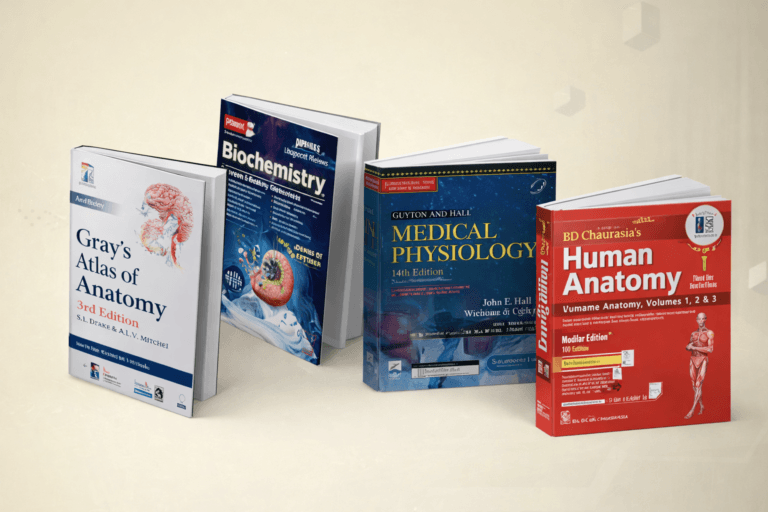
For many Indian MBBS students, B.D. Chaurasia’s Human Anatomy is a practical primary textbook. Gray’s Anatomy for Students is particularly useful for visual and conceptual learning, while Vishram Singh can be a strong undergraduate alternative. Snell’s Clinical Anatomy adds clinical perspective, and Netter’s Atlas of Human Anatomy can strengthen three-dimensional visualization.
This complete guide explains how beginners can choose and use Anatomy books without getting overwhelmed.
Quick Answer: Which Anatomy Book Is Best for MBBS Beginners?
For most Indian MBBS beginners, B.D. Chaurasia’s Human Anatomy is a practical primary textbook because of its undergraduate focus and regional organization.
If you learn best through visual explanations and clinical correlations, consider Gray’s Anatomy for Students as a supplementary resource.
For students who prefer a more focused undergraduate presentation, Vishram Singh is another option. Snell’s Clinical Anatomy is valuable for applied Anatomy, while Netter’s Atlas is useful for visual reference.
A simple beginner-friendly combination:
One primary textbook + one atlas/visual resource + your dissection notes
You do not need five textbooks to learn Anatomy effectively.
Why Is Anatomy Difficult for MBBS Beginners?
Anatomy can feel difficult because it combines several types of learning.
You need to understand:
- Anatomical terminology
- Bones and landmarks
- Muscles and attachments
- Arteries and veins
- Nerves and pathways
- Organs and their relations
- Histological structures
- Embryological development
- Surface anatomy
- Clinical applications
The challenge isn’t only the amount of information. Students must also develop three-dimensional thinking.
For example, knowing the name of a nerve is not enough. You should eventually understand its origin, course, anatomical relationships, branches, functions, and clinical consequences of injury.
That’s why textbook selection matters.
1. B.D. Chaurasia’s Human Anatomy
Best for: Primary undergraduate study and Indian MBBS preparation.
B.D. Chaurasia’s Human Anatomy is one of the most familiar Anatomy textbooks for MBBS students in India.
Its regional approach makes it practical for studying areas systematically, while illustrations help students connect written descriptions with anatomical structures.
Current publisher listings include 10th-edition volumes, so students purchasing a new copy should verify the specific volume and edition before ordering.
Strengths
- Undergraduate-oriented content
- Regional organization
- Detailed anatomical descriptions
- Useful diagrams
- Strong examination relevance
- Familiarity among Indian medical students
Best way to use it
Don’t attempt to memorize every sentence.
Instead, focus on:
Structure → Relations → Blood supply → Nerve supply → Function → Applied Anatomy
This approach produces better understanding than isolated memorization.
2. Gray’s Anatomy for Students
Best for: Visual learners and conceptual understanding.
Gray’s Anatomy for Students is specifically designed for medical students rather than functioning as a massive professional reference.
Its major advantage is its emphasis on clear illustrations, anatomical relationships, clinical correlations, surface anatomy, and imaging.
Why beginners may like it
It can help answer questions such as:
- Where exactly is this structure?
- What lies around it?
- Why is this relationship clinically important?
- How does the anatomy appear on imaging?
This makes it particularly useful when traditional textbook descriptions feel difficult to visualize.
Best use
Use it as your primary textbook if it matches your curriculum, or as a conceptual supplement to B.D. Chaurasia.
3. Vishram Singh’s Textbook of Anatomy
Best for: Students seeking a structured undergraduate textbook with strong diagram support.
Vishram Singh is another established option for first-year MBBS Anatomy.
It can be particularly useful for students who prefer a focused presentation rather than navigating extremely detailed reference material.
Potential advantages
- Undergraduate focus
- Structured explanations
- Diagram support
- Regional Anatomy coverage
- Useful for revision
B.D. Chaurasia vs Vishram Singh
There is no universal winner.
If your college faculty predominantly teaches from B.D. Chaurasia, following that resource may make your preparation easier. If you find Vishram Singh’s explanations more intuitive, it may be a better fit.
Consistency matters more than collecting multiple books.
4. Snell’s Clinical Anatomy by Regions
Best for: Applied Anatomy and clinical correlations.
Snell’s Clinical Anatomy by Regions connects anatomical structures with clinical situations.
Its approach can help students understand the relationship between textbook Anatomy and actual patient care.
Useful areas include:
- Surface anatomy
- Clinical examination
- Anatomical landmarks
- Imaging
- Surgical relevance
- Clinical conditions
It is especially useful once you have established your basic anatomical foundation.
Beginner tip
Don’t make Snell another book you feel obligated to finish cover-to-cover. Use it when you want to answer:
“Why does this anatomical structure matter clinically?”
5. Netter’s Atlas of Human Anatomy
Best for: Visualizing Anatomy.
An atlas and a textbook serve different purposes.
A textbook explains what a structure is and how it works.
An atlas helps you visualize where the structure is and how it relates to surrounding structures.
Netter’s Atlas is particularly useful for:
- Muscles
- Nerves
- Arteries
- Veins
- Organs
- Regional relationships
- Three-dimensional visualization
Is Netter’s mandatory?
No.
If you have limited funds, prioritize your primary textbook. You can also use your college library or legally available institutional resources to consult an atlas.
Anatomy Books for MBBS Beginners: Comparison
| Book | Best For | Beginner Use |
|---|---|---|
| B.D. Chaurasia | Undergraduate study & exams | ⭐⭐⭐⭐⭐ |
| Gray’s Anatomy for Students | Concepts & visual learning | ⭐⭐⭐⭐⭐ |
| Vishram Singh | Structured undergraduate learning | ⭐⭐⭐⭐ |
| Snell’s Clinical Anatomy | Clinical application | ⭐⭐⭐⭐ |
| Netter’s Atlas | Visual reference | ⭐⭐⭐⭐⭐ |
| Gray’s Anatomy | Advanced reference | ⭐⭐ |
The ratings above are a practical learning guide rather than an objective ranking. Your syllabus and faculty recommendations should remain the deciding factors.
Do MBBS Beginners Need More Than One Anatomy Book?
Not necessarily.
One of the most common first-year mistakes is buying multiple textbooks because seniors recommend different titles.
A better strategy is:
Core textbook
Choose B.D. Chaurasia, Vishram Singh, or Gray’s Anatomy for Students based on your requirements.
Visual resource
Add Netter’s Atlas or another suitable atlas if you struggle with spatial visualization.
Clinical supplement
Use Snell’s Clinical Anatomy when you need additional applied context.
Practical resources
Prioritize:
- Dissection notes
- Histology slides
- Osteology notes
- Faculty guidance
- Previous university questions
This creates a more balanced learning system than relying on textbooks alone.
How Should Beginners Study Anatomy?
Step 1: Preview the Topic
Before reading a chapter, identify the structures you are expected to learn.
Step 2: Read the Core Text
Study the topic from your main textbook rather than jumping between multiple books.
Step 3: Visualize
Use an atlas, diagrams, models, or dissection specimens to develop spatial understanding.
Step 4: Practice Diagrams
Regularly draw:
- Nerves
- Arteries
- Muscles
- Joints
- Anatomical spaces
- Brain pathways
Step 5: Apply Clinically
Ask:
What happens if this nerve is injured?
Why is this artery clinically important?
What anatomical structure is involved in this condition?
Step 6: Revise
Use spaced, repeated revision rather than trying to memorize an entire region in one sitting.
Anatomy Books vs Dissection: Which Is More Important?
Neither should replace the other.
Textbooks provide structure and explanation.
Dissection provides three-dimensional experience.
When studying a region, try to connect:
Textbook → Diagram → Dissection → Clinical application → Revision
This creates a stronger mental model than textbook memorization alone.
Common Mistakes MBBS Beginners Should Avoid
Buying too many textbooks
More books do not automatically mean better preparation.
Memorizing without visualization
Anatomy is spatial. Use diagrams, models, specimens, and atlases.
Ignoring practical Anatomy
Don’t postpone dissection and osteology preparation until examinations.
Avoiding clinical correlations
Applied Anatomy makes basic structures easier to remember and understand.
Studying only before examinations
Anatomy requires repeated exposure because the volume of information is substantial.
Frequently Asked Questions
Which Anatomy book is best for MBBS beginners?
B.D. Chaurasia is a practical primary choice for many Indian MBBS students. Gray’s Anatomy for Students is particularly strong for visual and conceptual learning, while Vishram Singh is another useful undergraduate option.
Is B.D. Chaurasia enough for first-year MBBS?
It can serve as a primary resource for many students, but requirements vary by university. Supplement it with practical teaching, diagrams, dissection, and additional references when necessary.
Is Gray’s Anatomy for Students better than B.D. Chaurasia?
Neither is universally better. B.D. Chaurasia may be more practical for many Indian undergraduate examinations, while Gray’s Anatomy for Students is particularly strong in visual and clinical learning.
Should I buy an Anatomy atlas?
An atlas can be extremely useful for visual learners, but it isn’t mandatory. Consider using a college library before buying one.
How many Anatomy books should a first-year MBBS student buy?
Start with one primary textbook. Add an atlas or clinical reference only if it addresses a specific learning need.
Final Verdict
The best Anatomy books for MBBS beginners are not necessarily the most comprehensive books on the market. The ideal resource is one that helps you understand anatomical relationships, visualize structures, prepare for assessments, and develop clinically useful knowledge.
For many Indian MBBS students, B.D. Chaurasia is a strong primary choice. Gray’s Anatomy for Students is excellent for conceptual and visual learning, while Vishram Singh offers another undergraduate-friendly option. Snell’s Clinical Anatomy can strengthen clinical understanding, and Netter’s Atlas is valuable for visual reference.
The smartest beginner strategy is simple:
Choose one core book → attend dissection → visualize structures → practice diagrams → connect Anatomy to clinical cases → revise repeatedly.
Don’t measure your preparation by how many Anatomy books you own. Measure it by how confidently you can identify, explain, visualize, recall, and apply anatomical structures.