

How to Choose the Right MBBS 1st Year Books for Medical College

Sayanti Chakrabarti
Starting MBBS is exciting, but choosing the right MBBS 1st year books can quickly become overwhelming. Anatomy, Physiology and Biochemistry introduce students to an entirely different level of medical learning, and each subject comes with multiple recommended textbooks, atlases, practical manuals, review books and question banks.
The biggest mistake first-year students make is assuming that they need to buy every book recommended by seniors or faculty. In reality, the best book collection is not the largest one—it is the one that matches your university curriculum, learning style, practical requirements and examination strategy.
Quick answer: Start with one reliable primary textbook for each subject, then add an atlas or practical manual where necessary. For most students, the ideal MBBS first-year book collection includes resources for Anatomy, Physiology and Biochemistry, supported by practical books and a question bank. Always prioritize books recommended by your medical college and aligned with the current curriculum.
What Subjects Are Covered in MBBS 1st Year?
The first year generally revolves around three foundational subjects:
Anatomy
Focuses on the structure of the human body, including:
- Gross anatomy
- Neuroanatomy
- Embryology
- Histology
- Surface anatomy
- Radiological anatomy
- Clinical anatomy
Physiology
Explains how the human body functions, including:
- Cardiovascular physiology
- Respiratory physiology
- Renal physiology
- Neurophysiology
- Endocrinology
- Gastrointestinal physiology
- Blood and immunity
- Reproductive physiology
Biochemistry
Explores the chemical and molecular basis of life, including:
- Carbohydrate metabolism
- Protein metabolism
- Lipid metabolism
- Enzymes
- Molecular biology
- Vitamins
- Minerals
- Clinical biochemistry
- Nutrition
Because the learning objectives differ across subjects, one type of book cannot effectively serve all three.
1. Start With Your Medical College Curriculum
Before purchasing books, check your college’s:
- Current syllabus
- Competency requirements
- Recommended reading list
- Practical syllabus
- Examination pattern
- Faculty recommendations
This is particularly important because universities and institutions can differ in how they organize topics and practical assessments.
A book may be excellent academically but still be inefficient if it contains extensive material outside your immediate curriculum.
The right principle is:
Curriculum first → Book selection second.
2. Choose One Primary Textbook Per Subject
First-year students often buy several textbooks for the same subject.
This can create unnecessary confusion.
Instead, select one primary book that you can study consistently.
Your primary textbook should offer:
- Clear explanations
- Logical organization
- Relevant diagrams
- Clinical correlations
- Appropriate depth
- Alignment with your curriculum
You can then use additional books selectively when a concept requires clarification.
Best Anatomy Books for MBBS 1st Year
Anatomy requires a slightly different strategy because it combines theory, visualization and practical learning.
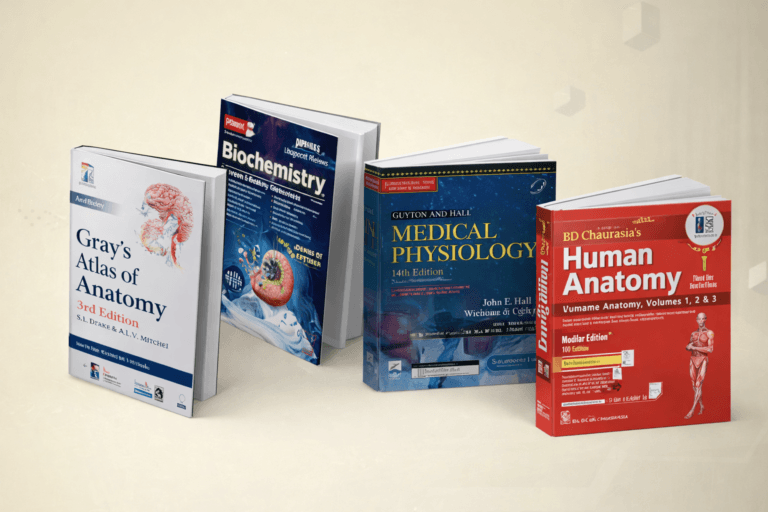
BD Chaurasia’s Human Anatomy
A popular undergraduate resource, particularly among Indian medical students.
Useful for:
- Regional anatomy
- Diagrams
- Neurovascular relationships
- Clinical anatomy
- University preparation
Gray’s Anatomy for Students
A strong option for students who prefer detailed explanations supported by visual and clinical correlations.
Anatomy Atlas
A textbook alone may not be enough for anatomy. An atlas such as Thieme Atlas of Anatomy or Netter’s Atlas of Human Anatomy can help students understand three-dimensional relationships.
Dissector
For students attending cadaveric dissection, a practical resource such as Cunningham’s Manual of Practical Anatomy can help organize laboratory learning.
Anatomy Book Formula
Textbook + Atlas + Dissector = Comprehensive Anatomy Preparation
You don’t necessarily need multiple textbooks.
Best Physiology Books for MBBS 1st Year
Physiology is fundamentally a conceptual subject.
Guyton and Hall Textbook of Medical Physiology
A strong choice for students who want to understand physiological mechanisms through logical explanations.
Ganong’s Review of Medical Physiology
Useful for deeper conceptual understanding and clarification of complex mechanisms.
AK Jain’s Textbook of Physiology
Can be useful for students who prefer structured undergraduate and examination-oriented content.
Physiology Book Formula
Primary textbook + Practical manual + MCQ/revision resource
Focus on understanding mechanisms rather than memorizing isolated facts.
Best Biochemistry Books for MBBS 1st Year
Biochemistry can initially appear difficult because it involves pathways, molecular processes and metabolic relationships.
Harper’s Illustrated Biochemistry
Useful for students who prefer concise explanations supported by illustrations.
Lippincott Illustrated Reviews: Biochemistry
Particularly useful for visual learners and students who like pathway-based explanations and review-oriented content.
Satyanarayana Biochemistry
A commonly used undergraduate resource that can help students connect biochemical concepts with clinical applications.
Biochemistry Book Formula
Primary textbook + Practical manual + MCQ/revision book
For metabolic pathways, diagrams and flowcharts can be especially effective.
Textbook vs Review Book: Which Should You Buy?
This distinction is critical.
Textbook
Best for:
- Learning concepts
- Understanding mechanisms
- Building subject foundations
- Preparing detailed answers
Review Book
Best for:
- Revision
- Quick recall
- Exam preparation
- Last-minute consolidation
A review book should generally supplement—not replace—the primary textbook, particularly when you’re learning a subject for the first time.
Do You Need Practical Books?
Yes, particularly for Anatomy and Physiology.
Practical examinations require skills that theory textbooks may not adequately cover.
Anatomy practical preparation may include:
- Osteology
- Cadaveric structures
- Spotters
- Surface anatomy
- Radiology
- Histology
- Viva
Physiology practical preparation may include:
- Hematology
- Blood pressure
- Pulse examination
- Cardiovascular examination
- Respiratory examination
- Clinical examination
- Laboratory experiments
- Viva
Biochemistry practical preparation may include:
- Laboratory procedures
- Biochemical estimations
- Interpretation
- Calculations
- Clinical correlations
- Viva
Your practical manual should therefore match your college’s laboratory curriculum.
How to Select Between Two Good Books
Sometimes you will find two equally reputable textbooks.
Instead of asking:
“Which book is more famous?”
ask:
1. Which one explains concepts more clearly to me?
2. Does it match my syllabus?
3. Can I realistically complete it?
4. Does it include useful diagrams and tables?
5. Does it support clinical application?
6. Is the edition reasonably current?
7. Does my faculty recommend it?
The best book is often the one you can understand, revise and apply consistently.
Should You Buy the Latest Edition?
Generally, a current edition is preferable because it may contain:
- Updated terminology
- Revised illustrations
- New clinical correlations
- Updated scientific information
- Improved organization
However, don’t automatically replace a usable older edition simply because a newer edition exists.
For core concepts, older editions can remain valuable. For curriculum-specific content, terminology and updated recommendations, check your college’s current requirements.
How Many MBBS 1st Year Books Do You Actually Need?
A focused collection might look like this:
| Subject | Core Resource | Additional Resource |
|---|---|---|
| Anatomy | 1 textbook | Atlas + Dissector |
| Physiology | 1 textbook | Practical manual |
| Biochemistry | 1 textbook | Practical/manual |
| All subjects | — | Question bank/revision resource |
This approach prevents resource overload.
Owning ten books doesn’t improve preparation if you only study two chapters from each.
Common Mistakes When Buying MBBS Books
Buying Every Book Seniors Recommend
Senior advice is valuable, but their learning style may differ from yours.
Choosing Books Only by Popularity
A famous textbook isn’t automatically the best fit for every student.
Ignoring Practical Books
First-year medical education isn’t limited to theory examinations.
Buying Too Many Review Books
Revision resources become useful after you’ve established your concepts.
Ignoring Your University’s Requirements
Your prescribed curriculum should be the first filter.
Choosing Based Only on Price
The cheapest book isn’t necessarily the most economical if it doesn’t meet your learning needs.
A Smart MBBS 1st Year Book-Buying Strategy
Use a three-stage approach.
Stage 1: First Month
Buy or access:
- One primary Anatomy textbook
- One primary Physiology textbook
- One primary Biochemistry textbook
Attend classes and identify where you need additional resources.
Stage 2: During Practical Classes
Add:
- Anatomy atlas
- Dissector
- Practical manuals
Choose these according to your department’s requirements.
Stage 3: Before University Exams
Add or use:
- Previous-year questions
- MCQ books
- Revision notes
- Short-answer resources
This approach reduces unnecessary spending and information overload.
How to Study From Your MBBS Books
Simply owning the right books isn’t enough.
Use an active learning cycle:
Read → Understand → Visualize → Recall → Practice → Revise
For Anatomy, prioritize diagrams and spatial relationships.
For Physiology, focus on mechanisms and flowcharts.
For Biochemistry, use pathways, tables and clinical correlations.
For all three subjects, test yourself regularly instead of repeatedly rereading the same pages.
Frequently Asked Questions
Which books should I buy for MBBS 1st year?
Start with one primary textbook each for Anatomy, Physiology and Biochemistry. Add an anatomy atlas, dissector and practical manuals according to your college’s requirements.
Is one book enough for each MBBS subject?
For most students, one primary textbook is enough for initial learning. Additional resources should solve specific needs rather than duplicate the same content.
Which anatomy book is best for first-year MBBS?
BD Chaurasia is a popular undergraduate choice. Students can supplement it with an atlas such as Thieme or Netter and a dissector for practical work.
Is Guyton necessary for MBBS first year?
Guyton can be an excellent physiology resource for conceptual understanding, but students should choose their primary textbook based on their curriculum, faculty guidance and learning style.
Should MBBS students buy question banks?
Question banks can be very useful for active recall and examination preparation, particularly after completing the relevant concepts.
Final Verdict
Choosing the right MBBS 1st year books isn’t about finding the biggest or most expensive collection. It is about creating a focused learning system.
A practical approach is:
Anatomy: Textbook + Atlas + Dissector
Physiology: Textbook + Practical Manual
Biochemistry: Textbook + Practical Manual
All subjects: Previous-year questions + selective revision/MCQ resources
Books such as BD Chaurasia, Guyton and Hall, Ganong, Lippincott, Harper’s, Satyanarayana, Thieme and Cunningham’s can each serve different purposes. Your final selection should depend on your medical college’s curriculum, faculty recommendations, learning preferences and examination requirements.
The most important rule is simple:
Don’t collect books. Build a study system.
Choose one strong primary resource, understand it thoroughly, use practical and visual resources strategically, and rely on active recall and previous-year questions for examination preparation.
That approach makes the transition into MBBS far more manageable—and gives you a stronger foundation for the clinical subjects that follow.