

Best B.Pharm 1st Year Books: Semester I and II Subject-Wise Guide

admin
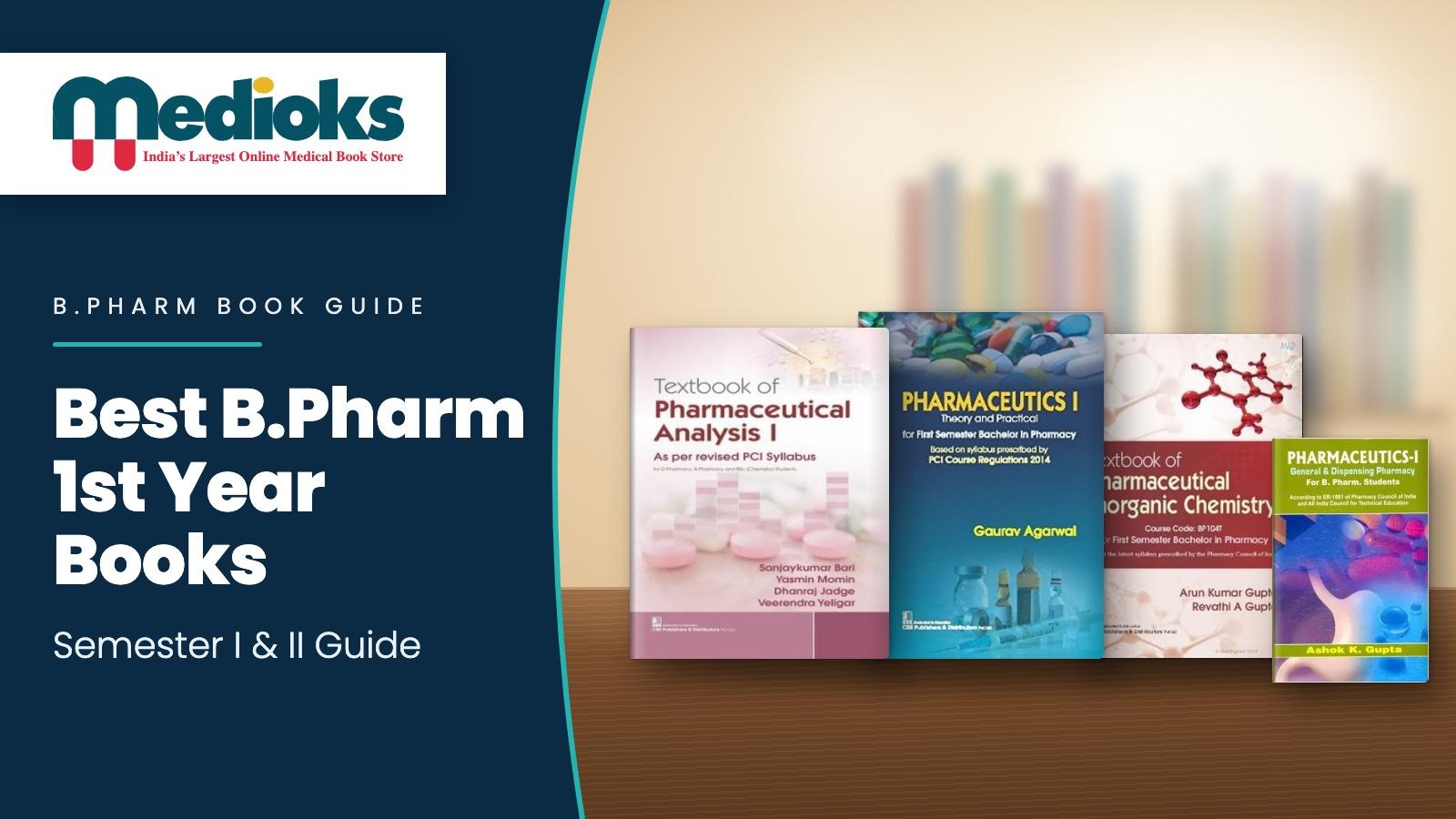
B.Pharm first-year students do best with one book per subject written for the Pharmacy Council of India (PCI) syllabus, such as a semester-specific textbook for Pharmaceutics I, Pharmaceutical Analysis I and Pharmaceutical Inorganic Chemistry, plus a standard anatomy and physiology book. Check that each book says “as per PCI syllabus” and matches your semester.
The first year of B.Pharm builds the scientific foundation for the whole course: how the body works, how drugs are analysed and made into dosage forms, and the chemistry behind them. This guide lists the usual first-year subjects and suggests books for each, all available on Medioks.
Quick answer
- Human Anatomy and Physiology: Ross and Wilson Anatomy and Physiology in Health and Illness, plus a B.Pharm-specific HAP book for Semester II.
- Pharmaceutical Analysis I: Textbook of Pharmaceutical Analysis I (S. Bari), as per the revised PCI syllabus.
- Pharmaceutics I: Pharmaceutics I: Theory and Practical for First Semester B.Pharm (Gaurav Agarwal).
- Pharmaceutical Inorganic Chemistry: Textbook of Pharmaceutical Inorganic Chemistry for First Semester B.Pharm (Arun Kumar Gupta).
- Semester II: books for Pharmaceutical Organic Chemistry I, Biochemistry and Human Anatomy and Physiology II.
B.Pharm first-year subjects
Under the PCI B.Pharm course regulations followed by most universities, the first year is divided into two semesters. The commonly published subject list is:
| Semester I | Semester II |
|---|---|
| Human Anatomy and Physiology I | Human Anatomy and Physiology II |
| Pharmaceutical Analysis I | Pharmaceutical Organic Chemistry I |
| Pharmaceutics I | Biochemistry |
| Pharmaceutical Inorganic Chemistry | Pathophysiology |
| Communication Skills | Computer Applications in Pharmacy |
| Remedial Biology or Remedial Mathematics | Environmental Sciences |
Semester I books
| Subject | Suggested book | Author |
|---|---|---|
| Human Anatomy and Physiology I | Ross and Wilson Anatomy and Physiology in Health and Illness | Anne Waugh, Allison Grant |
| Pharmaceutical Analysis I | Textbook of Pharmaceutical Analysis I (as per revised PCI syllabus) | S. Bari |
| Pharmaceutics I | Pharmaceutics I: Theory and Practical for First Semester B.Pharm | Gaurav Agarwal |
| Pharmaceutical Inorganic Chemistry | Textbook of Pharmaceutical Inorganic Chemistry for First Semester B.Pharm | Arun Kumar Gupta |
Alternatives include A Textbook of Pharmaceutical Analysis for First Year B.Pharm, Semester I, Pharmaceutics I: General and Dispensing Pharmacy (A.K. Gupta) and A Textbook of Pharmaceutical Inorganic Chemistry for B.Pharmacy Semester I.
Semester II books
- Human Anatomy and Physiology II for B.Pharmacy 2nd Semester (Payal Mittal, Manish Goswami).
- Pharmaceutical Organic Chemistry for Second Semester B.Pharm (Shweta Kapoor Bajaj), with the Practical Lab Manual of Pharmaceutical Organic Chemistry I for the lab.
- Pharmaceutical Biochemistry (S.P. Vyas) for biochemistry.
For pathophysiology, computer applications and environmental sciences, use the books your college recommends, because content and depth vary more between universities.
If your college follows a revised scheme
Some publishers have released books for a revised first-semester B.Pharm scheme. Medioks stocks titles such as Introduction to General Pharmacy for First Semester B.Pharm (Gaurav Agarwal) and Introduction to Pharmacognosy for First Year B.Pharm, Semester 1. If your university has adopted a newer scheme, ask your teachers which books match it before you buy.
How to choose B.Pharm books
- Match the semester and syllabus. Look for “as per PCI syllabus” and the correct semester on the cover or product page.
- Prefer books with practicals included where available. Theory-cum-practical books save money and keep content aligned.
- Use a standard reference for anatomy and physiology. Ross and Wilson is clear and well illustrated, and you’ll use it again in pharmacology.
- Don’t confuse D.Pharm and B.Pharm books. D.Pharm books follow a different syllabus and depth. Our D.Pharm book guide covers that course.
- Buy one book per subject. Use the library for extra references.
Subject-by-subject study tips
| Subject | What to focus on |
|---|---|
| Human Anatomy and Physiology | Body systems with diagrams. They form the base for pharmacology later |
| Pharmaceutical Analysis I | Errors, volumetric methods such as acid-base, redox and complexometric titrations, and calculations |
| Pharmaceutics I | History of pharmacy, dosage forms, prescriptions, pharmaceutical calculations and incompatibilities |
| Pharmaceutical Inorganic Chemistry | Impurities and limit tests, and inorganic compounds used in pharmacy, with their uses |
| Pharmaceutical Organic Chemistry I | Nomenclature, reaction mechanisms and the chemistry of functional groups |
| Biochemistry | Biomolecules, enzymes and metabolism, linked to drug action and disease |
| Pathophysiology | The basic mechanisms of common diseases, which you’ll need for pharmacology and pharmacotherapy |
Doing well in practicals
- Read the experiment before the lab, including the principle and calculations.
- Record observations immediately and complete your record the same day.
- Practise titration technique until your end points are consistent.
- Learn lab safety and follow it strictly, especially with acids, bases and organic solvents.
- Prepare for viva questions on the principle of each experiment and the reason for each step.
Pharmaceutical calculations
Calculations appear in Pharmaceutics I and Pharmaceutical Analysis I, and they’re easy marks once you’re comfortable. Practise percentage and ratio strength, dilution and concentration, posology (dose calculations by age and body weight), and the calculations used in titrations. Work through solved examples from your textbook, then attempt problems without looking at the answers.
Getting comfortable with organic chemistry
Pharmaceutical Organic Chemistry I in the second semester is the subject many students find hardest. It becomes much easier with a few habits:
- Learn nomenclature thoroughly first. You can’t follow reactions if you can’t name compounds.
- Understand mechanisms instead of memorising products. Electron movement explains why a reaction happens.
- Group reactions by functional group and make a summary table for each.
- Write reactions by hand regularly. Writing helps you remember reagents and conditions.
- Link chemistry to drugs. Noticing functional groups in familiar drugs makes the subject feel relevant.
Biochemistry and pathophysiology
Biochemistry explains the molecules and metabolic pathways of the body, and pathophysiology explains what goes wrong in disease. Both are foundations for pharmacology. For biochemistry, draw pathways as flowcharts, note the key enzymes and regulatory steps, and link each pathway to related disorders. For pathophysiology, focus on the mechanisms of common conditions such as inflammation, diabetes, hypertension and infections, because you’ll meet them again when you study drug treatment.
Communication skills and the remedial subjects
Communication skills, remedial biology or mathematics, computer applications and environmental sciences are sometimes treated as easy subjects, but they carry marks and affect your overall result. Communication skills are also important for pharmacists, who explain medicines to patients and work with doctors and colleagues. Give these subjects steady attention through the semester rather than leaving them to the last week.
A sample weekly study routine
- Weekdays: revise each day’s lectures the same evening, about an hour per major subject across the week.
- Practical days: read the next experiment beforehand and complete records the same day.
- Weekend: practise calculations and organic chemistry reactions, and catch up on any missed topics.
- Before sessional exams: revise from short notes and solve previous papers.
Common mistakes in first year
- buying D.Pharm or wrong-semester books by mistake,
- leaving practical records incomplete until the end of the semester,
- memorising organic reactions without understanding mechanisms,
- ignoring smaller subjects that still count towards your result, and
- falling behind early in a short semester.
Making the semester system work for you
B.Pharm follows a semester system with internal assessments and end-semester exams. Because each semester is short, falling behind early makes catching up difficult. Study each subject a little every week, keep up with practical records, and prepare for sessional exams seriously, because internal marks count towards your final result.
Why first year matters for your career
First-year subjects lead directly into later ones. Anatomy, physiology and biochemistry are the basis of pharmacology. Analysis leads to instrumental methods and quality control. Pharmaceutics I leads to physical pharmaceutics and industrial pharmacy, and organic chemistry leads to medicinal chemistry. Students who build strong foundations in first year usually find GPAT preparation and industry roles easier later.
Pharmaceutical Analysis I: building strong lab habits
Pharmaceutical Analysis I introduces the methods used to check the identity, purity and strength of drugs. You’ll learn about errors and their minimisation, preparation and standardisation of solutions, and volumetric methods such as acid-base, non-aqueous, precipitation, complexometric and redox titrations, along with some electrochemical methods depending on your syllabus. Accuracy in the lab and confidence with calculations are the two skills that matter most. They’re also the basis of quality control work in the pharmaceutical industry.
Buy genuine, current editions
Pharmacy books contain structures, formulae, doses and test procedures where small printing errors matter. Pirated copies often have unclear diagrams and missing pages. Buy genuine copies, check the edition on the product page, and make sure the book matches the current syllabus.
Where B.Pharm can take you
A B.Pharm degree opens several paths: work in the pharmaceutical industry in production, quality control, quality assurance or regulatory affairs; hospital and community pharmacy after registration with your State Pharmacy Council; medical and scientific roles in sales and marketing; and further study through M.Pharm, often via GPAT, or other postgraduate courses. Whatever path you choose, the core sciences you learn in first year will keep coming back.
Your first weeks in B.Pharm
- Collect your university’s syllabus and check which scheme it follows.
- Buy one book per subject for the first semester only.
- Get a lab coat and any lab items your college requires.
- Start a notebook of formulas and calculations.
- Find a study partner for practicals and revision.
Frequently asked questions
Which books are best for B.Pharm 1st year?
Semester-specific books written to the PCI syllabus for each subject, plus Ross and Wilson for anatomy and physiology, are a practical combination.
Is Ross and Wilson enough for HAP in B.Pharm?
It covers the core content clearly. Some students add a B.Pharm-specific HAP book that follows the semester syllabus closely.
Can I use D.Pharm books for B.Pharm?
Not as main books. D.Pharm books follow a different syllabus and depth. Use books written for B.Pharm.
Are theory-cum-practical books worth it?
Yes, especially for analysis, pharmaceutics and chemistry. They keep theory and lab work aligned.
How hard is B.Pharm first year?
Most students find it manageable with regular study. Analysis calculations and organic chemistry need the most practice.
Do I need separate practical manuals?
Many colleges prescribe their own manuals or record books. Check before buying.
Is B.Pharm first year useful for GPAT?
Yes. Topics such as analysis, inorganic chemistry, organic chemistry and physiology appear in GPAT. Keep good notes for later revision.
Should I buy all books for the year at once?
Buy books semester by semester. That way you can check your college’s recommendations first.
What if my university’s subject list differs?
Follow your university’s official scheme. Book choices should match its subject names and semester structure.
Which B.Pharm first-year subject is hardest?
Many students find Pharmaceutical Organic Chemistry I and the calculations in Pharmaceutical Analysis I the most demanding. Regular practice makes both manageable.
Do I need a separate book for remedial biology or mathematics?
Your college will usually recommend a short book or provide notes. These subjects are introductory, so a simple, syllabus-matched book is enough.
How important are internal assessment marks?
They count towards your semester result, so sessional exams, assignments and practical records all matter. Check your university’s marking scheme.
Can I use reference books from the library instead of buying?
Yes, for larger references. Most students still buy one syllabus-matched book per subject for regular study and revision.
The bottom line
For B.Pharm first year, buy one PCI-syllabus book per subject, semester by semester, use Ross and Wilson for anatomy and physiology, and keep up with practicals and calculations. Check your university’s scheme first, especially if it has adopted a revised first-semester structure.
Syllabus details can vary by university and change over time. Always confirm with your college’s official scheme and your teachers. Editions and availability change, so check the product page for the latest edition. Facts checked on 26 November 2026.