

Best BAMS 1st Year Books: Subject-Wise Guide (NCISM Syllabus)

admin
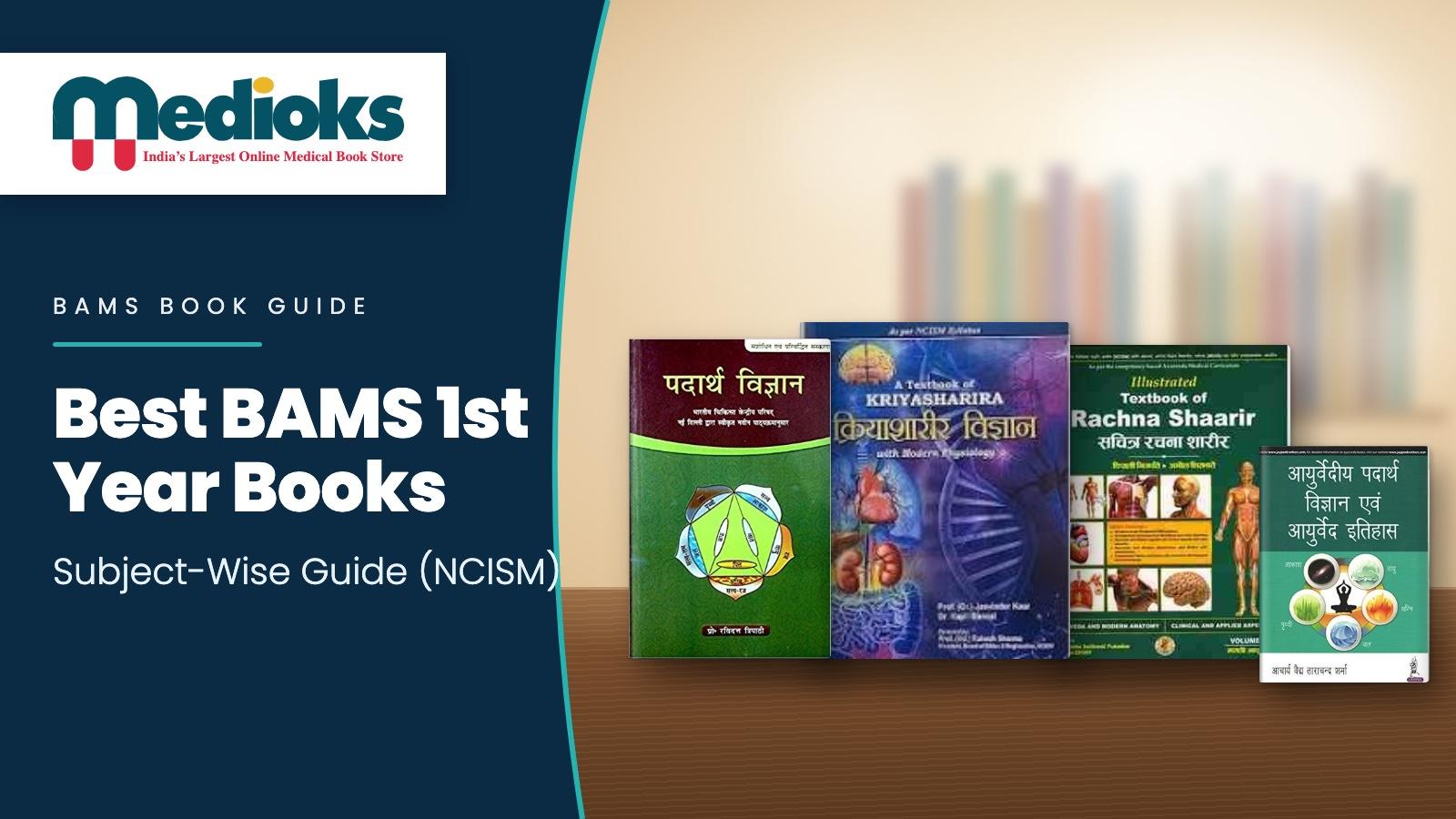
BAMS first-year students need one book for each subject of the First Professional: Padartha Vigyan, Sanskrit with Ayurveda Itihas, Kriya Sharir, Rachana Sharir and Samhita Adhyayan. Choose books written to the current NCISM syllabus, such as Prabodh Yerawar’s Sachitra Padarth Vigyan, an NCISM-based Kriya Sharira textbook and an illustrated Rachana Sharir textbook, and add a practical manual where your college requires one.
The first year of BAMS introduces the foundations of Ayurveda: its philosophy, the language of the classical texts, and the structure and function of the human body from both Ayurvedic and modern perspectives. This guide lists the main books for each subject, all available on Medioks, and explains how to study them.
Quick answer
- Padartha Vigyan: Sachitra Padarth Vigyan (Prabodh Yerawar) or Padarth Vigyan (Ravidatta Tripathi).
- Sanskrit and Ayurveda Itihas: Ayurved Sanskrit Sudha (for BAMS First Professional) or Sanskrit Parijnana.
- Kriya Sharir (physiology): A Textbook of Kriya Sharira with Modern Physiology (as per NCISM syllabus), or Subhash Ranade’s Illustrated Textbook of Kriya Sharira.
- Rachana Sharir (anatomy): Illustrated Textbook of Rachana Sharir (Dipali Nijwante) or Rachana Sharira Vijnana (Mahendra Singh).
- Samhita Adhyayan: Samhita Adhyayanam (Acharya Tarachand Sharma) and a practical workbook.
BAMS First Professional subjects
The National Commission for Indian System of Medicine (NCISM) regulates the BAMS course. Under the current curriculum, the First Professional typically includes the following subjects. Confirm the exact list and papers with your college, because details can be updated.
| Subject | What it covers |
|---|---|
| Padartha Vigyan | The philosophical basis of Ayurveda: padarthas, pramanas, panchamahabhuta and related principles |
| Sanskrit evam Ayurveda Itihas | Sanskrit grammar and reading for classical texts, and the history of Ayurveda |
| Kriya Sharir | Physiology: dosha, dhatu, mala, agni and srotas, together with modern physiology |
| Rachana Sharir | Anatomy: Ayurvedic concepts such as marma, alongside modern anatomy and dissection |
| Samhita Adhyayan | Study of selected portions of the classical samhitas |
Padartha Vigyan books
Padartha Vigyan can feel abstract at first, but it underpins every later subject. A good book explains concepts with examples and diagrams.
- Sachitra Padarth Vigyan by Prabodh Yerawar is an illustrated textbook that connects classical concepts with applied aspects, written to the NCISM syllabus.
- Padarth Vigyan by Ravidatta Tripathi is a long-standing Hindi textbook.
- Ayurvediya Padartha Vigyan evam Ayurveda Itihas by Acharya Vaidya Tarachand Sharma covers both Padartha Vigyan and the history of Ayurveda.
Sanskrit and Ayurveda Itihas books
Sanskrit helps you read the samhitas in their original form, which becomes important in later years.
- Ayurved Sanskrit Sudha for BAMS First Professional combines Sanskrit and Ayurveda Itihas in one textbook.
- Sanskrit Parijnana (Pratham Prashan Patra) by Acharya Vaidya Tarachand Sharma and Dr Chhavi Krishna Arya follows the first paper of the subject.
Kriya Sharir (physiology) books
- A Textbook of Kriya Sharira with Modern Physiology, Part 1 (Prof. Jasvinder Kaur and colleagues) is written to the new NCISM syllabus and integrates Ayurvedic and modern physiology.
- Illustrated Textbook of Kriya Sharira, Part 1 by Dr Subhash Ranade uses diagrams to explain concepts.
For modern physiology in more depth, a standard medical physiology textbook from the library is useful. See our guide to physiology books for options.
Rachana Sharir (anatomy) books
- Illustrated Textbook of Rachana Sharir, Part 1 by Dipali Nijwante is richly illustrated and combines Ayurvedic and modern anatomy.
- Rachana Sharira Vijnana, Volume 1 by Mahendra Singh is a Hindi textbook used in many colleges.
- Manual of Rachana Sharir: A Practical Guide by Piyushlata Maheshwari supports dissection and practical work.
Rachana Sharir includes dissection and osteology, much like MBBS anatomy. Our guide to first-year instruments covers the dissection kit and bones you’ll need.
Samhita Adhyayan books
- Samhita Adhyayanam by Acharya Ved Tarachand Sharma covers the prescribed portions of the classical texts.
- Practical Workbook of Samhita Adhyayan, Part 1 by Dr Prabodh Yerawar helps with structured practice and assignments.
For more Ayurveda study resources, see our guide to essential Ayurvedic study materials for exams.
Hindi, Sanskrit or English medium?
Many BAMS textbooks are published in Hindi, some in English, and some in both. Choose the language you understand best and in which you’ll write your exams, as permitted by your university. For Sanskrit terms and shlokas, learn the original wording, because examiners often ask you to quote or explain them. If you study in English, keep a glossary of key Sanskrit terms with their meanings.
How to study each subject
| Subject | Study tips |
|---|---|
| Padartha Vigyan | Make concept maps linking padarthas, pramanas and panchamahabhuta. Learn definitions word for word |
| Sanskrit | Practise grammar daily in small amounts. Read short passages from the samhitas aloud |
| Kriya Sharir | Study Ayurvedic and modern concepts side by side in tables, for example dosha functions alongside the related modern physiology |
| Rachana Sharir | Learn anatomy with diagrams, dissection and bones. Revise marma points with their locations and effects |
| Samhita Adhyayan | Learn key shlokas with their meaning and context. Revise regularly rather than just before exams |
Key Kriya Sharir concepts to master first
| Concept | What to learn |
|---|---|
| Dosha | Vata, Pitta and Kapha: their qualities, types (subdivisions), locations and functions, and signs of increase and decrease |
| Dhatu | The seven dhatus, their formation and nourishment, and their functions |
| Mala | The waste products of the body and their normal functions |
| Agni | The types of agni and their role in digestion and metabolism |
| Srotas | The channels of the body, their roots and signs of vitiation |
| Prakriti | Body constitution and how it’s assessed |
For each concept, write the Ayurvedic description and the related modern physiology side by side. This approach suits the NCISM curriculum and makes long answers more complete.
Rachana Sharir: dissection and osteology
Rachana Sharir practicals are similar to MBBS anatomy. You’ll dissect cadavers in groups, study bones and learn surface anatomy. Read the relevant part of your practical manual before each session, respect the body donor and follow your department’s rules, and use bones to learn features and attachments. Marma sharir is a distinctive part of Rachana Sharir: learn each marma’s location, its classification by structure and by effect of injury, and its clinical importance.
Ayurveda Itihas: what to focus on
The history of Ayurveda covers the origin of Ayurveda, the major acharyas and their samhitas, the brihat trayi and laghu trayi, the development of Ayurveda through different periods, and its present status in India and abroad. Timelines and tables of authors and texts make this subject much easier to revise.
Learning shlokas effectively
Shlokas from the classical texts are central to BAMS, and examiners often ask you to quote and explain them. Some habits that help:
- Understand before memorising. Read the meaning and context first, then learn the words.
- Learn in small portions and repeat them aloud each day.
- Write them out regularly. Writing helps you remember spelling and order.
- Link each shloka to a concept in your notes, so you can use it in answers.
- Revise weekly. Shlokas fade quickly without repetition.
Practicals and record books
First-year practicals usually include dissection and osteology in Rachana Sharir, and physiology experiments in Kriya Sharir, along with assignments in other subjects. Keep your record books neat and up to date, with labelled diagrams. Many colleges assess records as part of internal marks, so they’re worth the effort.
Your first weeks in BAMS
- Get the official syllabus and timetable from your college.
- Buy one main book per subject, plus any practical manuals your college requires.
- Start Sanskrit early. It makes everything else easier.
- Prepare for dissection: a white coat, gloves and a dissection kit, as your department advises.
- Form a study group for revision and shloka practice.
Preparing for First Professional exams
- Cover the syllabus once with your main books during the year.
- Make short notes and tables, especially for Kriya Sharir and Padartha Vigyan.
- Revise shlokas every week.
- Practise diagrams for Rachana Sharir and Kriya Sharir.
- Solve previous question papers from your university.
Buying BAMS books: practical tips
- Check the syllabus: prefer books that say they follow the NCISM syllabus for the First Professional.
- Check the volume or part: several textbooks are split into parts, and your first year may need only Part 1.
- Check the language before ordering, because many titles have separate Hindi and English editions.
- Buy genuine copies. Shlokas and diagrams must be accurate, and pirated copies often have errors.
Linking Ayurvedic and modern concepts
The NCISM curriculum encourages students to understand classical Ayurvedic concepts alongside modern science, especially in Kriya Sharir and Rachana Sharir. When you study a topic, write the Ayurvedic description and the relevant modern understanding side by side, and note where they align and where they differ. This makes answers richer and helps you in clinical subjects later.
How first year prepares you for later years
Each first-year subject feeds into the rest of the course. Padartha Vigyan’s principles explain how Ayurveda classifies and reasons about substances, which you’ll use in Dravyaguna. Kriya Sharir’s concepts of dosha, dhatu and agni form the basis of Roga Nidana (diagnosis) and Kayachikitsa (medicine). Rachana Sharir prepares you for Shalya (surgery) and clinical examination. Sanskrit skills help you read samhitas throughout the course. Building strong foundations now saves time later.
Frequently asked questions
Which books are needed for BAMS 1st year?
One book each for Padartha Vigyan, Sanskrit with Ayurveda Itihas, Kriya Sharir, Rachana Sharir and Samhita Adhyayan, plus practical manuals your college requires.
Which is the best Padartha Vigyan book?
Prabodh Yerawar’s Sachitra Padarth Vigyan is a popular illustrated option written to the NCISM syllabus. Ravidatta Tripathi’s Padarth Vigyan is a long-standing alternative.
Should I choose Hindi or English books?
Choose the language in which you understand best and will write your exams, as permitted by your university.
Do I need modern anatomy and physiology books too?
Your Rachana and Kriya Sharir books include modern content. A standard modern textbook from the library helps for topics that need more depth.
Is Sanskrit difficult for BAMS students?
It can be at first, especially without a Sanskrit background. Regular, short practice sessions and a good textbook make it manageable.
Are books written for the old CCIM syllabus still useful?
Much of the content overlaps, but the NCISM curriculum has changed some topics and structure. Prefer books that state they follow the current NCISM syllabus.
How should I learn marma points?
Learn them region by region with diagrams, noting each marma’s location, classification and the effects of injury. Link them to modern anatomy where possible.
Do I need a dissection kit in BAMS?
Most colleges require one for Rachana Sharir practicals. Check your department’s list before buying.
How many hours should I study daily in first year?
Consistency matters more than long hours. A daily routine with time for each subject and regular shloka revision works well.
Where can I find previous question papers?
Your college library and seniors are the best sources. Many universities also publish past papers.
Which subject is hardest in BAMS first year?
It varies, but many students find Sanskrit and Padartha Vigyan challenging at first because they’re new. Regular practice and concept maps help a lot.
Are illustrated textbooks better?
For Rachana and Kriya Sharir, diagrams make a big difference to understanding and to exam answers. Illustrated textbooks are especially useful for visual learners.
How do I balance Ayurvedic and modern content in answers?
Start with the Ayurvedic concept as described in the classical texts, then add the relevant modern understanding. Follow your teachers’ guidance on how much modern content your university expects.
The bottom line
For BAMS first year, buy one NCISM-based book per subject, start Sanskrit early, revise shlokas weekly, and learn Kriya and Rachana Sharir with diagrams that link Ayurvedic and modern concepts. That foundation will carry you through every later professional year.
Syllabus details can change and vary by university. Always follow your college’s official NCISM-based scheme and your teachers’ advice. Editions and availability change, so check the product page for the latest edition. Facts checked on 26 November 2026.