

Best Dravyaguna Vigyan Books for BAMS Students

admin
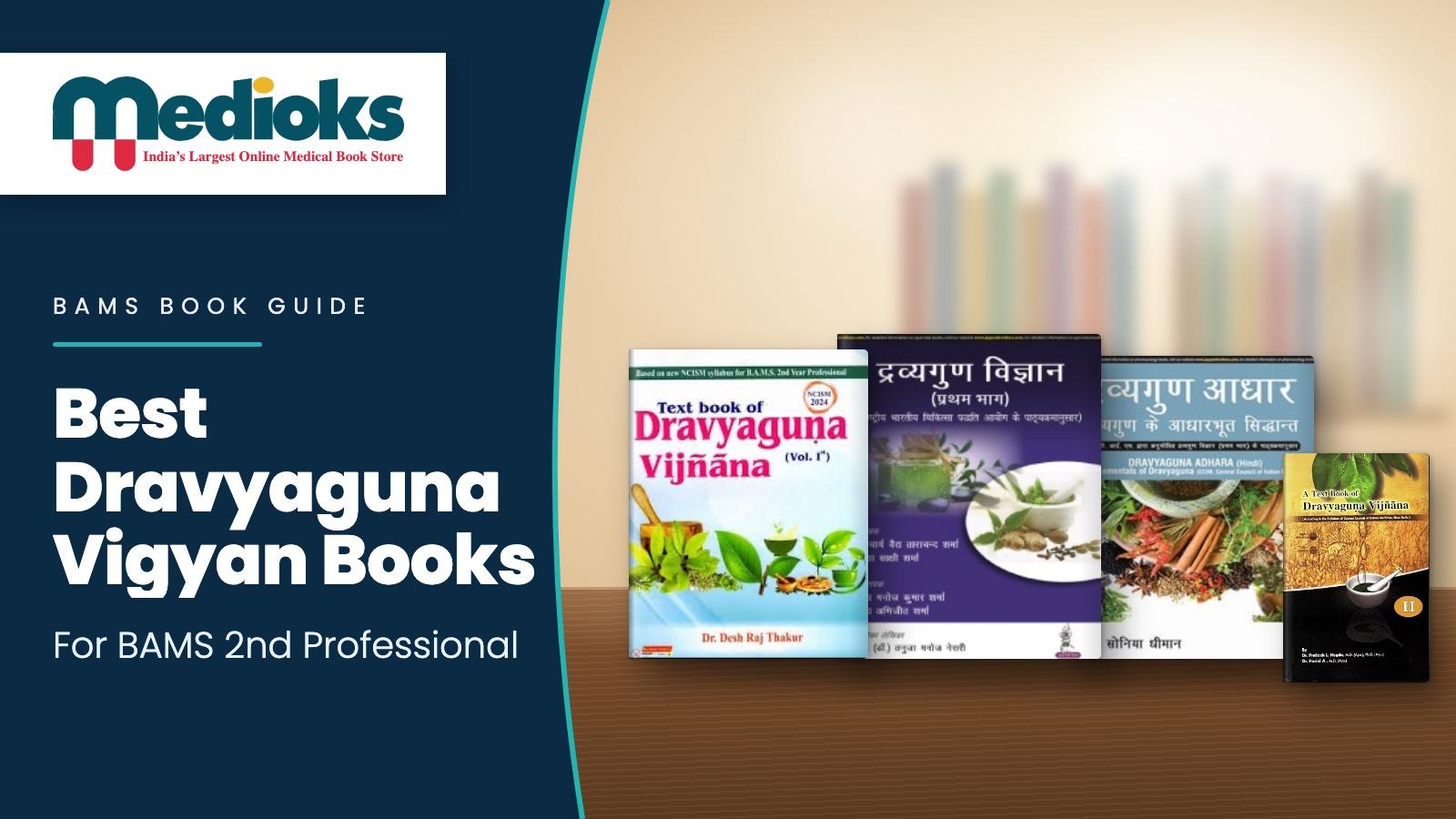
For Dravyaguna Vigyan, the most widely used English textbook is Prakash L. Hegde and Harini A.’s A Text Book of Dravyaguna Vijnana (three volumes), and popular Hindi options include Acharya Vaidya Tarachand Sharma’s Dravyaguna Vigyan and Desh Raj Thakur’s Textbook of Dravyaguna Vijnana. Add a book on the fundamentals (Dravyaguna Adhara) and a practical record book for identification work.
Dravyaguna Vigyan is the Ayurvedic science of medicinal substances: their properties, actions and therapeutic uses. It’s a major subject of the BAMS Second Professional and the foundation for prescribing in clinical practice. This guide compares the main books on Medioks and explains how to study the subject, from basic principles to drug identification.
Quick answer
- English, comprehensive: A Text Book of Dravyaguna Vijnana, Volumes 1 to 3 (Prakash L. Hegde, Harini A.).
- Hindi: Dravyaguna Vigyan, Pratham and Dwitiya Bhag (Acharya Vaidya Tarachand Sharma and colleagues), or Textbook of Dravyaguna Vijnana, Vol. 1 (Desh Raj Thakur).
- Fundamentals: Dravyaguna Adhara (Sonia Dhiman).
- Concise revision: Dravyaguna Sutramala (J.L.N. Sastry).
- Practicals: Practical Record Book of Dravyaguna for BAMS Students (Swati Goyal).
Dravyaguna books compared
| Book | Author | Language | Best for |
|---|---|---|---|
| A Text Book of Dravyaguna Vijnana (3 volumes) | Prakash L. Hegde, Harini A. | English | Comprehensive coverage of principles and individual drugs |
| Textbook of Dravyaguna Vijnana, Vol. 1 | Desh Raj Thakur | Hindi | NCISM-based coverage of the first part |
| Dravyaguna Vigyan (Pratham Bhag) | Acharya Vaidya Tarachand Sharma, Vaidya Sakshi Sharma | Hindi | Principles of Dravyaguna |
| Dravyaguna Vigyan (Dwitiya Bhag) | Acharya Vaidya Tarachand Sharma and others | Hindi | Individual drugs |
| Dravyaguna Adhara (Fundamentals of Dravyaguna) | Sonia Dhiman | Hindi | The basic principles, as a separate book |
| Dravyaguna Sutramala | J.L.N. Sastry | English | Concise revision |
| Practical Record Book of Dravyaguna | Swati Goyal | English | Practicals and identification records |
Hegde and Harini’s Text Book of Dravyaguna Vijnana
A Text Book of Dravyaguna Vijnana by Prakash L. Hegde and Harini A. is one of the most widely used English textbooks of the subject, available as a three-volume set. The volumes cover the fundamental principles and individual medicinal plants in detail, including their names, botanical descriptions, properties, actions, uses and formulations.
You can also buy Volume 2 and Volume 3 separately if you already have part of the set.
Hindi textbooks
- Dravyaguna Vigyan (Pratham Bhag) by Acharya Vaidya Tarachand Sharma and Vaidya Sakshi Sharma covers the principles, and Dravyaguna Vigyan (Dwitiya Bhag) covers individual drugs.
- Textbook of Dravyaguna Vijnana, Vol. 1 by Desh Raj Thakur is written to the NCISM syllabus.
- Sachitra Dravyaguna Vigyan, Part 2 is an illustrated option for individual drugs.
Books on the fundamentals
- Dravyaguna Adhara (Fundamentals of Dravyaguna) by Sonia Dhiman focuses on the basic principles, which many students find the hardest part of the subject.
- Dravyaguna Sutramala by Dr J.L.N. Sastry presents key concepts concisely for revision.
Nighantu books
Nighantus are the classical lexicons of Ayurvedic drugs, and their study is part of the subject.
- An Introduction to Nighantu of Ayurveda by Dr D. Shanthkumar Lucas explains the development and structure of the nighantus.
- Shrimad Vahatacharya’s Ashtanga Nighantu (Sonia Dhiman, Suwarna Meshram) presents one classical nighantu.
Practical record book
Dravyaguna practicals usually include identifying drugs, studying medicinal plants in the herbal garden and preparing herbarium specimens. The Practical Record Book of Dravyaguna for BAMS Students by Swati Goyal provides a structured format. Check your college’s requirements before buying.
For your first-year subjects, see our BAMS 1st year books guide, and for clinical practice later, our guide to clinical Ayurveda books.
What Dravyaguna Vigyan covers
| Area | Typical topics |
|---|---|
| Fundamental principles | Dravya, guna, rasa, vipaka, virya, prabhava and karma, and the relationships between them |
| Classification | Classifications of dravyas in the classical texts, including the ganas and vargas |
| Nighantus | The history and contents of the classical lexicons |
| Individual drugs | Names and synonyms, botanical source, parts used, properties, actions, therapeutic uses, doses and important formulations |
| Applied topics | Drug identification, adulteration and substitution, collection and storage, cultivation and conservation of medicinal plants, pharmacovigilance |
The exact syllabus and the list of drugs you must learn are set by NCISM and your university. Check your scheme for the current list.
Mastering the fundamental principles
Rasa, guna, virya, vipaka and prabhava are the concepts that explain how a drug acts. Students who understand them well find individual drugs much easier, because each drug’s description follows the same pattern. Some tips:
- Learn the definitions exactly, including the classical references your teachers emphasise.
- Make a master table of the six rasas with their mahabhuta composition, properties and effects on the doshas.
- Understand virya and vipaka with examples of well-known drugs.
- Learn prabhava through classical examples, where a drug’s action can’t be explained by its other properties.
A template for learning individual drugs
The number of drugs in the syllabus can feel overwhelming. Using the same template for every drug makes learning faster and answers more complete:
| Heading | What to note |
|---|---|
| Names | Sanskrit name, important synonyms, botanical name and family |
| Description | Key identifying features and the part used |
| Rasa panchaka | Rasa, guna, virya, vipaka and any prabhava |
| Dosha karma | Effect on the doshas |
| Karma | Main actions |
| Uses | Main therapeutic uses |
| Dose and formulations | Dose by form, and important formulations containing the drug |
The six rasas at a glance
A summary table of the rasas is one of the most useful revision tools in Dravyaguna. Build your own from your textbook, with columns for the rasa, its predominant mahabhutas, its main properties and its effect on each dosha. Examiners frequently ask about the rasas, and the same knowledge explains the actions of hundreds of individual drugs. Do the same for the gurvadi gunas, which are pairs of opposite qualities such as heavy and light, and for the types of virya and vipaka.
Understanding karma (actions)
Dravyaguna texts describe the actions of drugs with specific Sanskrit terms, such as deepana and pachana for digestive actions, and many others relating to particular systems of the body. Learn the definition of each karma your syllabus lists, with one or two classical example drugs. When you study an individual drug, you’ll then understand its actions immediately instead of memorising them separately.
Linking drugs to formulations
Most Ayurvedic medicines are formulations containing several drugs. For each important single drug, note two or three well-known formulations in which it’s a key ingredient. This helps you remember the drug’s uses, prepares you for Rasashastra and Bhaishajya Kalpana, and is useful in clinical subjects later.
Modern aspects of Dravyaguna
The current curriculum includes modern aspects of medicinal plants alongside classical concepts. These include basic pharmacognosy (macroscopic and microscopic identification), the main chemical constituents of important plants, and an introduction to research and quality standards. Your textbook will indicate how much depth your syllabus expects. These topics also help in postgraduate entrance exams.
Drug identification and the herbal garden
Practical exams often ask you to identify crude drugs and fresh plants. Visit your college’s herbal garden regularly, observe plants at different seasons, and handle crude drug samples in the museum or lab. Learn to recognise the part used, its colour, texture, smell and taste where safe and permitted. Herbarium preparation teaches you to observe plants carefully, and it often counts towards your practical marks.
Quality, safety and pharmacovigilance
Modern Dravyaguna teaching includes the quality and safety of herbal drugs. Learn about adulteration and substitution, the importance of correct identification, good collection and storage practices, and the basics of pharmacovigilance for Ayurvedic drugs. These topics are increasingly important in practice and in exams.
Cultivation and conservation of medicinal plants
Many medicinal plants are under pressure from over-harvesting and habitat loss. The syllabus usually includes good agricultural and collection practices, the right season and method for collecting different plant parts, and the conservation of endangered species. Understanding these topics helps you appreciate why quality and sustainable sourcing matter in Ayurvedic practice.
A simple study plan
- Start with the fundamental principles and master the rasa panchaka.
- Learn individual drugs in batches, using the same template every time.
- Visit the herbal garden weekly to link drugs with real plants.
- Revise with a concise book such as Dravyaguna Sutramala before exams.
- Solve previous question papers to learn which drugs and topics are asked most often.
Common mistakes in Dravyaguna
- memorising drugs before understanding the fundamental principles,
- mixing up drugs with similar names or synonyms,
- learning from notes with errors instead of a reliable textbook,
- never visiting the herbal garden until just before the practical exam, and
- leaving herbarium and record work to the last minute.
Studying Dravyaguna with friends
Dravyaguna suits group study. Quiz each other on synonyms, rasa panchaka and uses, take turns identifying crude drugs, and walk through the herbal garden together naming plants. Teaching a drug to a friend is a quick way to find out what you haven’t learned properly yet.
English or Hindi?
Choose the language in which you understand best and will write your exams, as permitted by your university. Hegde and Harini’s English textbook is widely used, while Hindi-medium students often prefer Tarachand Sharma’s or Desh Raj Thakur’s books. Whatever the language, learn the Sanskrit names and key terms precisely.
Frequently asked questions
Which is the best Dravyaguna book for BAMS?
Prakash L. Hegde and Harini A.’s A Text Book of Dravyaguna Vijnana is the most widely used English textbook. Tarachand Sharma’s and Desh Raj Thakur’s books are popular in Hindi.
Do I need all three volumes of Hegde?
Most students use all three, because they cover both principles and individual drugs. Check which volumes match your syllabus.
Which BAMS year is Dravyaguna taught in?
Dravyaguna Vigyan is a subject of the BAMS Second Professional. Check your university’s scheme for exact details.
How many drugs do I need to learn?
The number is set by your syllabus. Get the official list from your department and learn those drugs using a consistent template.
How do I remember rasa, guna, virya and vipaka for many drugs?
Group drugs with similar properties, use tables, and revise regularly. Linking each drug to a real plant in the herbal garden also helps.
Is a separate book on the fundamentals useful?
Yes, if you find the principles difficult. Dravyaguna Adhara focuses entirely on them.
Do I need a practical record book?
Most colleges require practical records. Use the format your college prescribes.
Is Dravyaguna useful after BAMS?
Very. It’s the basis of prescribing in Ayurvedic practice, and it’s important for AIAPGET and other postgraduate entrance exams.
Should I learn botanical names?
Yes. Botanical names and families are commonly asked, and they help you identify drugs correctly and avoid confusion between plants with similar Sanskrit names.
How do I revise Dravyaguna in the last month?
Revise the principles from your tables, go through your drug templates in batches, use a concise book such as Dravyaguna Sutramala, and solve previous question papers.
Are illustrated books helpful?
Yes, especially for identification. Pictures of plants and crude drugs make it easier to recognise them in practical exams.
Is Dravyaguna important for AIAPGET?
Yes. Dravyaguna is a key subject for postgraduate entrance exams, so strong notes and drug tables from your BAMS years will save you time later.
The bottom line
For Dravyaguna Vigyan, use Hegde and Harini’s textbook or a Hindi textbook such as Tarachand Sharma’s, master the fundamental principles first, learn every drug with the same template, and spend regular time in the herbal garden. That combination makes a large subject manageable and prepares you for clinical practice.
This article is educational guidance about books and study methods, not medical advice. Always follow your college’s NCISM-based syllabus and your teachers’ advice. Editions and availability change, so check the product page for the latest edition. Facts checked on 26 November 2026.