

Best Conservative Dentistry and Endodontics Books for BDS: Grossman, Sturdevant and More

admin
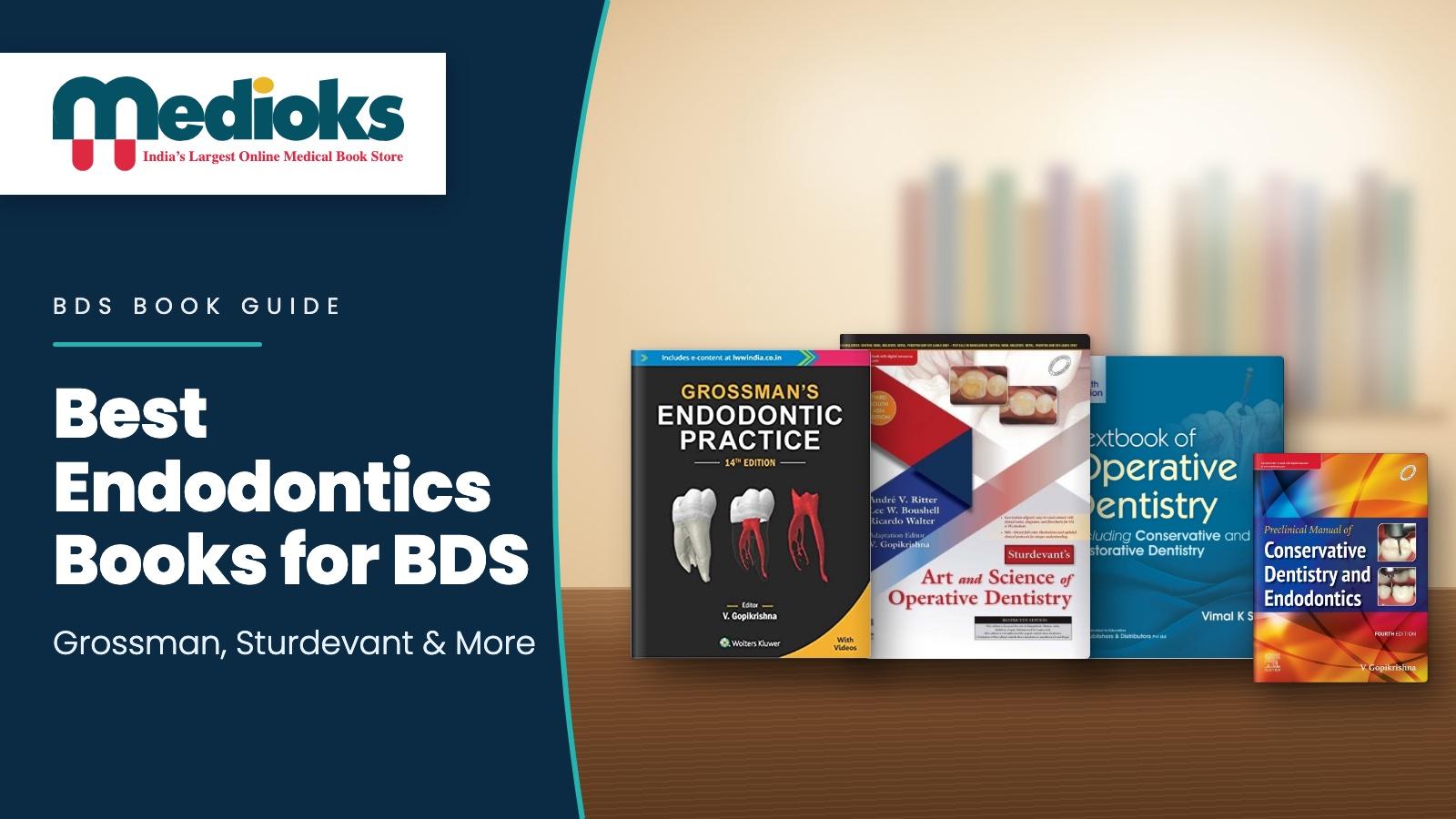
For BDS conservative dentistry and endodontics, most Indian students use Grossman’s Endodontic Practice for endodontics and Sturdevant’s Art and Science of Operative Dentistry, or an Indian operative dentistry text, for the conservative part. A preclinical manual covers the lab work you start in the earlier BDS years.
Conservative dentistry and endodontics covers cavity preparation and restorations, dental materials in clinical use, and root canal treatment. It’s a major clinical subject, usually examined in the final BDS year, with preclinical work earlier. Year placement varies by university, so check your own syllabus. This guide compares the main books.
Quick answer
- Endodontics: Grossman’s Endodontic Practice (edited by V. Gopikrishna).
- Operative and conservative dentistry: Sturdevant’s Art and Science of Operative Dentistry (South Asia edition, V. Gopikrishna), or an Indian text such as Vimal K. Sikri’s Textbook of Operative Dentistry.
- Preclinical lab work: Preclinical Manual of Conservative Dentistry and Endodontics (V. Gopikrishna).
- Quick revision: Concise Conservative Dentistry and Endodontics.
- International depth: Torabinejad’s Endodontics: Principles and Practice.
Books compared
| Book | Author / editor | Area | Best for |
|---|---|---|---|
| Grossman’s Endodontic Practice | V. Gopikrishna (ed.) | Endodontics | The standard endodontics text in Indian dental colleges |
| Sturdevant’s Art and Science of Operative Dentistry (South Asia edition) | V. Gopikrishna (ed.) | Operative | A classic operative dentistry text adapted for Indian students |
| Textbook of Operative Dentistry (including Conservative and Restorative Dentistry) | Vimal K. Sikri | Operative | An Indian alternative for conservative dentistry |
| Textbook of Operative Dentistry | Nisha Garg | Operative | Another popular Indian text |
| Endodontics: Principles and Practice (South Asia edition) | Mahmoud Torabinejad and others | Endodontics | International depth |
| Preclinical Manual of Conservative Dentistry and Endodontics | V. Gopikrishna | Preclinical | Lab exercises in the earlier years |
| Concise Conservative Dentistry and Endodontics | Ruchi Gupta, Jayshree Hegde, Vijay Prakash, Srirekha A. | Revision | Quick, exam-focused revision |
Endodontics books
- Grossman’s Endodontic Practice, now edited by V. Gopikrishna, is the endodontics book most Indian dental colleges follow. It covers pulp biology, diagnosis, access cavity preparation, cleaning and shaping, obturation and endodontic emergencies.
- Endodontics: Principles and Practice by Mahmoud Torabinejad and colleagues is a well-known international text, available in a South Asia edition.
- Essentials of Endodontics (Vimal Sikri) is a shorter Indian option.
Operative and conservative dentistry books
- Sturdevant’s Art and Science of Operative Dentistry (South Asia edition, V. Gopikrishna) is a classic covering cavity design, restorative materials and techniques.
- Textbook of Operative Dentistry, including Conservative and Restorative Dentistry (Vimal K. Sikri) is a popular Indian text.
- Textbook of Operative Dentistry (Nisha Garg) is another commonly used Indian book.
- Pickard’s Manual of Operative Dentistry (Kidd, Smith and Watson) is a concise UK operative dentistry text.
Preclinical and revision books
- Preclinical Manual of Conservative Dentistry and Endodontics (V. Gopikrishna) guides lab exercises such as cavity preparations on typodont teeth and preclinical endodontics.
- Concise Conservative Dentistry and Endodontics is a compact revision book for university exams.
For your complete dental book list, see our BDS book list for all years.
How to study the subject
- Get the basics of dental anatomy and materials right first. Cavity design and material choice depend on them.
- Learn endodontics as a sequence: diagnosis, access, working length, cleaning and shaping, irrigation, obturation and restoration.
- Draw diagrams of cavity classes, access cavity shapes and canal configurations. Examiners expect them.
- Link every clinical case to theory, and record it in your logbook.
- Revise instruments and materials visually for spotters and viva.
What the subject covers
Conservative dentistry and endodontics deals with saving natural teeth: restoring teeth damaged by caries, wear or trauma, and treating diseases of the pulp and the tissues around the root tip. Most BDS syllabi and textbooks cover:
| Area | Typical topics |
|---|---|
| Operative dentistry | Dental caries, cavity classification and preparation, isolation, matrices and wedges, instruments |
| Restorative materials | Amalgam, composite resins, glass ionomer cements, liners and bases, bonding agents |
| Indirect restorations | Inlays, onlays and the basics of cast and ceramic restorations |
| Pulp and periapical disease | Pulp biology, pulpitis, pulp necrosis, periapical lesions and diagnosis |
| Endodontic treatment | Access cavity, working length, cleaning and shaping, irrigation, obturation, retreatment |
| Other topics | Endodontic emergencies, traumatic dental injuries, bleaching, endodontic surgery basics |
Root canal treatment: the steps you’ll learn
- Diagnosis: history, clinical examination, pulp sensibility tests and radiographs.
- Anaesthesia and isolation: rubber dam isolation is a core standard of endodontic care.
- Access cavity preparation: designed to give straight-line access to the canals.
- Working length determination: using radiographs and, increasingly, electronic apex locators.
- Cleaning and shaping: with hand and rotary instruments, supported by irrigation.
- Obturation: filling the canals, commonly with gutta-percha and sealer.
- Post-endodontic restoration: protecting the tooth, often with a crown on posterior teeth.
- Follow-up: clinical and radiographic review of healing.
Grossman’s Endodontic Practice explains each step in detail, with the reasoning behind it. Learning the “why” helps in vivas.
Preclinical work: getting it right early
Preclinical conservative dentistry trains your hand skills before you treat patients. You’ll typically prepare cavities on typodont or extracted teeth and practise placing restorations. To do well:
- Know the ideal cavity outlines for each class before you start cutting.
- Use a mirror and indirect vision early, even when it feels slower.
- Check your work with your teacher at each stage rather than at the end.
- Keep your record book updated, with neat diagrams.
- Practise instrument grasps and finger rests. They’re the foundation of safe clinical work.
Understanding restorative materials
Material choice is a common exam and viva topic. For each material, learn its composition, properties, indications, manipulation and limitations. Compare materials in tables, for example amalgam vs composite, or conventional vs resin-modified glass ionomer. Your conservative dentistry book covers clinical use, and a dental materials textbook covers the science in more depth.
Clinical tips for your final-year postings
- take a good radiograph before every endodontic procedure,
- record pulp test results and diagnoses clearly in the case sheet,
- use rubber dam consistently,
- keep files organised and count them, to prevent instruments being left in canals, and
- ask your supervisor early when something doesn’t go to plan.
Planning for MDS in conservative dentistry and endodontics
Conservative dentistry and endodontics is a popular MDS speciality. If you’re interested, build a strong base in dental anatomy, materials and pulp biology, gain as much supervised clinical experience as you can, and become comfortable with international texts such as Torabinejad’s alongside Grossman. For entrance exam preparation, combine your textbooks with question practice for NEET MDS.
Common viva questions
- Classify dental caries, or cavities, and describe the outline form of a given class.
- Compare amalgam and composite restorations.
- What are the objectives of cleaning and shaping?
- Why is rubber dam isolation important?
- How do you determine working length?
- What are the causes of endodontic failure?
A simple study plan
- Early: dental anatomy, caries, cavity classification and instruments, alongside preclinical work.
- Clinical years: restorative materials and procedures, then pulp biology, diagnosis and endodontic treatment.
- Before exams: revise diagrams, comparison tables and viva questions, and solve previous papers.
Pulp and periapical diagnosis
Accurate diagnosis is the foundation of endodontics, and it’s a frequent exam topic. A diagnosis combines:
- History: the character of pain, triggers, duration, and whether the pain is spontaneous or provoked.
- Clinical examination: caries, restorations, cracks, swelling and sinus tracts.
- Pulp sensibility tests: such as cold and electric pulp tests, compared with control teeth.
- Periapical tests: percussion and palpation.
- Radiographs: to show caries depth, periapical changes and canal anatomy.
From these, you reach a pulpal diagnosis, such as reversible or irreversible pulpitis or pulp necrosis, and a periapical diagnosis. Learn the classification your textbook and department use, and practise applying it to every patient you see.
Dental trauma basics
Traumatic dental injuries, such as fractures, luxations and avulsions, are often managed by conservative dentistry and endodontics departments, especially in children and adolescents. Know the classification of injuries, emergency management of an avulsed tooth, and why follow-up matters. Your textbook and current trauma guidelines cover the details.
Indian or international textbooks?
Most BDS students use Indian textbooks or South Asian editions as their main books. These are written with Indian university exams in mind and are usually more affordable. International texts, such as Torabinejad’s Endodontics or Sturdevant’s original edition, offer more depth and are widely used in postgraduate training. A practical approach is to use one Indian or South Asia edition book for each part of the subject, and consult international texts in your library for topics you want to understand better or for MDS preparation. Whatever you choose, check that the edition is recent, because materials and techniques in conservative dentistry and endodontics continue to evolve.
Keeping good clinical records
Clinical records are part of your assessment, and good habits now carry into practice. For each patient, record the history, findings, test results, radiographs, diagnosis, treatment plan, consent and each step completed. Clear records also make it easier to discuss your cases in the viva.
Why this subject matters in practice
Restorations and root canal treatment are among the most common procedures in general dental practice. The habits you build in this subject, careful diagnosis, good isolation, gentle tissue handling and thorough records, directly affect how well your treatments last. That’s why examiners and clinical supervisors pay close attention to them during your postings.
Frequently asked questions
Which is the best endodontics book for BDS?
Grossman’s Endodontic Practice, edited by V. Gopikrishna, is the most commonly used endodontics book in Indian dental colleges.
Sturdevant or an Indian operative dentistry book?
Sturdevant (South Asia edition) is the classic text. Indian books such as Vimal Sikri’s or Nisha Garg’s are often preferred for exam-oriented answers. Choose one main book.
Do I need a separate preclinical manual?
Yes, it helps. A preclinical manual guides lab exercises and practical records that textbooks don’t cover step by step.
Is Torabinejad necessary for BDS?
It’s optional at BDS level. It’s useful if you want international depth or plan to pursue an MDS in conservative dentistry and endodontics.
Which year of BDS covers conservative dentistry?
Preclinical work usually starts in the earlier years, and the clinical subject is usually examined in the final year. The exact timing varies by university, so check your scheme.
Is Grossman enough for endodontics in BDS?
For most students, yes, combined with clinical work and previous question papers. Torabinejad is a good supplement if you want more depth.
Do I need a separate dental materials book?
Many BDS students study dental materials as a separate subject with its own textbook. Your conservative dentistry book covers clinical use of materials.
Which instruments should I know for the viva?
Hand cutting instruments, restorative instruments, endodontic files and their uses, rubber dam components, and obturation instruments are commonly asked.
How do I improve my cavity preparations?
Practise regularly on typodont teeth, check your outline and depth at each stage, and ask your teachers for feedback early rather than after finishing.
Is rotary endodontics part of the BDS syllabus?
Many colleges introduce rotary instruments, but the depth varies. Learn the principles from your textbook and follow your department’s teaching.
Is Sturdevant’s book useful for BDS exams?
Yes. The South Asia edition edited by V. Gopikrishna is widely used. It’s thorough on cavity design and restorative techniques. Some students prefer an Indian operative dentistry book for exam-oriented answers and use Sturdevant for deeper understanding.
Should I buy books for both conservative dentistry and endodontics?
Many students use one book for each, such as Sturdevant or an Indian operative dentistry text plus Grossman. A concise combined book is useful for final revision.
The bottom line
For BDS, Grossman’s Endodontic Practice plus one operative dentistry book, either Sturdevant or an Indian text, covers the subject well. Add a preclinical manual for lab work and a concise book for final revision.
Book recommendations are general guidance. Always follow your university’s syllabus and your faculty’s advice. Editions and availability change, so check the product page for the latest edition. Facts checked on 26 November 2026.