

Best Oral and Maxillofacial Surgery Books for BDS Students

admin
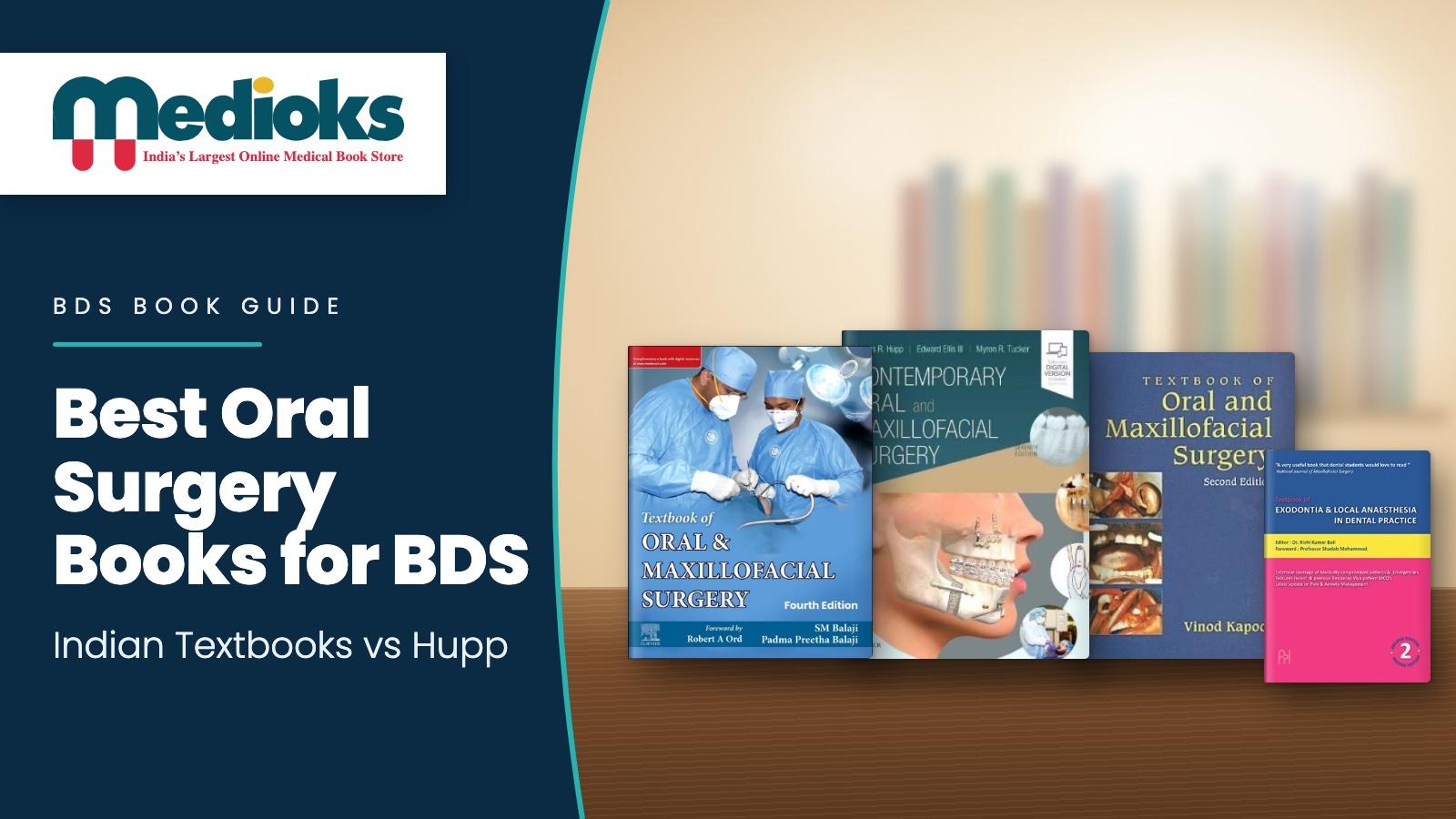
For BDS oral and maxillofacial surgery, most students use one Indian textbook, such as S.M. Balaji’s or Vinod Kapoor’s Textbook of Oral and Maxillofacial Surgery, as their main book, and add an exodontia and local anaesthesia book for clinical work. Hupp’s Contemporary Oral and Maxillofacial Surgery is the best-known international text.
Oral surgery in BDS covers local anaesthesia, extractions and impacted teeth, minor oral surgery, infections, cysts and tumours, maxillofacial trauma, TMJ disorders and medical emergencies in the dental chair. It’s usually examined in the final BDS year, but check your university’s scheme. This guide compares the main books.
Quick answer
- Main Indian textbook: Textbook of Oral and Maxillofacial Surgery by S.M. Balaji, Vinod Kapoor or B. Srinivasan. Choose one.
- International text: Contemporary Oral and Maxillofacial Surgery (James R. Hupp, Edward Ellis III, Myron R. Tucker).
- Extractions and local anaesthesia: Textbook of Exodontia and Local Anaesthesia in Dental Practice (Rishi Kumar Bali).
- Instruments: Atlas of Oral and Maxillofacial Surgical Instruments.
- Pocket reference: Oxford Handbook of Oral and Maxillofacial Surgery.
Oral surgery books compared
| Book | Author / editor | Type | Best for |
|---|---|---|---|
| Textbook of Oral and Maxillofacial Surgery | S.M. Balaji | Main textbook | Comprehensive Indian coverage |
| Textbook of Oral and Maxillofacial Surgery | Vinod Kapoor | Main textbook | An alternative Indian text |
| Textbook of Oral and Maxillofacial Surgery | B. Srinivasan | Main textbook | Another Indian option |
| Contemporary Oral and Maxillofacial Surgery | James R. Hupp, Edward Ellis III, Myron R. Tucker | International text | Clear principles and clinical technique |
| Textbook of Exodontia and Local Anaesthesia in Dental Practice | Rishi Kumar Bali | Clinical book | Extractions and LA, which are daily skills |
| Oxford Handbook of Oral and Maxillofacial Surgery | Luke Cascarini, Clare Schilling and others | Pocket handbook | Quick reference |
Indian textbooks
Several Indian textbooks of oral and maxillofacial surgery are used in dental colleges. You need only one:
- Textbook of Oral and Maxillofacial Surgery by S.M. Balaji
- Textbook of Oral and Maxillofacial Surgery by Vinod Kapoor
- Textbook of Oral and Maxillofacial Surgery by B. Srinivasan
Ask your department which one its teaching follows. For a shorter overview, Outline of Oral and Maxillofacial Surgery (K.C. Gupta) is available.
Hupp’s Contemporary Oral and Maxillofacial Surgery
Contemporary Oral and Maxillofacial Surgery by James R. Hupp, Edward Ellis III and Myron R. Tucker is the best-known international text in the subject. It’s especially strong on principles of exodontia, impacted teeth, surgical technique and patient assessment.
Use it alongside an Indian textbook if you want clearer explanations of technique, or if you plan to pursue an MDS in oral and maxillofacial surgery. An Introduction to Oral and Maxillofacial Surgery (David A. Mitchell) is a shorter introductory text.
Exodontia, instruments and clinical books
- Textbook of Exodontia and Local Anaesthesia in Dental Practice (Rishi Kumar Bali) covers the skills you use in every clinical session: nerve blocks, extraction technique and managing complications.
- Atlas of Oral and Maxillofacial Surgical Instruments (Syed Ahmed, Sheeraz Badal, Sandesh Chougule) helps with instrument spotters and viva.
- Oxford Handbook of Oral and Maxillofacial Surgery is a compact reference for clinics and wards.
- Practical Guide to Oral and Maxillofacial Surgery (C.P. Taware) is another practical companion.
Related reading: our guides to oral pathology books and the BDS book list for all years.
How to prepare for oral surgery exams
- Master local anaesthesia first: the anatomy of nerve blocks, techniques, drugs, doses and complications.
- Learn extraction principles and instruments together. Know which forceps and elevators are used for which teeth.
- Use classifications for impacted teeth, such as Winter’s and Pell and Gregory’s, and practise drawing them.
- Prepare medical emergencies in the dental chair: syncope, anaphylaxis, hypoglycaemia and others, with first-line management.
- Revise maxillofacial trauma with diagrams of fracture patterns, such as Le Fort fractures.
What BDS oral surgery covers
| Area | Typical topics |
|---|---|
| Basics | Asepsis and sterilisation, patient assessment, medically compromised patients |
| Local anaesthesia | Anatomy of nerve supply, drugs, techniques, complications |
| Exodontia | Principles of extraction, instruments, techniques, complications |
| Impacted teeth | Classification, assessment, surgical removal, complications |
| Infections | Odontogenic infections, fascial space infections, osteomyelitis |
| Cysts and tumours | Jaw cysts, odontogenic and non-odontogenic tumours, principles of management |
| Trauma | Mandibular and midface fractures, assessment and principles of fixation |
| Other topics | TMJ disorders, salivary gland disorders, preprosthetic surgery, oral cancer basics, medical emergencies |
Local anaesthesia: the foundation of oral surgery
Almost every procedure in oral surgery starts with local anaesthesia, so it deserves serious attention. Learn:
- Nerve anatomy: the branches of the trigeminal nerve that supply the teeth and oral tissues.
- Techniques: inferior alveolar nerve block, infiltrations, and other blocks used in your clinic.
- Drugs: common local anaesthetic agents, vasoconstrictors and maximum safe doses.
- Complications: local complications such as haematoma and trismus, and systemic ones such as toxicity and allergic reactions.
- Special patients: considerations for patients with heart disease, pregnancy and other medical conditions.
Principles of exodontia
- Assessment: medical history, clinical examination and radiographs.
- Consent: explaining the procedure, risks and alternatives.
- Anaesthesia appropriate to the tooth and patient.
- Instrument choice: the correct forceps and elevators for the tooth.
- Technique: controlled force, proper support of the jaw, and protection of neighbouring teeth.
- Socket care and haemostasis.
- Post-operative instructions and follow-up.
Rishi Kumar Bali’s book on exodontia and local anaesthesia covers these practical skills in detail, which is why it’s useful alongside a main textbook.
Impacted third molars
Impacted lower third molars are among the most common topics in BDS oral surgery exams. Be ready to:
- classify impactions using Winter’s classification and the Pell and Gregory classification,
- assess difficulty from a radiograph,
- describe the surgical steps: flap design, bone removal, tooth sectioning, delivery and closure, and
- list complications such as dry socket, nerve injury and bleeding, and how to prevent and manage them.
Medical emergencies in the dental chair
Every dental student must be able to recognise and manage common emergencies. Learn the first-line management of:
- syncope (fainting), the most common emergency,
- hypoglycaemia,
- anaphylaxis,
- asthma attacks,
- seizures, and
- chest pain and cardiac arrest, including basic life support.
Follow your college’s emergency protocols, and know where the emergency kit is in every clinic you work in.
Making the most of your oral surgery posting
- observe as many procedures as you can before performing them,
- keep a log of extractions and other procedures,
- practise suturing on models,
- learn sterilisation and instrument handling routines thoroughly, and
- take medical histories carefully. They prevent most complications.
Considering MDS in oral and maxillofacial surgery
Oral and maxillofacial surgery is a demanding and popular MDS speciality, covering trauma, pathology, orthognathic surgery and more. If you’re interested, build strong foundations in anatomy and medicine, gain extra surgical exposure, and use international texts such as Hupp’s alongside Indian textbooks.
A simple study plan
- Start with anatomy and local anaesthesia, because everything else builds on them.
- Move to exodontia and impactions during your clinical postings.
- Then cover infections, cysts, tumours and trauma, using diagrams and classifications.
- Revise medical emergencies regularly. They’re asked often and matter in real practice.
Odontogenic infections
Infections arising from teeth are common, and some can spread to fascial spaces in the head and neck and become serious. Learn:
- how infection spreads from teeth into surrounding spaces,
- the anatomy of the main fascial spaces and the signs of their involvement,
- principles of management: removing the cause, drainage where needed, and appropriate antibiotics,
- warning signs such as difficulty swallowing or breathing, trismus and rapidly spreading swelling, and
- when a patient needs urgent referral or hospital admission.
Maxillofacial trauma basics
Facial fractures are an important part of the final-year syllabus. Learn the classification of mandibular and midface fractures, including Le Fort fractures, clinical signs, the role of imaging, and the principles of reduction and fixation. Diagrams of fracture lines are commonly asked in exams, so practise drawing them neatly.
Asepsis and sterilisation in oral surgery
Infection control is fundamental in oral surgery, and it’s a common viva topic. Learn the difference between cleaning, disinfection and sterilisation, the methods used for different instruments, how autoclaves work and how sterilisation is monitored, and how to set up and maintain a sterile field. Hand hygiene, gloves and appropriate personal protective equipment protect both patients and staff. Following your clinic’s protocols every time is part of professional practice.
Treating medically compromised patients
Many patients needing extractions have medical conditions that affect treatment, such as diabetes, hypertension, heart disease, bleeding disorders or use of anticoagulants. A careful medical history, liaison with the patient’s doctor where needed, and adjustments to anaesthesia and technique prevent most complications. Your textbook covers specific conditions. Take this topic seriously, because it matters every day in practice.
Oral surgery skills in general practice
Even if you don’t specialise, oral surgery skills are used every day in general dental practice. Safe local anaesthesia, routine extractions, managing complications and recognising when to refer are core skills for every dentist. Treat your oral surgery posting as training for daily practice, and you’ll get far more out of it than exam marks alone.
Frequently asked questions
Which is the best oral surgery book for BDS?
An Indian Textbook of Oral and Maxillofacial Surgery, by S.M. Balaji, Vinod Kapoor or B. Srinivasan, is the usual main book. Hupp’s Contemporary Oral and Maxillofacial Surgery is the leading international text.
Should BDS students buy Hupp?
It’s optional. It’s very helpful for understanding technique, and especially useful if you’re considering an MDS in oral surgery.
Do I need a separate local anaesthesia book?
Many students find it useful, because LA and extractions are daily clinical skills. A combined exodontia and LA book covers both.
How do I prepare for instrument spotters?
Use an instrument atlas, handle the instruments during postings, and learn each one’s name, use and the procedure it belongs to.
Which year is oral surgery taught in BDS?
Oral and maxillofacial surgery is usually examined in the final year, with local anaesthesia and exodontia taught during clinical postings. Check your university’s scheme.
How many extractions do BDS students need to complete?
Requirements vary by college and university. Your department’s logbook will set the number of procedures you need to complete and record.
Is Hupp better than Indian oral surgery textbooks?
Hupp is excellent for understanding technique and principles. Indian textbooks are often closer to university exam patterns. Many students use an Indian book as their main text and Hupp as a supplement.
What are the most common oral surgery viva topics?
Local anaesthesia techniques and complications, extraction instruments, impacted third molars, dry socket, fascial space infections and medical emergencies are common.
How do I prevent dry socket after an extraction?
Atraumatic technique, good post-operative instructions and advice to avoid smoking help reduce the risk. Learn the full prevention and management from your textbook.
Do I need an instrument atlas?
It’s very useful for spotters and viva, especially if you learn visually. Handling the instruments during postings is just as important.
Which Indian oral surgery textbook should I choose?
S.M. Balaji’s and Vinod Kapoor’s textbooks are both used in Indian dental colleges. Ask your department which one its teaching follows, and choose one main book rather than several.
Is oral surgery important for NEET MDS?
Yes. Oral and maxillofacial surgery is part of the NEET MDS syllabus. Strong foundations in local anaesthesia, exodontia, infections and trauma help in both university exams and MDS entrance preparation.
How can I practise suturing?
Use suture practice pads or models in your skills lab, and ask your department about supervised practice. Good suturing technique also helps in other clinical subjects.
The bottom line
Choose one Indian oral surgery textbook as your main book, add an exodontia and local anaesthesia book for clinical skills, and use an instrument atlas for spotters. Add Hupp if you want international depth.
Book recommendations are general guidance. Always follow your university’s syllabus and your faculty’s advice. Editions and availability change, so check the product page for the latest edition. Facts checked on 26 November 2026.