

Best Medical-Surgical Nursing Books for B.Sc Nursing (Adult Health Nursing)

admin
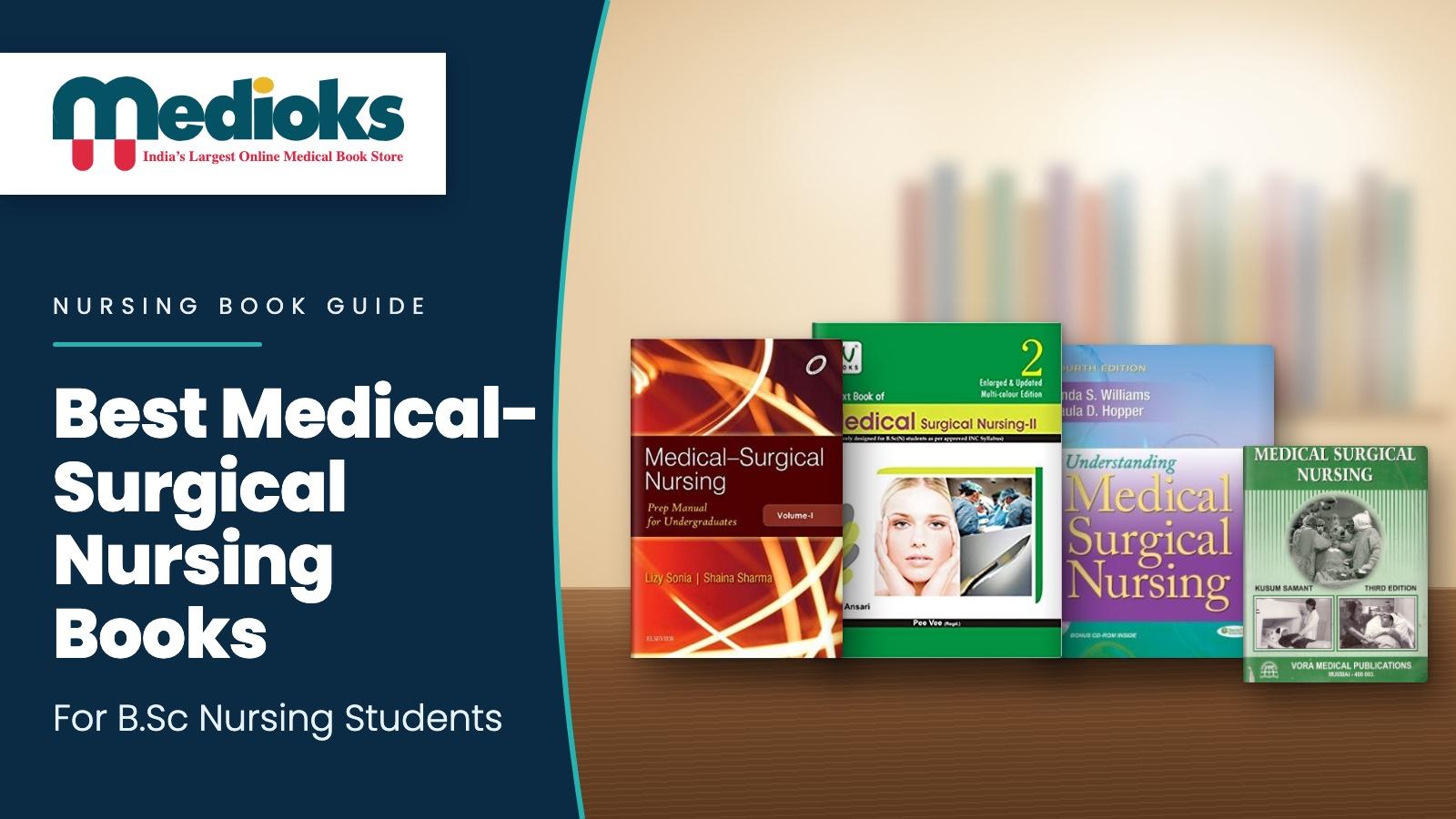
For medical-surgical nursing, now taught as Adult Health Nursing in the revised INC B.Sc Nursing curriculum, most Indian students use one Indian textbook written to the syllabus, such as Lizy Sonia and Shaina Sharma’s Medical-Surgical Nursing volumes or Javed Ansari’s Textbook of Medical Surgical Nursing, plus a clinical handbook for the wards. International texts such as Brunner and Suddarth’s are the standard references for depth.
Medical-surgical nursing is the largest clinical subject in B.Sc Nursing. It covers the nursing care of adults with medical and surgical conditions across every body system, and it’s taught over more than one semester. This guide compares the main books on Medioks and explains how to use them in theory, practicals and clinical postings.
Quick answer
- Main Indian textbooks: Medical-Surgical Nursing, Volumes I and II (Lizy Sonia, Shaina Sharma), or A Textbook of Medical Surgical Nursing II (Javed Ansari).
- Other Indian options: Medical Surgical Nursing by Kusum Samant or by Vijayalakshmi Venkatesh.
- International depth: Understanding Medical Surgical Nursing (Williams and Hopper), and Brunner and Suddarth’s references.
- On the ward: Clinical Handbook for Brunner and Suddarth’s Textbook of Medical-Surgical Nursing.
- Practicals: the practical record book your college prescribes.
Medical-surgical nursing in the current curriculum
The Indian Nursing Council’s revised B.Sc Nursing curriculum, introduced in 2021, organises the course into semesters and uses the name Adult Health Nursing (Medical-Surgical Nursing) for this subject, split into parts I and II. Many books still use the older title, Medical-Surgical Nursing, and cover the same content. When you buy a book, check that it follows the syllabus your college uses, especially if you’re in the revised semester system.
Medical-surgical nursing books compared
| Book | Author | Type | Best for |
|---|---|---|---|
| Medical-Surgical Nursing, Volume I and II | Lizy Sonia, Shaina Sharma | Main textbook | Syllabus-based coverage across both parts |
| A Textbook of Medical Surgical Nursing II for B.Sc Nursing | Javed Ansari | Main textbook | The second part of the subject |
| Medical Surgical Nursing | Kusum Samant | Main textbook | A long-standing Indian text |
| Medical Surgical Nursing | Vijayalakshmi Venkatesh | Main textbook | Another Indian option |
| Understanding Medical Surgical Nursing | Linda Williams, Paula Hopper | International text | Clear explanations of disease and nursing care |
| Clinical Handbook for Brunner and Suddarth’s Textbook of Medical-Surgical Nursing | Madhvi (South Asia edition) | Clinical handbook | Quick reference on the wards |
| Brunner and Suddarth’s Handbook of Laboratory and Diagnostic Tests | Wolters Kluwer | Handbook | Understanding lab tests and nursing responsibilities |
Main Indian textbooks
- Medical-Surgical Nursing, Volume I and Volume II by Lizy Sonia and Shaina Sharma cover the subject in two parts, matching the way it’s taught.
- A Textbook of Medical Surgical Nursing II for B.Sc Nursing by Javed Ansari focuses on the second part of the subject.
- Medical Surgical Nursing by Kusum Samant is a well-known Indian text.
- Medical Surgical Nursing by Vijayalakshmi Venkatesh is another option.
Choose one main book and use it consistently. Your faculty may recommend a particular author.
International texts and handbooks
- Understanding Medical Surgical Nursing by Linda Williams and Paula Hopper explains disease processes and nursing care clearly, which helps when you want to understand the reasons behind interventions.
- Clinical Handbook for Brunner and Suddarth’s Textbook of Medical-Surgical Nursing is a compact reference for the wards, based on one of the best-known nursing textbooks in the world.
- Brunner and Suddarth’s Handbook of Laboratory and Diagnostic Tests explains common tests, normal values and the nursing care around them.
Practical record books
Practical records and clinical assignments count in internal assessment. A structured record book, such as the Practical Record Book of Adult Health Nursing / Medical Surgical Nursing, Part I, helps you document procedures, care plans and case studies. Check which format your college requires before buying.
For your other first-year subjects, see our B.Sc Nursing first year books guide.
What the subject covers
| Area | Typical topics |
|---|---|
| Foundations | Concepts of health and illness, the nursing process, fluid and electrolyte balance, pain, infection control |
| Perioperative nursing | Pre-operative preparation, intra-operative care, post-operative care and complications |
| Body systems | Respiratory, cardiovascular, gastrointestinal, renal, endocrine, neurological, musculoskeletal, integumentary, haematological, reproductive |
| Special areas | Oncology nursing, critical care basics, emergency and disaster nursing, burns, ENT and eye conditions, care of older adults |
| Pharmacology in practice | Safe drug administration, monitoring and patient education |
Use the nursing process for every patient
Medical-surgical nursing answers and care plans are built on the nursing process:
- Assessment: history, physical examination, vital signs and investigations.
- Nursing diagnosis: the patient’s actual and potential problems.
- Planning: measurable goals and expected outcomes.
- Implementation: nursing interventions with their rationale.
- Evaluation: whether the goals were met, and what to change.
Examiners often give a case and ask for nursing diagnoses and a care plan. Practise writing care plans for the common conditions you see on the wards.
How to write high-scoring answers
For a long question on a disease, a reliable structure is:
- definition,
- causes and risk factors,
- pathophysiology, often as a flowchart,
- clinical features,
- diagnostic tests,
- medical and surgical management,
- nursing management using the nursing process, and
- complications and patient education.
Nursing management usually carries the most marks, so make it detailed and specific to the patient.
Getting the most from clinical postings
- Prepare before each shift: read about the conditions of the patients you’ll care for.
- Practise core procedures under supervision, such as vital signs, medication administration, wound care, catheter care and IV therapy.
- Keep your record book up to date, writing care plans and case studies while the details are fresh.
- Follow infection control every time, including hand hygiene and safe sharps disposal.
- Communicate with patients and families. Education about medicines, diet and follow-up is a core nursing role.
Perioperative nursing essentials
Surgical nursing topics appear in almost every exam. Learn the pre-operative checklist, including consent, fasting, skin preparation and documentation; the nurse’s role in the operating theatre, including asepsis and patient safety; and post-operative care, including airway, pain, fluids, wound care, early mobilisation and the recognition of complications such as bleeding, infection and deep vein thrombosis.
Safe medication practice
Nurses administer most medicines in hospital, so medication safety is central to this subject. Learn the rights of medication administration that your college teaches, drug calculations, common high-alert medicines such as insulin, anticoagulants and potassium, and how to monitor and report adverse effects. Always follow your hospital’s policies and check doses with a qualified nurse or doctor.
High-yield conditions by system
Every body system has a few conditions that appear again and again in exams and on the wards. Make sure you can write a complete answer, including nursing management, for each of these:
| System | Commonly asked conditions |
|---|---|
| Respiratory | Pneumonia, chronic obstructive pulmonary disease, asthma, tuberculosis, chest drainage care |
| Cardiovascular | Hypertension, myocardial infarction, heart failure, valvular disease |
| Gastrointestinal | Peptic ulcer, liver cirrhosis, intestinal obstruction, appendicitis, stoma care |
| Renal | Acute kidney injury, chronic kidney disease, dialysis care, urinary calculi |
| Endocrine | Diabetes mellitus, thyroid disorders |
| Neurological | Stroke, head injury, seizures, care of the unconscious patient |
| Musculoskeletal | Fractures, traction and cast care, osteoarthritis |
| Other | Burns, cancer care, shock, care of older adults |
Fluids, electrolytes and vital signs
Many medical-surgical problems involve fluid and electrolyte imbalance. Learn the signs of dehydration and fluid overload, how to maintain an accurate intake and output chart, the common electrolyte disturbances such as hyponatraemia and hyperkalaemia, and the nurse’s role in safe intravenous therapy. Accurate vital signs and early recognition of deterioration are some of the most important nursing skills. Many hospitals use early warning scores, so learn the system your hospital uses and when to escalate.
Pain assessment and comfort
Pain is often called the fifth vital sign. Learn how to assess pain using the scales your hospital uses, the nursing measures that relieve pain alongside medication, and how to monitor patients receiving opioids. Good pain control speeds recovery after surgery, helps patients breathe deeply and move early, and reduces complications.
Caring for older adults
A large share of adult patients in medical and surgical wards are older adults. Learn the common problems they face, such as falls, pressure injuries, confusion and delirium, multiple medications and reduced mobility, and the nursing measures that prevent them. Questions on pressure injury prevention and fall prevention are common in both theory and practical exams.
Preparing for university exams
- Study system by system from your main textbook.
- Make flowcharts of pathophysiology and tables of drugs and investigations.
- Write at least one care plan for each major condition.
- Solve previous question papers from your university.
- Revise procedures and their rationale for the practical exam.
Documentation and handover
Clear documentation protects patients and nurses. Record observations, care given, medicines and changes in the patient’s condition accurately and on time, using your hospital’s format. At handover, use a structured approach so that important information isn’t missed. Good habits now will serve you throughout your career.
Medical-surgical nursing for competitive exams
Medical-surgical nursing carries significant weight in nursing officer recruitment exams and other competitive tests. For these, combine your textbook knowledge with MCQ practice. See our guide to the best nursing competition books.
Frequently asked questions
Which is the best medical-surgical nursing book for B.Sc Nursing?
Indian textbooks written to the syllabus, such as Lizy Sonia and Shaina Sharma’s volumes or Javed Ansari’s book, are the most practical choices. Use Brunner and Suddarth’s references for depth.
Is Adult Health Nursing the same as Medical-Surgical Nursing?
Yes, in the revised INC curriculum the subject is called Adult Health Nursing (Medical-Surgical Nursing). Many books still use the older name.
Do I need Brunner and Suddarth?
It’s optional for most students. The clinical handbook is a useful, more affordable way to use Brunner and Suddarth on the wards.
How many books do I need?
Usually one main textbook, one clinical handbook and the practical record book your college prescribes.
How do I write a nursing care plan?
Follow the nursing process: assessment, nursing diagnosis, goals, interventions with rationale, and evaluation. Base it on a real patient whenever you can.
Is medical-surgical nursing important for nursing officer exams?
Yes. It’s one of the most heavily tested subjects in many nursing competitive exams. Practise MCQs alongside your textbook.
Are GNM medical-surgical nursing books suitable for B.Sc Nursing?
GNM books cover similar topics but are written for the diploma syllabus. B.Sc Nursing students should use books written for their own curriculum.
What’s the best way to learn pathophysiology?
Draw flowcharts that link the cause, the changes in the body and the symptoms. Then link each symptom to a nursing intervention.
Should I buy both volumes at once?
Buy each part when you start that part of the subject, unless your college recommends otherwise.
How do I prepare for the medical-surgical nursing practical exam?
Practise common procedures until you can perform them smoothly, know the rationale for each step, and be ready to present a patient using the nursing process. Keep your record book complete, because examiners often review it.
Which topics carry the most marks?
It varies by university, but long questions on common conditions with full nursing management appear often. Previous question papers are the best guide to your university’s pattern.
Is a pocket handbook useful in clinical postings?
Yes. A clinical handbook helps you check a condition or procedure quickly before caring for a patient. Read the topic properly in your textbook later.
The bottom line
For medical-surgical (adult health) nursing, choose one Indian textbook written to your syllabus, keep a Brunner and Suddarth clinical handbook for the wards, and use the nursing process for every answer and care plan. Regular practice on real patients is what turns theory into confident care.
Book recommendations are general guidance. Always follow your college’s syllabus and your faculty’s advice, and follow hospital policies in clinical practice. Editions and availability change, so check the product page for the latest edition. Facts checked on 26 November 2026.