

Latest MBBS Curriculum and Recommended Books (2026 Complete Guide)

Sayanti Chakrabarti
The MBBS curriculum in India has undergone significant changes in recent years to produce competent, ethical, and patient-centered medical professionals. Under the National Medical Commission (NMC), the Competency-Based Medical Education (CBME) framework has transformed how medical students learn, shifting the focus from rote memorization to clinical reasoning, skill development, and early patient exposure.
For aspiring doctors, understanding the latest MBBS curriculum is just as important as selecting the right textbooks. The books you choose should not only help you succeed in university examinations but also strengthen your conceptual understanding for clinical practice and future assessments such as the National Exit Test (NExT).
This guide explains the latest MBBS curriculum for 2026, outlines the subjects taught in each professional year, discusses the qualities of good medical textbooks, and provides practical recommendations for choosing the best study resources.
Quick Answer: What Is the Latest MBBS Curriculum?
The current MBBS curriculum in India follows the NMC Competency-Based Medical Education (CBME) model.
Key features include:
- Competency-based learning outcomes.
- Early Clinical Exposure (ECE).
- Integrated teaching across subjects.
- Skills and simulation-based training.
- Self-directed learning.
- Attitude, Ethics, and Communication (AETCOM) modules.
- Greater emphasis on clinical application than rote memorization.
Students are expected to demonstrate practical competencies rather than simply reproduce textbook information during examinations.
Why the MBBS Curriculum Changed
Modern healthcare demands doctors who can think critically, communicate effectively, and make evidence-based clinical decisions.
The updated curriculum aims to develop graduates who can:
- Diagnose common medical conditions.
- Communicate empathetically with patients.
- Apply scientific knowledge in clinical settings.
- Practice ethical medicine.
- Continue lifelong professional learning.
This shift makes choosing comprehensive and clinically oriented textbooks more important than ever.
MBBS Curriculum Structure (Year-Wise)
The MBBS program is organized into professional phases, with each year focusing on different aspects of medical education.
First Professional MBBS
Core subjects include:
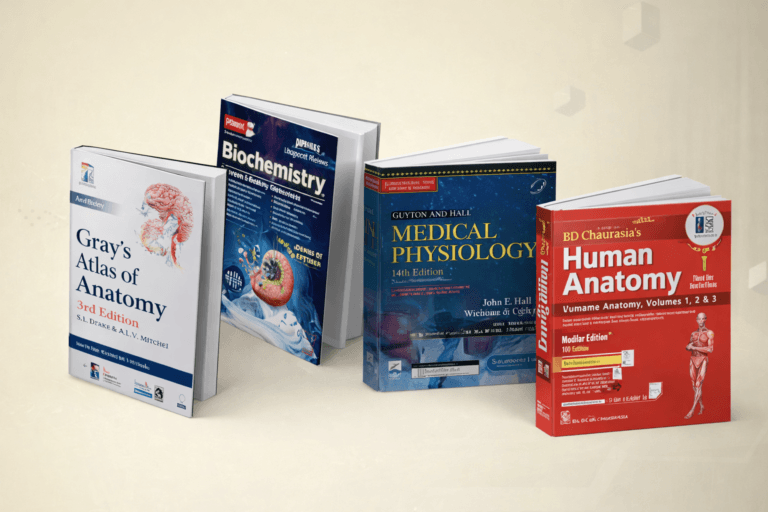
- Anatomy
- Physiology
- Biochemistry
Students also participate in:
- Anatomy dissection
- Histology practicals
- Physiology laboratory experiments
- Biochemistry practicals
- Early Clinical Exposure (ECE)
- AETCOM sessions
Recommended Learning Resources
Choose standard textbooks that provide:
- Conceptual explanations
- Clinical correlations
- Clear diagrams
- Practical relevance
- CBME-aligned content
Supporting resources such as anatomy atlases, dissection manuals, and practical record books are equally important.
Second Professional MBBS
The second year bridges basic sciences with clinical medicine.
Major subjects include:
- Pathology
- Microbiology
- Pharmacology
- Forensic Medicine & Toxicology
Students learn:
- Disease mechanisms
- Microorganisms and infections
- Drug actions
- Medical jurisprudence
- Laboratory diagnosis
- Rational prescribing
Recommended Books
Select updated textbooks that include:
- Flowcharts
- Clinical case discussions
- Diagnostic algorithms
- Practical exercises
- Evidence-based medicine
Practical manuals and question banks can be used as supplementary resources.
Third Professional MBBS (Part I)
Students begin developing stronger clinical reasoning skills through community and specialty medicine.
Subjects include:
- Community Medicine
- Ophthalmology
- Otorhinolaryngology (ENT)
Learning focuses on:
- Preventive healthcare
- National health programs
- Epidemiology
- Eye disorders
- Ear, nose, and throat diseases
Recommended Resources
Choose textbooks with:
- Community-based examples
- Public health statistics
- Clinical photographs
- Case discussions
- Updated national health guidelines
- Final Professional MBBS
The final year prepares students for independent clinical decision-making.
Major subjects include:
- General Medicine
- General Surgery
- Obstetrics & Gynaecology
- Pediatrics
- Orthopaedics
- Dermatology
- Psychiatry
- Anaesthesiology
- Radiology
Students spend a significant amount of time in clinical postings, interacting with patients under faculty supervision.
Recommended Books
The best textbooks for final-year MBBS should include:
- Clinical case discussions
- Differential diagnosis
- Management protocols
- Evidence-based treatment guidelines
- Practical examination preparation
These resources also support preparation for NExT and postgraduate entrance examinations.
Characteristics of a Good MBBS Textbook
Choosing the right medical book is about more than selecting a popular title.
A high-quality textbook should offer:
1. Concept-Based Learning
It should explain why diseases occur and how treatments work, not simply list facts.
2. Clinical Correlation
Theoretical concepts should be connected to real patient scenarios.
3. Updated Medical Information
Medical science evolves rapidly. Prefer the latest editions that incorporate current classifications, guidelines, and treatment recommendations.
4. Clear Illustrations
High-quality diagrams, flowcharts, tables, and clinical images improve understanding and retention.
5. CBME Alignment
Books should support competency-based learning objectives and practical skill development.
Standard Textbooks vs Review Books
Many students wonder whether concise review books can replace standard textbooks.
Standard Textbooks
Best suited for:
- Building concepts.
- Understanding disease mechanisms.
- Developing clinical reasoning.
- Long-term retention.
- Preparing for NExT.
Review Books
Useful for:
- Quick revision.
- MCQ practice.
- Internal assessments.
- Last-minute exam preparation.
The most effective strategy is to learn from standard textbooks and use review books only for revision.
Printed Books or Digital Resources?
Medical students increasingly use both printed and digital learning materials.
Advantages of Printed Books
- Easier annotation.
- Better concentration.
- Improved memory retention.
- Comfortable for extended reading.
Advantages of Digital Resources
- Portable.
- Searchable.
- Accessible anytime.
- Helpful for quick revision.
A blended learning approach allows students to benefit from both formats.
How to Choose the Right MBBS Books
Before buying medical textbooks, consider these points:
- Follow the latest NMC CBME curriculum.
- Buy the most recent edition.
- Prefer authentic publisher editions.
- Choose books recommended by faculty.
- Select resources with practical and clinical integration.
- Avoid purchasing multiple textbooks for the same subject unless necessary.
Quality matters far more than quantity.
Study Strategy for the Latest MBBS Curriculum
Success in the competency-based curriculum requires active learning.
A practical study plan includes:
- Study concepts from standard textbooks.
- Attend lectures and clinical postings regularly.
- Participate actively in practical sessions.
- Prepare concise handwritten notes.
- Revise every week.
- Solve previous-year university questions.
- Practice clinical case discussions and MCQs.
Consistent revision and practical application are more effective than memorizing large volumes of information before exams.
Common Mistakes MBBS Students Should Avoid
Avoid these common pitfalls:
- Relying only on coaching notes.
- Ignoring practical manuals.
- Studying only for examinations.
- Purchasing outdated editions.
- Neglecting clinical postings.
- Skipping self-directed learning.
Developing disciplined study habits early makes clinical years and competitive exams much easier.
Tips for Buying MBBS Books Online
When purchasing textbooks online:
- Choose trusted medical bookstores.
- Verify the ISBN and edition.
- Compare prices.
- Read customer reviews.
- Ensure the books are original publisher editions.
- Purchase practical manuals separately if required.
Buying authentic books ensures accurate content, better print quality, and long-term durability.
Frequently Asked Questions (FAQs)
What is the latest MBBS curriculum in India?
The latest MBBS curriculum follows the National Medical Commission’s Competency-Based Medical Education (CBME) framework, emphasizing clinical competence, ethics, communication, integrated teaching, and early clinical exposure.
Which books are recommended for MBBS students?
Students should use one standard textbook for each subject, supported by practical manuals, atlases, and question banks where appropriate. The best choice depends on the curriculum, faculty recommendations, and learning style.
Are review books enough for MBBS?
No. Review books are useful for revision but cannot replace standard textbooks, which provide detailed conceptual understanding and clinical reasoning.
How important are the latest editions?
Very important. Updated editions reflect current medical knowledge, revised classifications, and changes aligned with the NMC CBME curriculum.
Can I prepare for NExT using standard textbooks?
Yes. Standard textbooks form the conceptual foundation required for NExT, while MCQ practice and revision resources can be added later.
Conclusion
The latest MBBS curriculum is designed to produce competent, compassionate, and clinically skilled doctors who are prepared to meet the evolving needs of modern healthcare. Rather than emphasizing memorization alone, the CBME framework encourages integrated learning, early clinical exposure, ethical practice, and continuous skill development.
Choosing the right textbooks is a critical part of succeeding in this curriculum. Invest in updated, CBME-aligned standard textbooks that explain concepts clearly, connect theory with clinical practice, and support long-term learning. Combine these with practical manuals, consistent revision, and active participation in clinical postings to build a strong foundation for university examinations, NExT, and your future medical career.
Whether you’re beginning MBBS or progressing to the next professional year, selecting the right books today will support your academic success and help you become a confident, evidence-based medical practitioner tomorrow.