

What Is the Latest MBBS Microbiology Syllabus? A Complete CBME Guide for Medical Students (2026)

Sayanti Chakrabarti
Microbiology is one of the most important para-clinical subjects in the MBBS curriculum. It bridges the gap between basic medical sciences and clinical medicine by helping students understand infectious diseases, host immunity, antimicrobial therapy, laboratory diagnosis, and infection prevention.
Many second-year MBBS students ask:
“What is the latest MBBS Microbiology syllabus?”
The answer is that Indian medical colleges currently follow the National Medical Commission (NMC) Competency-Based Medical Education (CBME) curriculum, which emphasizes competency development, early clinical exposure, integrated learning, practical skills, and patient-centered medical education rather than rote memorization. (NMC)
This guide explains the latest MBBS Microbiology syllabus, chapter by chapter, highlights the competencies students are expected to achieve, and recommends the best books and study strategies for university examinations and competitive exams like NEET PG, INI-CET, FMGE, and NEXT.
Quick Answer
According to the latest NMC CBME curriculum, MBBS Microbiology broadly includes:
- General Microbiology
- Immunology
- Bacteriology
- Virology
- Mycology
- Parasitology
- Clinical (Applied) Microbiology
- Hospital Infection Control
- Antimicrobial Resistance
- Laboratory Diagnosis
The syllabus also includes practical exercises, microscopy, staining techniques, culture methods, sterilization, biomedical waste management, and infection control competencies. (NMC)
Why Is Microbiology Important in MBBS?
Microbiology helps future doctors understand:
- Causes of infectious diseases
- Disease transmission
- Immune response
- Laboratory investigations
- Rational antibiotic use
- Hospital-acquired infections
- Infection prevention strategies
A strong understanding of microbiology is essential for clinical medicine, surgery, pediatrics, obstetrics and gynecology, pathology, pharmacology, and community medicine.
Latest MBBS Microbiology Syllabus (NMC CBME)
The current curriculum follows a competency-based approach where students develop practical and clinical skills in addition to theoretical knowledge. (NMC)
Unit 1: General Microbiology
This section introduces the fundamentals of microorganisms.
Major topics include:
- History of microbiology
- Classification of microorganisms
- Bacterial cell structure
- Growth and nutrition of bacteria
- Bacterial genetics
- Sterilization and disinfection
- Culture media
- Microscopy
- Staining techniques
- Specimen collection
- Laboratory biosafety
Students also learn aseptic techniques and infection prevention principles.
Unit 2: Immunology
Immunology forms one of the most clinically relevant portions of the syllabus.
Topics include:
- Innate immunity
- Adaptive immunity
- Antigens and antibodies
- Complement system
- Cytokines
- Hypersensitivity reactions
- Autoimmune diseases
- Immunodeficiency disorders
- Vaccines
- Immunization schedules
- Organ transplantation
Understanding immunology is essential for infectious diseases and vaccine-based medicine.
Unit 3: Bacteriology
Bacteriology occupies a significant portion of the curriculum.
Students study medically important bacteria including:
- Staphylococcus
- Streptococcus
- Pneumococcus
- Neisseria
- Corynebacterium
- Clostridium
- Bacillus
- Mycobacterium tuberculosis
- Enterobacteriaceae
- Vibrio cholerae
- Salmonella
- Shigella
- Pseudomonas
- Helicobacter pylori
For each organism, students learn:
- Morphology
- Pathogenesis
- Clinical features
- Laboratory diagnosis
- Prevention
- Treatment principles
Unit 4: Virology
Virology focuses on medically important viruses.
Key topics include:
- Viral structure
- Viral replication
- DNA viruses
- RNA viruses
- Influenza virus
- Hepatitis viruses
- HIV
- Rabies virus
- Dengue virus
- Coronavirus
- Human papillomavirus
Students also study antiviral drugs and vaccination strategies.
Unit 5: Mycology
Students learn fungal infections and laboratory diagnosis.
Important fungi include:
- Candida
- Aspergillus
- Cryptococcus
- Dermatophytes
- Mucormycosis-causing fungi
Topics include:
- Classification
- Morphology
- Clinical presentation
- Diagnosis
- Antifungal therapy
Unit 6: Parasitology
Parasitology focuses on protozoa and helminths.
Important organisms include:
- Entamoeba histolytica
- Giardia lamblia
- Plasmodium
- Leishmania
- Toxoplasma
- Taenia
- Ascaris
- Hookworm
- Filaria
Students learn life cycles, disease mechanisms, diagnosis, and prevention.
Unit 7: Clinical (Applied) Microbiology
This unit connects microbiology with patient care.
Topics include:
- Bloodstream infections
- Respiratory infections
- Gastrointestinal infections
- Urinary tract infections
- Sexually transmitted infections
- Central nervous system infections
- Skin and soft tissue infections
- Opportunistic infections
Students also understand specimen selection and interpretation of microbiological reports.
Unit 8: Hospital Infection Control
Modern healthcare requires strong infection control practices.
Topics include:
- Biomedical waste management
- Personal protective equipment (PPE)
- Hand hygiene
- Needle-stick injury prevention
- Hospital-acquired infections
- Isolation precautions
- Sterilization protocols
These competencies are emphasized under the CBME curriculum.
Unit 9: Antimicrobial Resistance
One of the newest priorities in medical education is antimicrobial stewardship.
Students study:
- Antibiotic resistance mechanisms
- Rational antibiotic prescribing
- Antimicrobial susceptibility testing
- Stewardship programs
- Multidrug-resistant organisms
This topic has become increasingly important due to rising global antimicrobial resistance.
Practical MBBS Microbiology Syllabus
The practical component develops laboratory skills.
Students perform:
- Gram staining
- Acid-fast staining
- Microscopy
- Culture media identification
- Sterilization demonstrations
- Antibiotic sensitivity testing
- Specimen handling
- Identification of microorganisms
- Serological tests
Practical skills contribute significantly to university examinations.
Competencies Expected Under CBME
The NMC curriculum expects MBBS students to:
- Identify common pathogens.
- Explain disease transmission.
- Interpret microbiology laboratory reports.
- Apply infection prevention measures.
- Practice rational antimicrobial use.
- Understand vaccine principles.
- Demonstrate laboratory safety.
- Correlate microbiological findings with clinical cases.
This competency-based approach focuses on application rather than memorization. (NMC)
Best Books for the Latest MBBS Microbiology Syllabus
To cover the syllabus effectively, students commonly use:
Primary Textbook
Essentials of Medical Microbiology – Apurba Sastry
Recommended because of:
- Simple explanations
- NMC-aligned content
- Flowcharts
- Clinical integration
- Exam-oriented presentation
Reference Book
Ananthanarayan & Paniker’s Textbook of Microbiology
Ideal for:
- Detailed conceptual understanding
- Advanced learning
- Competitive examinations
Color Atlas
A microbiology atlas helps students identify organisms, staining patterns, and microscopic findings during practical examinations.
How to Study the MBBS Microbiology Syllabus
An effective strategy includes:
- Study one system at a time.
- Integrate microbiology with pathology and pharmacology.
- Revise diagrams and flowcharts regularly.
- Practice staining techniques.
- Solve previous university question papers.
- Create organism comparison tables.
- Focus on clinical applications instead of isolated facts.
Consistent revision leads to better long-term retention.
Where to Buy Original MBBS Microbiology Books
Choosing authentic textbooks is just as important as selecting the right ones.
Always buy:
- Latest editions
- Original publisher copies
- Updated CBME-compatible textbooks
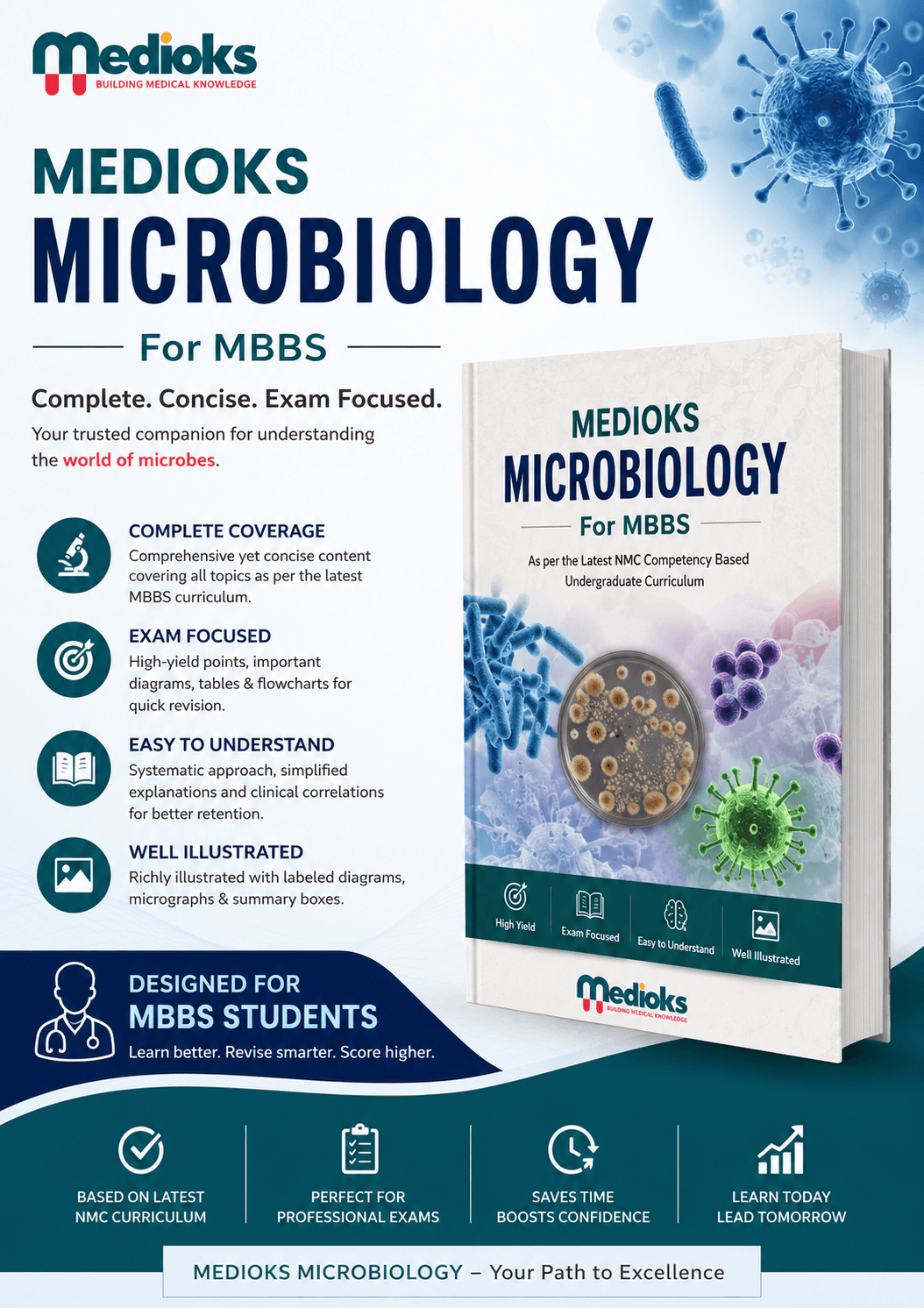
Many MBBS students purchase their medical books from Medioks, a trusted online medical bookstore that offers genuine microbiology textbooks, practical manuals, color atlases, and complete MBBS book sets from leading publishers. Buying original editions ensures updated content, high-quality printing, and long-term durability.
Frequently Asked Questions (FAQs)
What is included in the latest MBBS Microbiology syllabus?
The syllabus includes General Microbiology, Immunology, Bacteriology, Virology, Mycology, Parasitology, Clinical Microbiology, Infection Control, and Antimicrobial Resistance, along with practical laboratory training. (NMC)
Does the NMC follow the CBME curriculum?
Yes. The National Medical Commission has implemented the Competency-Based Medical Education (CBME) curriculum for MBBS programs in India. (NMC)
Which microbiology book is best for MBBS?
Apurba Sastry’s Essentials of Medical Microbiology is widely recommended as the primary textbook, while Ananthanarayan & Paniker is an excellent reference.
Is microbiology important for NEET PG?
Yes. Microbiology is a core para-clinical subject and contributes significantly to NEET PG, FMGE, INI-CET, and NEXT preparation because these exams are based on the MBBS curriculum. (DigiNerve)
Where can I buy original MBBS microbiology books?
Trusted online medical bookstores such as Medioks offer genuine and latest-edition MBBS microbiology books from reputed publishers.
Conclusion
The latest MBBS Microbiology syllabus is designed to prepare students for modern clinical practice through competency-based learning. Rather than focusing solely on memorization, the CBME curriculum emphasizes clinical application, laboratory skills, infection control, antimicrobial stewardship, and integrated medical education.
By understanding each unit systematically, using standard textbooks like Apurba Sastry and Ananthanarayan & Paniker, and practicing laboratory competencies regularly, students can perform well in university examinations while building a strong foundation for postgraduate entrance exams and future clinical careers.
To ensure you’re studying from authentic and updated resources, purchase your textbooks from trusted platforms like Medioks, where you’ll find genuine MBBS microbiology books, atlases, and practical manuals aligned with the latest curriculum.