

Best Books for FMGE Preparation in 2026: A Subject-Wise Guide for Foreign Medical Graduates

admin
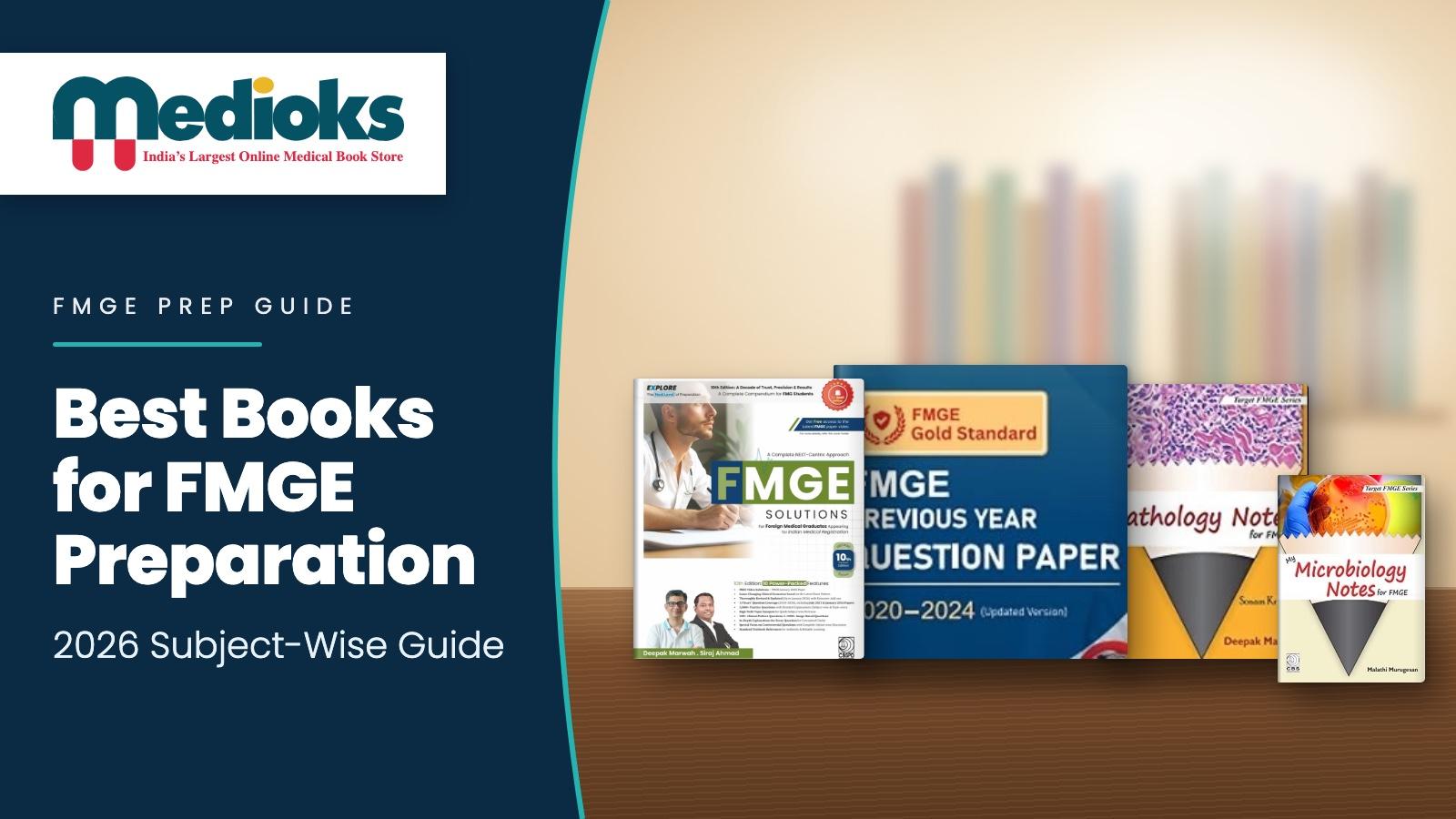
The most effective FMGE preparation usually combines one comprehensive FMGE book, such as FMGE Solutions, with previous-year questions and short notes for high-weightage subjects. Foreign medical graduates often start with gaps from a different curriculum, so focused revision books work better than reading full Indian textbooks for every subject.
The Foreign Medical Graduate Examination (FMGE) is the screening test Indian citizens with a primary medical qualification from abroad must pass to practise in India. It is conducted by the National Board of Examinations in Medical Sciences (NBEMS). This guide explains the exam format and which books fit each stage of preparation.
Quick answer
- Core book: FMGE Solutions (Deepak Marwah, Siraj Ahmad).
- Previous-year questions: an FMGE previous-year question paper book (2020–2024).
- Subject notes: short FMGE-focused books such as My Pathology Notes for FMGE, My Microbiology Notes for FMGE and Surgery Sixer for FMGE.
- Exam format: 300 MCQs, and you need 150 marks (50%) to pass. Check natboard.edu.in for current dates and rules.
FMGE exam format at a glance
| Feature | Details |
|---|---|
| Conducted by | National Board of Examinations in Medical Sciences (NBEMS) |
| Format | Computer-based test with 300 single-best-answer MCQs, in two parts of 150 questions each |
| Passing standard | 150 out of 300 (50%) |
| Negative marking | None |
| Sessions | Usually held twice a year. Check the official schedule |
| Subjects | Pre-clinical, para-clinical and clinical subjects of the Indian MBBS curriculum |
Core FMGE books
FMGE Solutions by Deepak Marwah and Siraj Ahmad is one of the most widely used FMGE books. It covers all subjects in a revision format, with topic summaries and questions.
- Strengths: covers the whole syllabus in one place, designed around the FMGE pattern, and good for repeated revision.
- Limitations: it’s condensed, so for topics you never studied properly abroad, you may need a standard Indian textbook chapter or your coaching notes.
- Best for: almost every FMGE candidate, as the main book.
Previous-year question books
Previous-year questions show which topics come up repeatedly and how questions are framed. Medioks stocks an FMGE previous-year question paper book (2020–2024).
Use it in two ways: topic-wise after studying each subject, and then as full timed papers in the final weeks.
Subject-wise notes
Short subject books help with high-yield areas where many candidates lose marks:
- My Pathology Notes for FMGE (Pruthi)
- My Microbiology Notes for FMGE (Murugesan)
- Surgery Sixer for FMGE (H. Sandhu)
- One Touch Psychiatry for NEET/NExT/FMGE/INI-CET (Dr Prashant Agrawal)
Community medicine is often a high-yield area for screening exams. For PSM books, see our community medicine book guide.
A simple preparation plan
- Take a baseline test using previous-year questions to find your weak subjects.
- Do a first pass of your core book, subject by subject, and solve questions after each chapter.
- Fill gaps with subject notes for weak or high-weightage subjects.
- Revise twice more, faster each time, from the core book and your own notes.
- Take full timed papers in the final weeks to build speed and stamina for 300 questions.
Common mistakes to avoid
- Buying too many books. One core book, revised three times, beats five books read once.
- Ignoring short subjects. Subjects like ENT, ophthalmology, dermatology and psychiatry add up.
- Skipping timed practice. Many candidates know the content but run short of time.
- Using outdated material. Check that national programme and guideline content is current.
Planning for NEET PG after FMGE? See our guide to NEET PG question banks.
Who needs to take FMGE?
FMGE is the screening test for Indian citizens, and Overseas Citizens of India, who have a primary medical qualification from a medical institution outside India and want to register to practise in India. Some countries’ qualifications are exempt under the rules. Because eligibility rules and exemptions can change, always check the current information bulletin on the NBEMS website before you apply.
Why FMGE feels hard, and how to make it easier
Many candidates find FMGE harder than expected. The reasons are usually practical rather than about ability:
- A different curriculum. Courses abroad may cover subjects in a different order or depth from the Indian MBBS curriculum, and some topics, such as Indian national health programmes, may not be taught at all.
- Language and question style. Students who studied in another language may need time to adjust to English-language MCQs written in the Indian exam style.
- Time since graduation. Candidates who graduated some time ago may need to rebuild basic sciences.
- Breadth. The exam covers pre-clinical, para-clinical and clinical subjects together, so every subject needs some attention.
The fix is a structured plan: identify gaps early, use one core book consistently, and practise questions throughout.
How to divide your time across subjects
FMGE covers all the subjects of the Indian MBBS curriculum. Rather than giving every subject equal time, many candidates organise preparation into three groups:
| Group | Subjects | Approach |
|---|---|---|
| Large clinical subjects | Medicine, surgery, obstetrics and gynaecology, paediatrics | The most time. Focus on common conditions, guidelines and management |
| Para-clinical subjects | Pathology, pharmacology, microbiology, community medicine, forensic medicine | High-yield facts and concepts. Community medicine needs Indian programme knowledge |
| Pre-clinical and short subjects | Anatomy, physiology, biochemistry, ENT, ophthalmology, dermatology, psychiatry, orthopaedics, anaesthesia, radiology | Steady revision of high-yield topics. Don’t skip them, because they add up |
Check the official NBEMS information bulletin for the current subject list and any published distribution of questions.
A sample weekly routine
- Weekdays: study one subject block from your core book in the morning, and solve questions on the same topics in the evening.
- One day a week: revise everything from the past week and note your mistakes.
- One day a week: take a timed test, starting with subject tests and moving to full papers closer to the exam.
- Every day: review a small set of facts you keep forgetting, using short notes or flashcards.
Keep a mistake log
One of the most effective FMGE habits is a simple mistake log. For every question you get wrong, write down the topic, why you got it wrong (didn’t know it, misread it, or confused two similar facts), and the correct fact in one line. Revise the log every week. Over time, it becomes a personalised revision book built entirely around your weak areas.
Exam-day strategy
- Answer every question. There’s no negative marking, so an educated guess is always better than leaving a question blank.
- Don’t get stuck. Mark difficult questions and come back to them later.
- Watch the clock in each part, so you have time to review.
- Read carefully. Many errors come from missing words like “except” or “most common”.
- Follow the official instructions on documents, reporting time and items allowed in the centre.
After you pass
Passing FMGE is the step towards registration. After that, candidates usually complete an internship as required by the National Medical Commission before full registration. Requirements can change, so follow the current NMC and state medical council guidance. Many candidates then begin NEET PG preparation, and the habits you build for FMGE, especially question practice and mistake logs, carry straight over.
Using coaching and online resources wisely
Many FMGE candidates use coaching classes or online platforms. These can help with structure and motivation, but they work best alongside a core book and your own revision. If you use video lectures, watch at a steady pace, make short notes, and always follow each topic with questions. More resources won’t help if they replace practice.
Making revision stick
FMGE tests a very large syllabus, so remembering what you’ve studied is as important as covering it. Spaced revision helps: revisit each subject briefly a few days after studying it, again a week later, and again before the exam. Short notes, tables and the mistake log described above make these quick revisions possible. Many candidates also find that explaining a topic aloud, or teaching it to a study partner, shows quickly what they haven’t really understood.
High-yield areas many candidates underestimate
- Community medicine: Indian national health programmes, immunisation schedules, epidemiology and biostatistics. These are often new to foreign graduates and need an up-to-date source.
- Forensic medicine: medicolegal procedures and Indian law, which may differ from what was taught abroad. Check that your source reflects current laws.
- Pharmacology: drug classes, mechanisms and adverse effects appear across clinical questions too.
- Image-based questions: clinical photographs, X-rays and specimens. Practise with question banks that include images.
- Short clinical subjects: ENT, ophthalmology, dermatology and psychiatry, where a few hours of focused revision can earn several marks.
Choosing between FMGE books
When comparing FMGE books, check the publication year and edition, whether recent exam questions are included, how clearly each topic is explained, and whether the book includes images. A book you’ll actually revise three times is worth more than a thicker one you can’t finish. If you’re unsure, look at sample pages on the product listing or ask recent successful candidates which book they used.
Whichever book you choose, stick with it. Switching core books midway is one of the most common reasons candidates run out of time for revision.
Frequently asked questions
Which is the best book for FMGE preparation?
FMGE Solutions by Deepak Marwah and Siraj Ahmad is one of the most widely used core books. Combine it with previous-year questions.
What is the FMGE passing mark?
You need 150 out of 300 marks (50%). There is no negative marking. Confirm current rules on natboard.edu.in.
Are previous-year questions enough to pass FMGE?
They’re essential, but not enough on their own. Use them alongside a core book that covers the full syllabus.
Is FMGE being replaced by NExT?
NExT has been proposed as a common exit exam that may eventually replace FMGE. Until an official NBEMS or NMC notification says otherwise, prepare for FMGE as currently conducted.
How long should I prepare for FMGE?
It depends on your starting point. Many candidates plan several months of structured study. A baseline test helps you decide.
How many attempts can I take at FMGE?
Check the current NBEMS information bulletin and NMC rules for attempt limits and the time window for qualifying. These rules have been updated in the past, so rely only on official notices.
Should I read standard Indian textbooks for FMGE?
Not cover to cover. Use a core FMGE book for the whole syllabus, and dip into standard textbooks only for topics you find confusing.
How many hours a day should I study for FMGE?
It depends on your schedule and starting point. A consistent daily routine, with a fixed time for questions and revision, matters more than very long hours on some days and none on others.
Are clinical subjects more important than pre-clinical ones?
Clinical subjects usually take more preparation time, but every subject contributes marks. Don’t skip pre-clinical and short subjects. High-yield revision of them is efficient.
Is community medicine difficult for foreign graduates?
It can be, because it includes Indian national health programmes and statistics that aren’t taught abroad. Give it dedicated time with an up-to-date source.
Can I prepare for FMGE and NEET PG together?
The content overlaps a great deal, but focus on passing FMGE first. Good FMGE preparation builds a strong base for NEET PG later.
Where do I find official FMGE dates?
On the official NBEMS website, natboard.edu.in, which publishes the information bulletin, application dates and results.
The bottom line
For FMGE, build your preparation around one core book, solve previous-year questions throughout, and use short subject notes for weak areas. Revise repeatedly, practise full timed papers, and always confirm exam details on the official NBEMS website.
Exam details can change. Always confirm dates, eligibility and rules on the official NBEMS website. Book recommendations are general guidance, and editions and availability change. Facts checked on 26 November 2026.