

Best Clinical Case Books for MBBS Practical Exams: Long Cases, Short Cases and Viva

admin
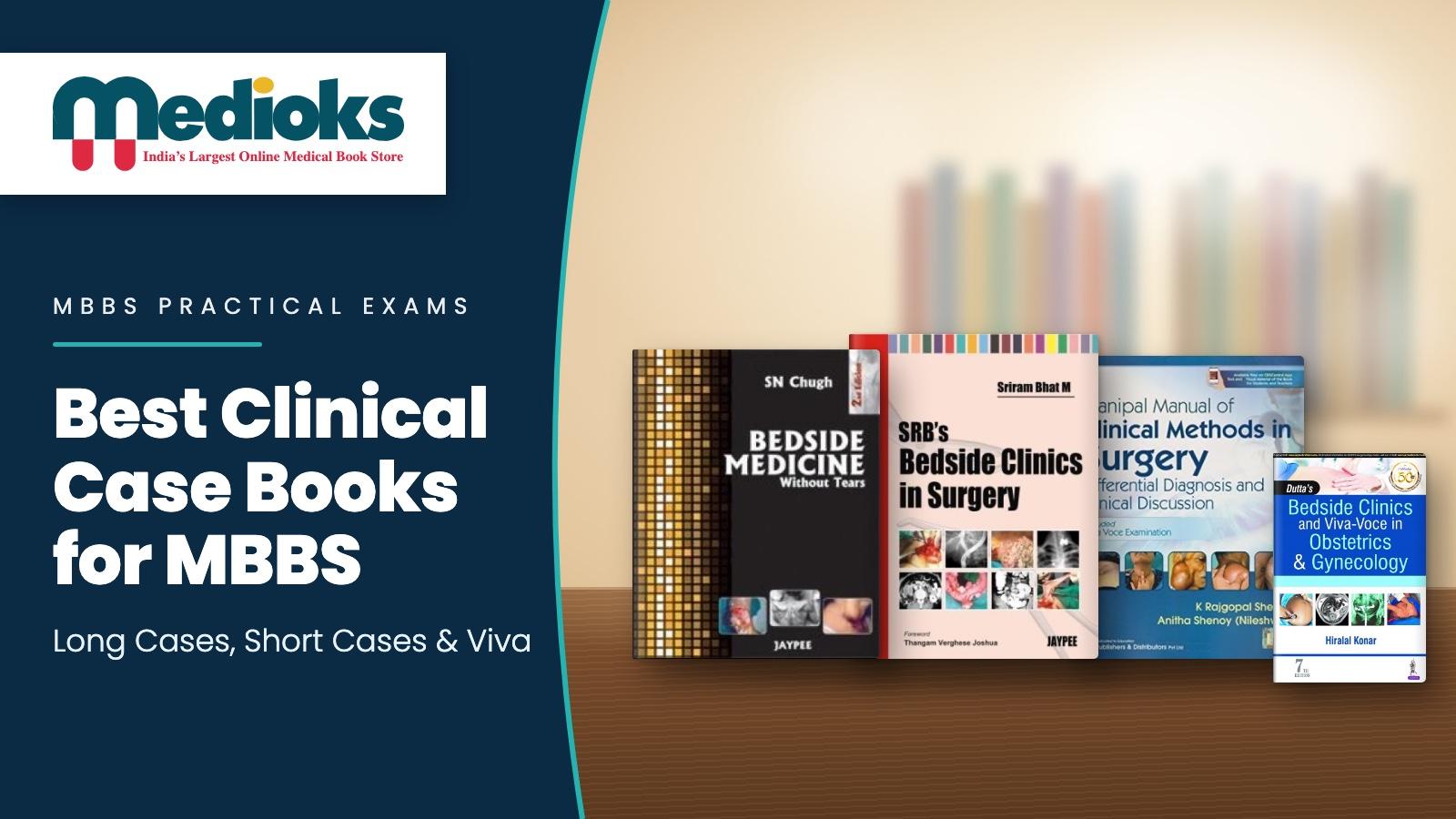
For the final MBBS clinical exams, a case book teaches you how to present: what to ask, what to examine, and how to discuss the diagnosis. For medicine, many Indian students use S.N. Chugh’s Bedside Medicine Without Tears or a long and short cases book. For surgery, SRB’s Bedside Clinics in Surgery or the Manipal clinical methods book are the most common choices.
Textbooks teach diseases, but practical exams test how you approach a patient. This guide covers case books for medicine, surgery, obstetrics and orthopaedics, and how to use them alongside your postings. If you need a book on clinical examination technique itself, see our comparison of Hutchison vs Macleod.
Quick answer
- Medicine: Bedside Medicine Without Tears (S.N. Chugh), plus a long and short cases book.
- Surgery: SRB’s Bedside Clinics in Surgery, or the Manipal Manual of Clinical Methods in Surgery.
- Obstetrics and gynaecology: Dutta’s Bedside Clinics and Viva-Voce.
- Orthopaedics: John Ebnezar’s Long Cases in Practical Orthopedic Examinations.
- Most important: present real cases to your teachers. No book replaces practice.
Why you need a case book
In a long case, examiners judge how well you take a history, examine systematically, reach a provisional diagnosis, give sensible differentials and plan investigations and management. Case books model this flow for common exam cases, so you learn a structure you can apply to any patient.
Case books compared
| Book | Author | Subject | Best for |
|---|---|---|---|
| Bedside Medicine Without Tears | S.N. Chugh | Medicine | Case-based bedside approach for MBBS exams |
| Clinical Methods in Medicine: Clinical Skills and Practices | S.N. Chugh | Medicine | Examination methods and their interpretation |
| Manual of Clinical Methods | P.S. Shankar | Medicine | A compact clinical methods guide |
| Short and Long Cases of Medicine | Raman | Medicine | Case-wise exam preparation |
| SRB’s Bedside Clinics in Surgery | Sriram Bhat M | Surgery | Long and short surgical cases |
| Manipal Manual of Clinical Methods in Surgery | K. Rajgopal Shenoy | Surgery | Examination, differential diagnosis and discussion |
| Long Cases in Practical Orthopedic Examinations | John Ebnezar | Orthopaedics | Orthopaedic long cases |
Medicine case books
- Bedside Medicine Without Tears (S.N. Chugh) is a popular case-based book for MBBS medicine practicals.
- Clinical Methods in Medicine: Clinical Skills and Practices (S.N. Chugh) focuses on examination methods.
- Manual of Clinical Methods (P.S. Shankar) is a compact alternative.
- Short and Long Cases of Medicine (Raman) is organised case by case.
- Clinical Methods and Interpretation in Medicine (Ashis Kumar Saha) links findings to interpretation.
For medicine textbooks, see our general medicine book guide.
Surgery case books
- SRB’s Bedside Clinics in Surgery (Sriram Bhat M) covers common long and short cases.
- Manipal Manual of Clinical Methods in Surgery (K. Rajgopal Shenoy) emphasises differential diagnosis and clinical discussion.
- Surgery Long Cases in Short is a compact revision book.
For surgery textbooks, see our surgery book guide.
OBG and orthopaedics
- Dutta’s Bedside Clinics and Viva-Voce in Obstetrics & Gynecology (Hiralal Konar) is the most common OBG clinical book.
- Long Cases in Practical Orthopedic Examinations (John Ebnezar) covers orthopaedic long cases.
How to use a case book well
- Read the case the evening before you see a similar patient, then compare the book’s approach with what you find.
- Build your own case template for each system, and use it every time.
- Present cases aloud to friends or teachers. Fluency matters in the exam.
- Prepare for the discussion after each case: differentials, key investigations and first-line management.
- Revise common short cases visually. Many are about recognising signs quickly.
How MBBS clinical exams are usually structured
Practical exam formats vary between universities, but final-year clinical exams commonly include:
| Component | What happens | What examiners look for |
|---|---|---|
| Long case | You take a full history and examine a patient, then present and discuss the case | A structured history, systematic examination, a sensible diagnosis and a management plan |
| Short cases | You examine one or more patients briefly and describe your findings | Correct technique, recognising signs and reaching a diagnosis quickly |
| OSCE stations | Timed stations testing specific skills | Communication, technique and accuracy |
| Viva and spotters | Questions on instruments, specimens, X-rays and drugs | Applied knowledge |
Your college will tell you its exact format. Case books are most useful for the long case, short cases and the discussion that follows.
Common medicine cases to prepare
- Cardiovascular: valvular heart disease, heart failure, hypertension.
- Respiratory: pleural effusion, consolidation, chronic obstructive pulmonary disease, bronchiectasis, tuberculosis.
- Abdomen: chronic liver disease, hepatosplenomegaly, ascites.
- Nervous system: hemiplegia, paraplegia, peripheral neuropathy, cerebellar signs.
- Other: anaemia, chronic kidney disease, diabetes and its complications.
Common surgery cases to prepare
- thyroid swellings and other neck lumps,
- breast lumps,
- hernias,
- varicose veins and ulcers,
- scrotal swellings,
- abdominal lumps, and
- peripheral arterial disease.
How to present a case confidently
- Start with a one-line summary: age, sex and main complaint with duration.
- Tell the story in order. Examiners follow a chronological history more easily.
- Include relevant negatives. Saying what’s absent shows you thought about the differential diagnosis.
- Describe findings in a fixed sequence: inspection, palpation, percussion, auscultation.
- Give a clear diagnosis. Commit to one, then list your differentials.
- Know why you’d order each investigation, and what result you expect.
- Be honest. If you missed a sign, say so. Examiners respect honesty more than invented findings.
How to practise effectively
- Present to classmates in pairs or small groups, and time yourselves.
- Ask residents to hear one case a week. Their feedback is often the most practical you’ll get.
- Use the case book after each patient, comparing your presentation with the model.
- Rehearse the discussion. Prepare the five or six questions most often asked after each common case.
- Practise examination steps physically, not just in your head.
Choosing your case books
You don’t need many books. Pick one case book for medicine and one for surgery, plus the OBG and orthopaedics books if your exams include those cases. Use the same book throughout final year so you get used to its structure. Books with plenty of tables and differential diagnosis lists suit last-minute revision, while books with detailed discussion suit earlier, deeper preparation.
Common mistakes in clinical exams
- presenting findings you didn’t actually elicit,
- a disorganised history that jumps between topics,
- forgetting the general examination,
- listing investigations without explaining why, and
- not thanking or respecting the patient. Examiners notice professionalism.
Preparing for the discussion after a case
After you present, examiners usually ask questions that test your understanding. For each common case, prepare short answers to these questions: What are the causes? Which investigations would you order first, and why? What does each investigation show? What is the first-line treatment? What are the complications? When would you refer or operate? Writing these as one-page summaries for your most common cases is one of the best uses of final-year revision time.
Professionalism in clinical exams
Clinical exams test how you behave with patients as well as what you know. Introduce yourself, explain what you’re going to do, ask for consent, keep the patient comfortable and covered, wash your hands, and thank the patient at the end. These habits take seconds and are noticed by examiners.
Examination templates by system
Having a fixed template for each system stops you missing steps under exam pressure:
- Cardiovascular: general examination and pulse, blood pressure, JVP, precordium (inspection, palpation, percussion, auscultation), and signs of heart failure.
- Respiratory: general examination, upper respiratory tract, chest inspection, palpation, percussion and auscultation, front and back.
- Abdomen: inspection, superficial and deep palpation, organ palpation, percussion including shifting dullness, auscultation, hernial orifices and external genitalia as appropriate.
- Nervous system: higher functions, cranial nerves, motor system, sensory system, reflexes, cerebellar signs and gait.
- Local surgical examination: inspection, palpation, percussion, auscultation, regional lymph nodes and the relevant system.
Write each template on a single card and practise until you can do it without looking. Case books show how these templates apply to specific conditions.
OBG and orthopaedic cases
Obstetric cases include an obstetric history, calculation of gestational age, general and obstetric examination, and discussion of the management of pregnancy and delivery. Gynaecology cases include menstrual history and pelvic examination findings, presented with consent and privacy. Dutta’s Bedside Clinics covers both formats.
Orthopaedic cases focus on the examination of joints and limbs, deformities, nerve injuries and fractures. A structured approach of look, feel, move, and special tests works for most orthopaedic cases. John Ebnezar’s long cases book follows this kind of approach for exam preparation.
The last two weeks before your practical exam
- present at least one case every day,
- revise your one-page case summaries,
- practise examination templates on classmates,
- revise instruments, X-rays and specimens, and
- sleep well before the exam. Clear thinking matters more than one more case.
Beyond the exam
The skills you build with case books, taking a focused history, examining systematically and presenting clearly, are the same skills you’ll use every day as an intern. Students who practise presenting during final year usually find ward rounds, handovers and referrals much easier once they start work. That’s a good reason to treat case practice as preparation for clinical life, not just for the exam.
Frequently asked questions
Which is the best clinical case book for MBBS medicine?
S.N. Chugh’s Bedside Medicine Without Tears is a popular choice. A long and short cases book is a good companion.
Which surgery case book is best for MBBS?
SRB’s Bedside Clinics in Surgery and the Manipal Manual of Clinical Methods in Surgery are both widely used. Choose one.
Is a case book better than Hutchison or Macleod?
They do different jobs. Hutchison and Macleod teach examination technique. Case books teach how to present and discuss exam cases. Many students use one of each.
When should I start using case books?
From your first clinical postings, and especially through final year. Don’t leave them until the weeks before the practical exam.
How many long cases should I practise before the exam?
As many as you can. Aim to present at least the common cases in each system several times, so that the structure becomes automatic.
What if I can’t find a sign the examiner expects?
Report what you actually found. If you’re unsure, say so and describe how you’d confirm it. Inventing findings is a common reason for losing marks.
Do I need different case books for OSCEs?
OSCEs test focused skills, such as a single examination or a communication task. A clinical methods book like Hutchison or Macleod often helps more for OSCE stations than a case book.
How long should a long case presentation take?
Your examiners will usually tell you. Practise a complete presentation in around five to ten minutes, with a shorter version ready if you’re asked to summarise.
Should I memorise case book presentations word for word?
No. Learn the structure and the key points, then present the patient in front of you. Examiners can tell when a presentation is memorised rather than observed.
Are paediatric cases different?
Yes. Paediatric cases include growth, development, immunisation and nutrition. Prepare them with a paediatric clinical book or your paediatrics textbook.
Which case book is best for medicine practicals?
Many students use S.N. Chugh’s Bedside Medicine Without Tears. Others prefer a long and short cases book. Choose one that matches your college’s exam format and stick with it through final year.
Do surgery and medicine cases need different preparation?
Yes. Medicine cases focus more on systemic examination and diagnosis, while surgery cases focus more on local examination of a lump, ulcer or swelling and on operative management.
The bottom line
Pick one case book per major subject, use it alongside real patients, and present cases as often as you can. A clear, practised structure is what turns clinical knowledge into marks in the practical exam.
Book recommendations are general guidance. Always follow your college’s practical exam format and your teachers’ advice. Editions and availability change, so check the product page for the latest edition. Facts checked on 26 November 2026.