

Best Surgery Books for MBBS: Bailey & Love vs SRB’s Manual and What to Buy

admin
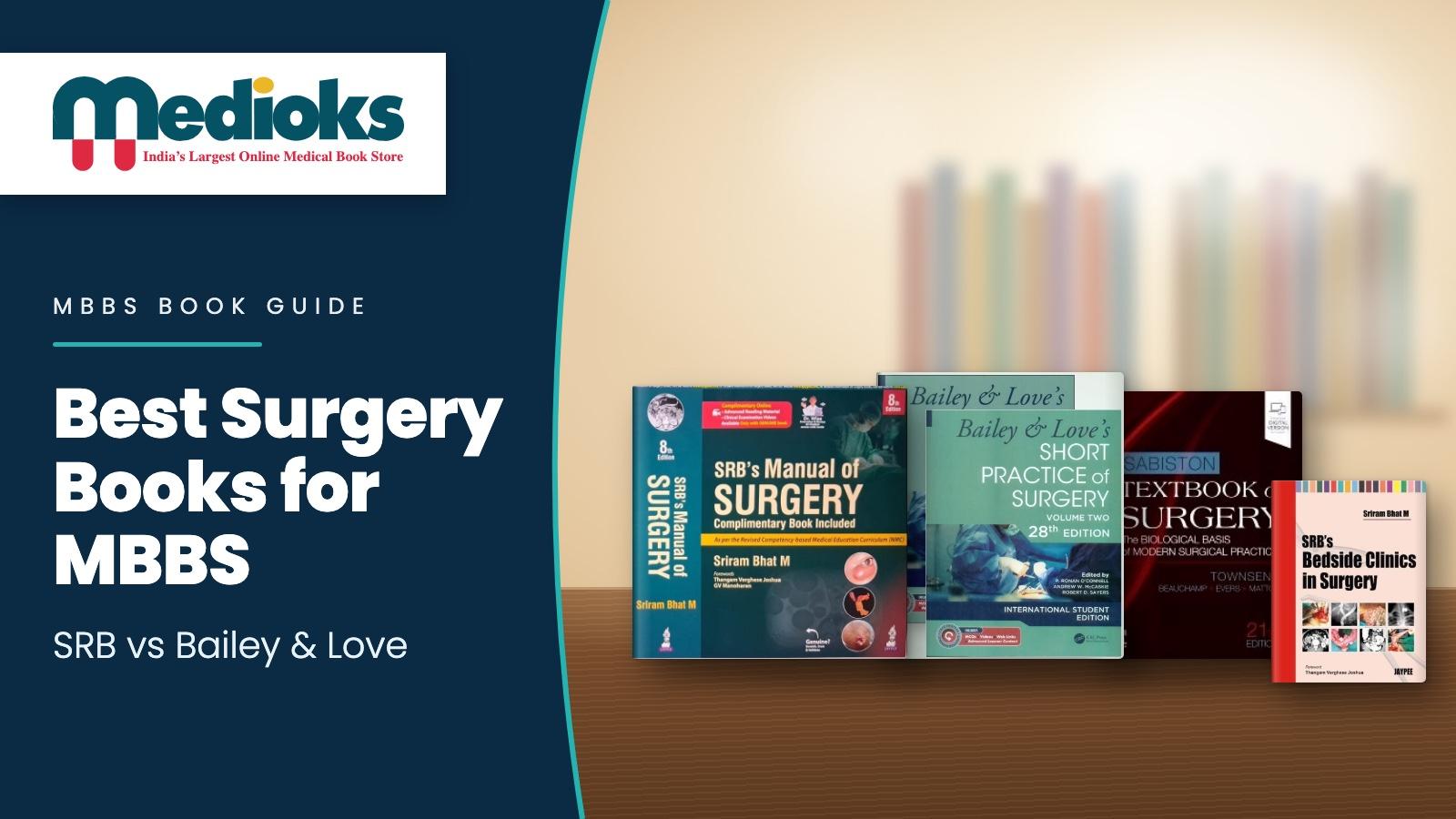
For MBBS surgery, most Indian students read one main textbook, usually SRB’s Manual of Surgery for exam-oriented reading or Bailey & Love’s Short Practice of Surgery for depth, and add a clinical book for case presentations. Sabiston is a reference for residents, not a must-buy for undergraduates.
General surgery is one of the four major subjects of the final MBBS phase, alongside medicine, obstetrics and gynaecology, and paediatrics. It has a large theory syllabus and a demanding clinical exam with long cases, short cases, instruments, X-rays and specimens. This guide shows which books cover each part.
Quick answer
- Exam-oriented main book: SRB’s Manual of Surgery (Sriram Bhat M).
- Depth and concepts: Bailey & Love’s Short Practice of Surgery (two-volume set).
- Clinical cases: SRB’s Bedside Clinics in Surgery, or the Manipal Manual of Clinical Methods in Surgery.
- Physical signs: Hamilton Bailey’s Demonstrations of Physical Signs in Clinical Surgery.
- Instruments and X-rays: a practical guide to surgical instruments.
- Reference only: Sabiston Textbook of Surgery.
Surgery books compared
| Book | Author / editor | Type | Best for |
|---|---|---|---|
| SRB’s Manual of Surgery | Sriram Bhat M | Main textbook | Exam-oriented reading, with plenty of tables, flowcharts and clinical photos |
| Bailey & Love’s Short Practice of Surgery | Norman Williams, P. Ronan O’Connell and others | Main textbook | Depth, concepts and the international standard. Two volumes |
| Sabiston Textbook of Surgery | Courtney M. Townsend and others | Reference | Residents and in-depth reading |
| SRB’s Bedside Clinics in Surgery | Sriram Bhat M | Clinical book | Long and short case presentation |
| Manipal Manual of Clinical Methods in Surgery | K. Rajgopal Shenoy | Clinical book | Clinical examination, differential diagnosis and discussion |
| Hamilton Bailey’s Demonstrations of Physical Signs in Clinical Surgery | J.S.P. Lumley | Clinical classic | Learning and demonstrating physical signs |
Main textbooks
SRB’s Manual of Surgery
SRB’s Manual of Surgery by Sriram Bhat M is one of the most widely used surgery books among Indian MBBS students. It’s known for its clinical photographs, tables and point-wise layout, which make it easy to write structured answers.
- Strengths: exam-friendly layout, Indian clinical context and extensive illustrations.
- Limitations: it’s a large book, so many students read it topic by topic during postings rather than cover to cover.
- Best for: students who want one book that maps closely to university exams.
Bailey & Love’s Short Practice of Surgery
Bailey & Love’s Short Practice of Surgery is one of the best-known surgery textbooks in the world. It explains principles and surgical decision-making in depth.
- Strengths: authoritative, strong on principles, and useful well beyond MBBS for surgical PG aspirants.
- Limitations: it’s long, and it isn’t written around Indian university question patterns.
- Best for: students who want depth, or who plan to pursue surgery.
Sabiston Textbook of Surgery
Sabiston Textbook of Surgery is a detailed reference used mainly by surgical residents. Undergraduates can use it from the library when a topic needs more depth.
Clinical and bedside books
The surgery clinical exam usually includes a long case and short cases, such as lumps, swellings, ulcers, hernias, thyroid, breast and varicose veins. These books help you structure history, examination and discussion:
- SRB’s Bedside Clinics in Surgery covers case presentation in the same style as SRB’s Manual.
- Manipal Manual of Clinical Methods in Surgery (K. Rajgopal Shenoy) focuses on examination and differential diagnosis.
- Hamilton Bailey’s Demonstrations of Physical Signs in Clinical Surgery is a classic for learning how to elicit and describe signs.
- Surgery Long Cases in Short is a compact revision book for long cases.
For clinical case books across medicine and surgery, see our guide to clinical case books for MBBS practical exams.
Instruments, X-rays and operative surgery
The instruments, specimens and X-ray part of the exam is often where marks are lost. Learn what each instrument is, how it’s used, and in which operations. Useful books include:
- A Practical Guide to Surgical Instruments, X-Rays and Operative Interventions (Ajay Kumar Agarwal)
- Introduction to Surgical Instruments & Procedures for Undergraduates (Kapur)
SRB or Bailey & Love: how to choose
| If you… | Choose |
|---|---|
| want structured, exam-ready answers | SRB’s Manual of Surgery |
| want depth and plan to pursue surgery | Bailey & Love, with SRB for quick revision |
| struggle with case presentations | Add SRB’s Bedside Clinics or the Manipal clinical methods book |
| need a reference for rare topics | Sabiston, from the library |
How to prepare for surgery exams
- Read surgery alongside your postings. A case you’ve examined is far easier to remember than one you’ve only read about.
- Master the general topics first: wounds, ulcers, swellings, cysts, sinuses and fistulae, shock, burns, fluids and nutrition.
- Use a fixed case format for every long case: history, examination, provisional diagnosis, differentials, investigations and management.
- Learn instruments in groups, such as retractors, clamps and needle holders, rather than one by one.
- Revise from your own notes and tables, then use a short book for the final pass.
For your other final-year subjects, see our final year MBBS book guide.
What the MBBS surgery syllabus covers
Surgery is one of the largest final-year subjects. It’s easier to manage once you see how the syllabus is organised. Most surgery books and question papers follow a similar structure:
| Area | Typical topics |
|---|---|
| General surgery principles | Wound healing, ulcers, sinuses and fistulae, cysts, tumours, surgical infections, shock, fluids and nutrition, burns, trauma basics |
| Head, neck and endocrine | Thyroid, parathyroid, salivary glands, neck swellings, oral cancer |
| Breast | Benign breast disease, breast cancer, assessment of a breast lump |
| Gastrointestinal surgery | Oesophagus, stomach, small and large bowel, appendix, hernias, hepatobiliary and pancreatic surgery, acute abdomen |
| Vascular surgery | Varicose veins, peripheral arterial disease, aneurysms |
| Urology | Stones, prostate, testicular swellings, urinary tract tumours |
| Other areas | Basics of neurosurgery, cardiothoracic and paediatric surgery, and orthopaedics as taught in your college |
General principles appear in almost every exam, and they underpin everything else. Many students find it pays to master them first.
How to present a surgery long case
The long case often carries the most marks in the surgery practical exam. A clear, practised structure helps you present confidently:
- Patient details and presenting complaint, in the patient’s own words and with duration.
- History of present illness: for a swelling, its onset, duration, progression, pain, and associated symptoms.
- Past, personal, family and treatment history, focused on what’s relevant to the case.
- General examination, including vital signs, pallor, icterus, lymph nodes and nutrition.
- Local examination: inspection, palpation, percussion and auscultation, described in a fixed order.
- Systemic examination of the relevant systems.
- Summary and provisional diagnosis, stated clearly in one or two sentences.
- Differential diagnoses and why you’ve ranked them that way.
- Investigations and management plan, including the operation you would consider.
Examiners often follow up with questions about anatomy, investigations and operative steps. Prepare those for your common cases too.
Common short cases to prepare
Short cases test how quickly you recognise and examine a condition. Common ones in Indian university exams include:
- thyroid swellings,
- breast lumps,
- inguinal and other hernias,
- varicose veins,
- ulcers, sinuses and lipomas or other lumps,
- scrotal swellings such as hydrocele, and
- neck swellings, including lymph nodes.
For each one, practise a focused examination you can complete in a few minutes, and the key clinical signs that point to the diagnosis.
Instruments, specimens and X-rays in the viva
The viva tests applied knowledge. Prepare in these groups:
- Instruments: name, parts, uses, and the operations where they’re used. Group them, for example by retractors, clamps, scissors and needle holders.
- Specimens: describe what you see, then give a diagnosis and its key features.
- X-rays and imaging: plain abdominal X-rays, chest X-rays, contrast studies and basic CT appearances of common surgical conditions.
- Operative surgery: the steps of common operations, such as hernia repair, appendicectomy and thyroidectomy, and their complications.
Surgery for NEET PG
Surgery is a high-weightage subject in PG entrance exams. If you plan to take NEET PG:
- use your main surgery textbook for concepts,
- add a surgery review book or question bank for MCQ practice,
- pay attention to recent guidelines and staging systems, which change more often than textbook basics, and
- revise anatomy alongside surgery, because many surgical MCQs are applied anatomy questions.
See our NEET PG book guide for subject-wise review books.
A simple final-year surgery study plan
- Early in the year: general principles and the topics of your current posting.
- Middle of the year: systemic surgery, one system at a time, alongside short-case practice.
- Before the exam: revise from your notes, rehearse long cases aloud, and spend dedicated sessions on instruments, specimens and X-rays.
Surgery books after MBBS
The books you choose now will keep being useful. During internship, a clinical manual or a pocket guide helps on busy surgical wards, where you’ll assess acute abdomens, manage wounds and prepare patients for theatre. If you plan to pursue general surgery, Bailey & Love becomes a core text during residency, and Sabiston becomes a regular reference. Students who build strong foundations with one good textbook during MBBS usually find the move to PG reading much smoother.
Frequently asked questions
Which is the best surgery book for MBBS?
SRB’s Manual of Surgery is the most common choice for university exams. Bailey & Love’s Short Practice of Surgery is the standard for depth. Choose one as your main book.
Is SRB’s Manual enough for MBBS surgery?
For theory, many students find it enough. Add a clinical book for case presentations and practise instruments and X-rays separately.
Should MBBS students buy Bailey & Love?
It’s worth it if you want depth or plan to pursue surgery. If you only want exam-focused reading, SRB is usually more efficient.
Do I need Sabiston as an undergraduate?
No. It’s a reference book for residents. Use your library copy.
Which book helps most with surgery long cases?
A dedicated clinical book, such as SRB’s Bedside Clinics in Surgery or the Manipal Manual of Clinical Methods in Surgery, combined with regular case presentations during postings.
How many surgery books should a final-year student own?
For most students, three are enough: one main textbook, one clinical or bedside book, and one instruments guide. Use your library for reference books like Sabiston.
Is Bailey & Love good for NEET PG surgery?
It’s excellent for concepts, but it’s long. Many PG aspirants use their main textbook for understanding and a review book or question bank for MCQ practice.
Which surgery topics are asked most often in university exams?
General principles such as ulcers, swellings, shock, burns and wound healing, along with common systemic topics such as thyroid, breast, hernia and acute abdomen, appear frequently. Previous question papers from your university are the best guide.
How do I remember surgical instruments?
Learn them in groups by function, handle them during postings and in the skills lab, and link each one to the operation where you’ve seen it used.
Should I read surgery before my surgery posting starts?
A quick read of general principles before your posting helps you follow ward rounds. After that, read about the cases you actually see.
Is SRB’s Manual updated regularly?
Medical textbooks are revised periodically. Check the product page for the current edition before you buy, and use the edition your college recommends.
Should I buy the two-volume Bailey & Love set?
Medioks lists Bailey & Love as a two-volume set. It’s a substantial investment, so it makes most sense if you want depth or plan a surgical career. Otherwise, SRB’s Manual is usually enough for MBBS.
The bottom line
Pick one main surgery textbook, SRB for exam-ready reading or Bailey & Love for depth. Add one clinical book and an instruments guide, and present cases regularly during postings. That combination covers theory, clinicals and viva without overbuying.
Book recommendations are general guidance. Always follow your college’s syllabus and your faculty’s advice. Editions and availability change, so check the product page for the latest edition. Facts checked on 26 November 2026.