

Best USMLE Step 1 Books for Indian Medical Students (2026 Guide)

admin
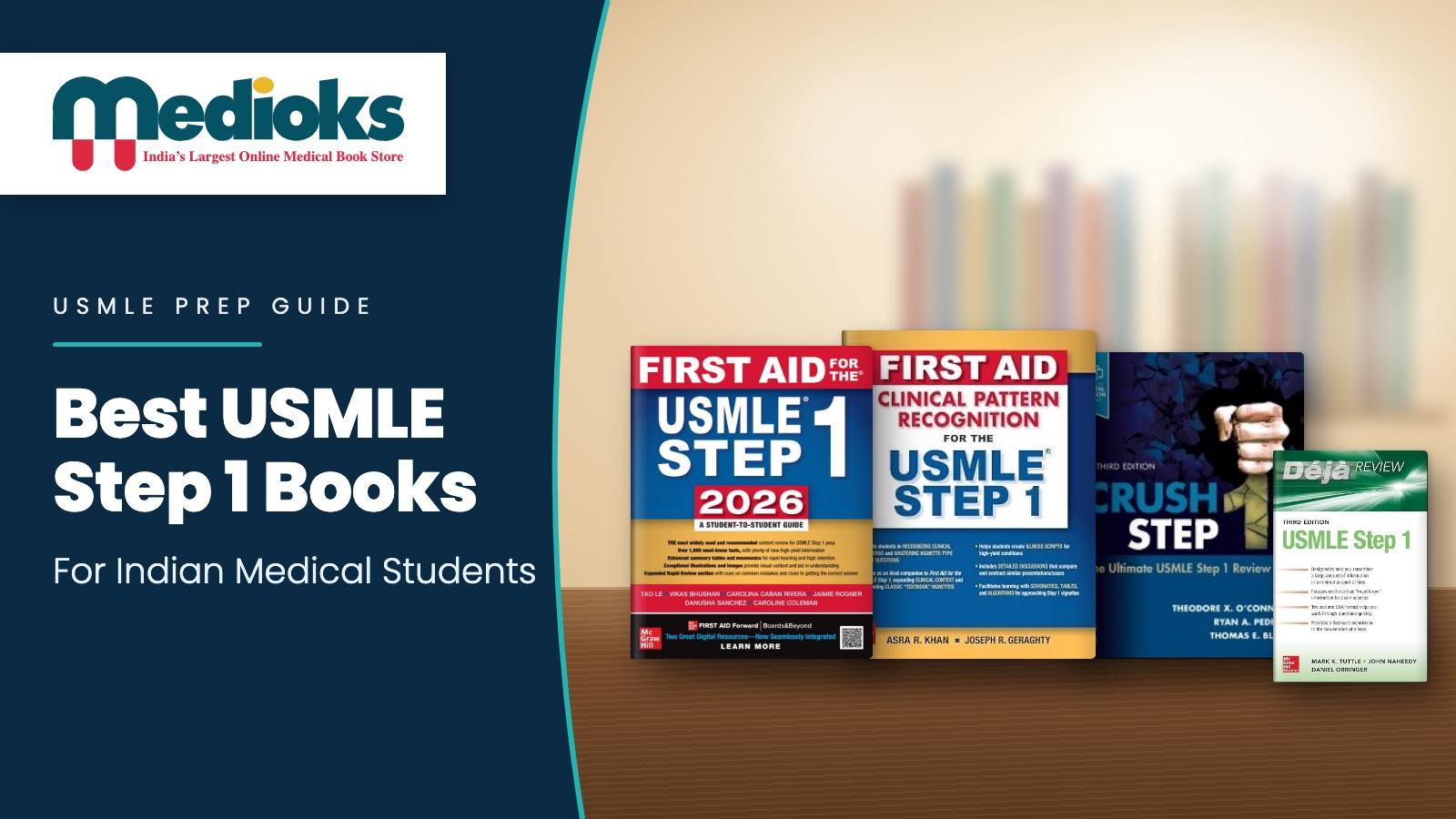
For USMLE Step 1, First Aid for the USMLE Step 1 is the book almost every candidate uses as their central review text. Medioks stocks the 2026 edition. Most students pair it with an online question bank and one or two shorter books for weak areas. Indian MBBS students already know much of the content, so the challenge is reorganising it around the USMLE’s integrated, mechanism-based style.
This guide covers what changed with Step 1’s pass/fail scoring, which books to buy, and how Indian students can fit Step 1 preparation around MBBS.
Quick answer
- Core review book: First Aid for the USMLE Step 1 (2026 edition).
- Clinical vignettes: First Aid Clinical Pattern Recognition for the USMLE Step 1.
- Rapid review: Crush Step 1, or Deja Review USMLE Step 1.
- Systems-based review: Step-Up to USMLE Step 1.
- Remember: Step 1 has been reported as pass/fail since 26 January 2022.
USMLE Step 1 basics for Indian students
- What it tests: the basic sciences behind medicine, including anatomy, physiology, biochemistry, pathology, pharmacology, microbiology and behavioural science, through clinical vignettes.
- Scoring: since 26 January 2022, Step 1 results have been reported only as pass or fail, with no three-digit score.
- Registration: international medical students and graduates apply through ECFMG (part of Intealth).
- What changed with pass/fail: Step 2 CK scores now carry more weight in residency applications, so many students now plan Step 1 and Step 2 CK together.
Always check current requirements on the official USMLE and ECFMG websites.
Step 1 books compared
| Book | Author / editor | Type | Best for |
|---|---|---|---|
| First Aid for the USMLE Step 1 (2026) | Tao Le and others | Core review book | The central text for annotating and revising |
| First Aid Clinical Pattern Recognition for the USMLE Step 1 | Asra R. Khan and others | Vignette practice | Recognising classic presentations |
| Crush Step 1 | Theodore X. O’Connell, Ryan A. Pedigo, Thomas E. Blair | Rapid review | A fast, systems-based pass |
| Deja Review USMLE Step 1 | Mark Tuttle | Question-and-answer review | Quick self-testing |
| Step-Up to USMLE Step 1 | McInnis | Systems review | An integrated, organ-system approach |
| USMLE Step 1 Secrets in Color | Theodore O’Connell | Q&A review | Concept checks in a question format |
First Aid for the USMLE Step 1
First Aid for the USMLE Step 1 is updated every year and condenses the high-yield Step 1 content into one book. Most candidates use it as a framework: they read it repeatedly and annotate it with notes from their question bank.
- Strengths: high-yield, organised by discipline and system, and widely used, so its content aligns with how candidates prepare.
- Limitations: it’s dense and assumes prior learning. It works best alongside question practice, not as a first-time textbook.
- Tip: buy the latest edition. Older editions miss recent updates.
Supplementary books
Add one or two of these depending on your needs:
- First Aid Clinical Pattern Recognition for the USMLE Step 1 trains you to spot classic vignette patterns.
- Crush Step 1 is a fast, systems-based review.
- Deja Review USMLE Step 1 is a question-and-answer book for quick recall practice.
- Step-Up to USMLE Step 1 reviews content by organ system.
- USMLE Step 1 Secrets in Color tests concepts in Q&A form.
- USMLE Step 1 Platinum Notes (Ashfaq Ul Hassan) is another condensed guide.
Most candidates also use an online question bank. Books and question practice work best together.
How Indian students should plan
- Use your MBBS foundation. Indian pre-clinical and para-clinical subjects cover most Step 1 content. What changes is the integrated, mechanism-focused question style.
- Start with First Aid plus questions, rather than rereading Indian textbooks cover to cover.
- Focus on areas Indian curricula cover differently, such as US-style biostatistics, ethics and behavioural science, and some pharmacology naming.
- Plan the calendar around MBBS exams and ECFMG requirements, including eligibility windows and scheduling.
- Think about Step 2 CK early. With Step 1 pass/fail, Step 2 CK scores matter more for residency applications.
If you’re also preparing for Indian PG entrance, see our NEET PG book guide.
The USMLE pathway for Indian graduates
For Indian students who want to train in the United States, Step 1 is usually the first exam. The broad pathway looks like this, though details change, so always check the official USMLE and ECFMG websites:
- Step 1: basic sciences applied to clinical scenarios, now reported as pass or fail.
- Step 2 CK (Clinical Knowledge): clinical medicine. Its score matters a lot for residency applications.
- ECFMG certification: the certification international medical graduates need before entering US graduate medical education. Its requirements include exams and verification of your medical credentials.
- Residency application and the Match: applying for residency programmes and interviewing.
- Step 3: usually taken during or after the first year of residency.
Many Indian students also gain US clinical experience and letters of recommendation, which residency programmes often value. Planning early helps you fit everything around MBBS and internship.
How USMLE questions differ from Indian exams
| Feature | Typical Indian exams | USMLE Step 1 |
|---|---|---|
| Question style | Often short, fact-based MCQs | Long clinical vignettes testing mechanisms |
| What’s tested | Recall of facts and lists | Applying basic science to a patient scenario, often in two or three steps |
| Subjects | Separate subjects | Integrated by organ system |
| Extra areas | Indian programmes and guidelines | Biostatistics, ethics, communication and US health-system concepts |
Indian students often know the facts. The adjustment is learning to reason through a vignette: identify the diagnosis, work out the mechanism, and answer the specific question asked.
How to use First Aid effectively
- Use it as your base. Read the relevant First Aid section before you do questions on a topic.
- Annotate it. When a question teaches you something new, add a short note in the margin of the matching First Aid page.
- Revise it repeatedly. Many candidates read First Aid several times during preparation, getting faster each time.
- Don’t use it alone. First Aid is condensed. When a topic doesn’t make sense, look it up in a fuller resource, then return to First Aid.
Building a Step 1 schedule around MBBS
- Foundation phase: during pre-clinical and para-clinical years, study your Indian subjects well, with an eye on mechanisms and integration.
- Dedicated phase: a focused period of several weeks or months for First Aid, questions and self-assessments.
- Assessment phase: official and third-party practice tests to check readiness before booking or sitting the exam.
The right timing depends on your college schedule, internship plans and finances. Talk to seniors who have taken the exam recently.
Areas Indian students often need to strengthen
- Biostatistics and epidemiology: study designs, sensitivity and specificity, and interpreting results.
- Ethics and communication: consent, confidentiality and difficult conversations, framed in the US context.
- Behavioural science and psychiatry.
- Immunology and genetics: often tested in depth.
- Pharmacology: mechanisms and side effects, including drug names used in the US.
Practical planning
USMLE involves registration fees, testing costs, travel to a test centre and preparation resources, and the process takes time. Check current fees, eligibility periods and test centre availability on the official websites, and plan a realistic budget before you start.
Staying consistent
Step 1 preparation is long. What helps most is consistency: a fixed daily routine, regular question practice, honest review of mistakes and enough rest. Many successful candidates say a steady, sustainable pace mattered more than any single book.
Using practice tests
Self-assessment tests help you judge when you’re ready. Take one near the start of your dedicated period to set a baseline, then more as you get closer to the exam. Use the results to adjust your schedule: put extra time into weak systems and disciplines, and review every question you miss. Many candidates decide on their exam date based on consistent practice test results rather than a fixed calendar.
Discipline-by-discipline priorities
| Discipline | What to focus on |
|---|---|
| Pathology | Mechanisms of disease. It links almost every other subject and appears throughout Step 1 |
| Pharmacology | Mechanisms, adverse effects and interactions, using US drug names |
| Physiology | Cardiovascular, renal and respiratory physiology, often tested with graphs and calculations |
| Microbiology and immunology | Organism features, virulence factors, and immune mechanisms and deficiencies |
| Biochemistry and genetics | Metabolic pathways linked to clinical disorders, and inheritance patterns |
| Behavioural science | Ethics, communication, biostatistics and epidemiology |
Organ-system study, such as cardiovascular or renal, helps you link these disciplines the way Step 1 questions do.
Why question banks matter so much
Most successful Step 1 candidates complete a large number of practice questions. Questions teach the exam’s style, expose gaps you didn’t know you had, and train you to reason through long vignettes under time pressure. Review every explanation carefully, including for questions you got right, because the explanations often contain the most useful teaching. Then add the key point to your First Aid. Books and questions together form the core of preparation, with practice tests used to check progress.
Indian students who have prepared for NEET PG will find some habits familiar, such as timed blocks and reviewing mistakes. The difference is that USMLE explanations focus on mechanisms, so take time to understand why each wrong option is wrong.
Finally, keep your MBBS studies on track while you prepare. Strong performance in your own university exams and internship still matters for your career in India and for residency applications abroad.
Frequently asked questions
Which is the best book for USMLE Step 1?
First Aid for the USMLE Step 1 is the standard core review book. Use the latest edition, alongside a question bank.
Is Step 1 still scored?
No. Since 26 January 2022, Step 1 results have been reported only as pass or fail.
Can Indian MBBS students take Step 1 during MBBS?
International medical students can apply through ECFMG if they meet its eligibility requirements. Check the current rules on the ECFMG website.
Do I need Indian textbooks for Step 1?
Not as your main resource. Use them for topics you never learned well, but build your preparation around First Aid and questions.
When is the best time for Indian students to take Step 1?
Many take it after completing their pre-clinical and para-clinical subjects, often during the clinical years or internship, when basic sciences are still fresh. The best time depends on your college schedule and plans.
Do I need US clinical experience?
Many residency programmes value US clinical experience and US letters of recommendation, but it isn’t part of Step 1 itself. Research the programmes you’re interested in.
Is First Aid enough to pass Step 1?
Most candidates use First Aid together with a question bank and self-assessment tests. First Aid alone is rarely enough.
Do I need a review book for each subject?
Not necessarily. Many candidates use First Aid plus one or two subject resources for their weakest areas, such as pathology or pharmacology.
Is Step 2 CK more important than Step 1 now?
Since Step 1 became pass/fail, many residency programmes look more closely at Step 2 CK scores. Passing Step 1 is still essential.
Where can I find official USMLE information?
The official USMLE website and the ECFMG website publish current rules, fees, eligibility and exam content outlines. Always check them before registering.
Can I take Step 1 from India?
USMLE exams are delivered at authorised test centres, and centres have been available in India. Check current test centre availability and scheduling rules when you register, as they can change.
The bottom line
Build Step 1 preparation around the latest First Aid, add one or two supplementary books for your weak areas, and practise questions throughout. Indian students have a strong content base. The key is adapting to the USMLE’s integrated question style and planning ahead for Step 2 CK.
Exam rules can change. Always confirm eligibility and requirements on the official USMLE and ECFMG websites. Book recommendations are general guidance. Facts checked on 26 November 2026.