

Best Emergency Medicine Books for Interns and Residents

admin
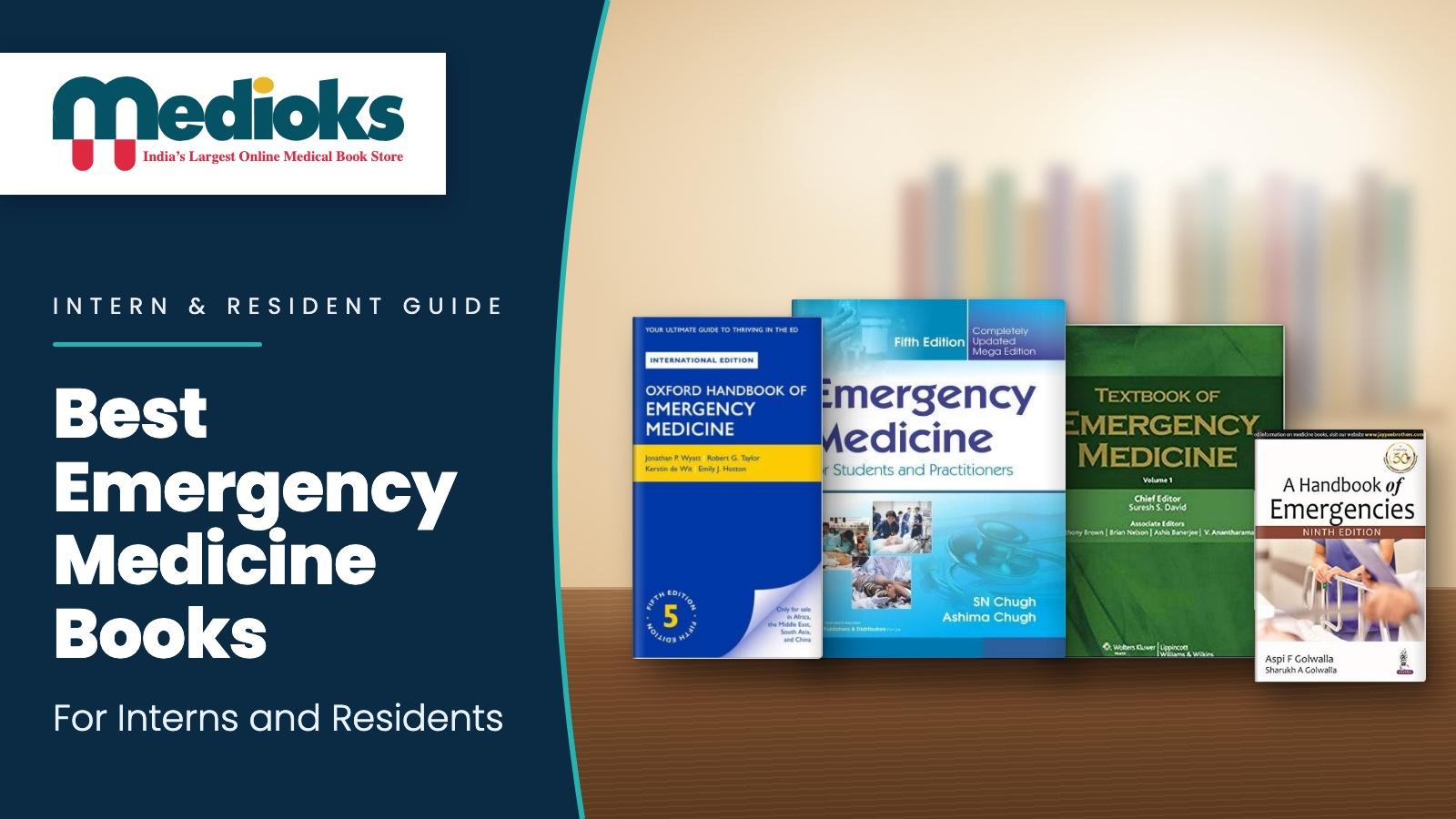
For interns and junior residents, the Oxford Handbook of Emergency Medicine is the most practical book to keep in the emergency department, and S.N. Chugh’s Emergency Medicine for Students and Practitioners or Aspi Golwalla’s A Handbook of Emergencies are popular Indian options. For a full reference, Suresh S. David’s Textbook of Emergency Medicine covers the speciality in depth, and books on ABGs and ACLS fill important practical gaps.
The emergency department is where many interns first make decisions on their own, often at night. A good book won’t replace senior support or hospital protocols, but it helps you recognise sick patients, organise your thinking and prepare for common emergencies. This guide compares the main emergency medicine books on Medioks and explains how to use them.
Quick answer
- Pocket handbook: Oxford Handbook of Emergency Medicine (Jonathan Wyatt and others).
- Indian books: Emergency Medicine for Students and Practitioners (S.N. Chugh, Ashima Chugh) and A Handbook of Emergencies (Aspi Golwalla).
- Comprehensive reference: Textbook of Emergency Medicine, two volumes (Suresh S. David).
- Quick concepts: Lecture Notes: Emergency Medicine.
- Essential skills: Arterial Blood Gases Made Easy and an ACLS study guide.
Emergency medicine books compared
| Book | Author / editor | Type | Best for |
|---|---|---|---|
| Oxford Handbook of Emergency Medicine | Jonathan Wyatt and others | Pocket handbook | Quick, structured guidance on shift |
| Emergency Medicine for Students and Practitioners | S.N. Chugh, Ashima Chugh | Indian textbook | Common emergencies in the Indian setting |
| A Handbook of Emergencies | Aspi Golwalla | Indian handbook | A compact, practical guide |
| Textbook of Emergency Medicine (2 volumes) | Suresh S. David | Reference | In-depth reading for residents |
| Lecture Notes: Emergency Medicine | Moulton and others | Concise text | Core concepts quickly |
| Emergency Medicine Clinical Essentials | James G. Adams | Reference | Comprehensive international reference |
| Arterial Blood Gases Made Easy | Iain A.M. Hennessey | Skills book | Interpreting blood gases |
| ACLS Study Guide | Barbara Aehlert | Skills book | Resuscitation algorithms and rhythms |
Oxford Handbook of Emergency Medicine
The Oxford Handbook of Emergency Medicine fits in a pocket and covers presentations from chest pain and breathlessness to trauma, poisoning and paediatric emergencies in a consistent, structured format. It’s especially useful for quick reminders before you see a patient. It’s written from a UK perspective, so always check drug choices and protocols against your own hospital’s guidelines.
Indian emergency medicine books
- Emergency Medicine for Students and Practitioners by S.N. Chugh and Ashima Chugh covers common emergencies with an Indian clinical focus, including conditions such as snakebite and poisoning that are frequent in India.
- A Handbook of Emergencies by Aspi Golwalla is a compact, practical guide that has been popular with Indian doctors for many years.
- Textbook of Emergency Medicine by Suresh S. David is a comprehensive two-volume reference, suitable for emergency medicine residents and those who want depth.
International references
- Lecture Notes: Emergency Medicine explains core concepts concisely.
- Emergency Medicine: Clinical Essentials by James G. Adams is a large international reference.
- Manual of Emergency Medicine by G. Richard Braen is a practical manual.
Skills books: ABGs and resuscitation
- Arterial Blood Gases Made Easy by Iain A.M. Hennessey teaches a step-by-step approach to blood gas interpretation, a daily skill in emergency care.
- ACLS Study Guide by Barbara Aehlert covers advanced cardiac life support algorithms, rhythms and drugs. Always follow the current guidelines taught in your certified course.
Paediatric and obstetric emergencies
- Handbook of Paediatric Emergency Medicine (Brennan, Berry, Powell and Pusic) covers emergencies in children, where doses and normal values differ from adults.
- Handbook of Obstetric and Gynecologic Emergencies (Guy Benrubi) covers emergencies in pregnancy and gynaecology.
For related reading, see our guides to ICU and critical care books, ECG books and books to own before internship.
The ABCDE approach
Every emergency book teaches a structured first assessment, and it’s the most important habit you can build. The ABCDE approach:
| Step | What to check | Examples of immediate actions |
|---|---|---|
| A: Airway | Is the airway open and protected? | Airway manoeuvres and adjuncts, call for help early |
| B: Breathing | Rate, effort, oxygen saturation, chest findings | Oxygen as appropriate, treat the cause |
| C: Circulation | Pulse, blood pressure, capillary refill, bleeding | IV access, fluids or blood as indicated, control bleeding |
| D: Disability | Level of consciousness, pupils, blood glucose | Treat hypoglycaemia, protect the airway if consciousness is reduced |
| E: Exposure | Full examination, temperature, rashes, injuries | Keep the patient warm and maintain dignity |
Reassess after every intervention, and escalate early if the patient isn’t improving.
Common emergencies to prepare for
- Cardiac: acute coronary syndromes, arrhythmias, acute heart failure.
- Respiratory: acute asthma, exacerbations of COPD, pneumonia, pulmonary embolism.
- Neurological: stroke, seizures, reduced consciousness.
- Metabolic: diabetic ketoacidosis, hypoglycaemia, electrolyte emergencies.
- Toxicology and envenomation: common poisonings, including pesticides in many parts of India, and snakebite.
- Infections: sepsis, and tropical infections such as dengue and malaria.
- Trauma: primary survey, head injury, chest and abdominal trauma, fractures.
- Others: anaphylaxis, acute abdomen, obstetric emergencies.
A general approach to poisoning
Poisoning is a frequent reason for emergency visits in India. Whatever the substance, emergency books teach a similar general approach:
- Stabilise the patient with the ABCDE approach first.
- Take a careful history: what was taken, how much, when and by what route, ideally confirmed by relatives or containers.
- Look for a toxidrome, a recognisable pattern of signs that points to a group of poisons.
- Decide on decontamination, specific antidotes and supportive care according to your hospital’s protocols and a poisons information resource.
- Monitor closely, because some poisonings worsen hours later.
- Remember the medicolegal and mental health aspects, including assessment of self-harm risk.
For snakebite, follow the national and hospital protocols on first aid, assessment and the use of anti-snake venom. Indian books such as Chugh’s cover these conditions in the local context.
Triage: seeing the right patient first
Emergency departments use triage systems to decide who needs to be seen first. Learn the system your hospital uses, the warning signs that move a patient to the highest priority, and why patients must be reassessed while they wait. Recognising a sick patient quickly, from the end of the bed, is one of the most valuable skills you’ll develop in the emergency department.
Sepsis: early recognition saves lives
Sepsis is common and can deteriorate quickly. Learn the warning signs, such as fever or low temperature, fast breathing, fast heart rate, low blood pressure and confusion, and your hospital’s sepsis pathway, which usually includes early cultures, early appropriate antibiotics, fluids and close monitoring. Emergency books explain the principles, but local protocols set the details.
Your first emergency shifts: practical tips
- Learn the department: where the resuscitation trolley, defibrillator, airway equipment and emergency drugs are kept.
- Know the protocols: chest pain, stroke, sepsis, trauma and poisoning pathways in your hospital.
- Triage matters: understand how patients are prioritised, and always see the sickest patient first.
- Escalate early: calling a senior is a sign of good judgement, not weakness.
- Document clearly: times, findings, treatments and the response to treatment.
- Communicate with families honestly and kindly, especially in serious situations.
Medicolegal cases in the emergency department
In India, emergency doctors often handle medicolegal cases such as road traffic accidents, assaults, poisonings and burns. Learn your hospital’s procedures for registering medicolegal cases, informing the police where required, documenting injuries accurately and preserving evidence. Your forensic medicine knowledge becomes very practical here. When in doubt, ask a senior or the medical officer in charge.
Resuscitation skills
Basic and advanced life support skills save lives, and you’re expected to be competent in them from your first day as an intern. Take a certified BLS or ACLS course if your institution offers one, practise on mannequins regularly, and learn the roles within a resuscitation team. Guidelines are updated periodically, so always follow the version currently taught and used in your hospital.
How to use emergency books well
- Before a shift, read about two or three common presentations.
- After a shift, read about the patients you saw, especially any you found difficult.
- Keep a pocket handbook for quick checks, and use a fuller textbook for learning.
- Annotate your handbook with local protocols and important phone numbers.
- Never rely on a book over your hospital’s protocols and senior advice.
Handover and documentation
Emergency departments run around the clock, so patients are often handed over between doctors. Use a structured format: the patient’s identity and working diagnosis, key findings, treatment given and its response, pending results, and the plan with clear actions. Write notes as you go, including times, because events move quickly. Accurate records protect patients and doctors, and they matter especially in medicolegal cases. If a patient is admitted or referred, make sure the receiving team knows what’s been done and what’s outstanding, and tell the patient and family what happens next. Before you leave a shift, check that every patient you saw has a clear plan and an assigned doctor.
Emergency medicine as a career
Emergency medicine is a growing speciality in India, with MD and DNB training programmes in emergency medicine. It suits doctors who enjoy variety, quick decision-making and hands-on procedures. If you’re interested, spend extra time in the emergency department during internship, build strong resuscitation skills and talk to emergency physicians about the training pathway.
Frequently asked questions
Which is the best emergency medicine book for interns?
The Oxford Handbook of Emergency Medicine is the most practical pocket book. S.N. Chugh’s and Aspi Golwalla’s books are popular Indian alternatives.
Do interns need a big emergency medicine textbook?
Not usually. A pocket handbook plus your medicine textbook is enough for most interns. Residents in emergency medicine benefit from a comprehensive reference such as Suresh S. David’s textbook.
Is the Oxford Handbook suitable for India?
Its structured approach works anywhere, but drug choices and protocols may differ. Always follow your hospital’s guidelines, and use an Indian book for conditions common in India.
Should I learn ABG interpretation separately?
Yes. ABGs are a daily emergency skill. A short book such as Arterial Blood Gases Made Easy helps you learn a reliable method quickly.
Is ACLS certification necessary?
Requirements vary by institution, but resuscitation training is strongly recommended for every doctor working in emergency care.
How do I handle a medicolegal case as an intern?
Follow your hospital’s medicolegal procedures, document carefully and involve a senior or the medical officer in charge.
Which emergencies are most common in Indian hospitals?
Chest pain, breathlessness, fever and sepsis, trauma, poisoning, snakebite, stroke and diabetic emergencies are common in many hospitals. The pattern varies by region and season.
Do I need a separate paediatric emergency book?
If you’ll see children regularly, yes. Paediatric doses, normal values and emergencies differ from adults.
Can emergency medicine books help with NEET PG?
They help with clinical reasoning and topics such as resuscitation, toxicology and trauma, but use dedicated review books and question banks for exam preparation.
How do I stay calm in a resuscitation?
Preparation helps most: know the algorithms, practise on mannequins, know where everything is, and understand your role in the team. Following a structured approach also keeps you focused under pressure.
Which book should I read before my first emergency posting?
Read the ABCDE approach, resuscitation basics and the common presentations in a pocket handbook, and learn a method for ABGs. Then read about the patients you actually see.
The bottom line
Keep the Oxford Handbook of Emergency Medicine or an Indian handbook such as Chugh’s or Golwalla’s with you on shift, learn ABGs and resuscitation properly, and use the ABCDE approach with every sick patient. Above all, know your hospital’s protocols and call for senior help early.
This article is educational guidance about books, not clinical advice. Always follow your hospital’s protocols, current resuscitation guidelines and senior advice. Editions and availability change, so check the product page for the latest edition. Facts checked on 26 November 2026.