

Best Orthodontics Books for BDS: Proffit vs Gurkeerat Singh vs Bhalajhi

admin
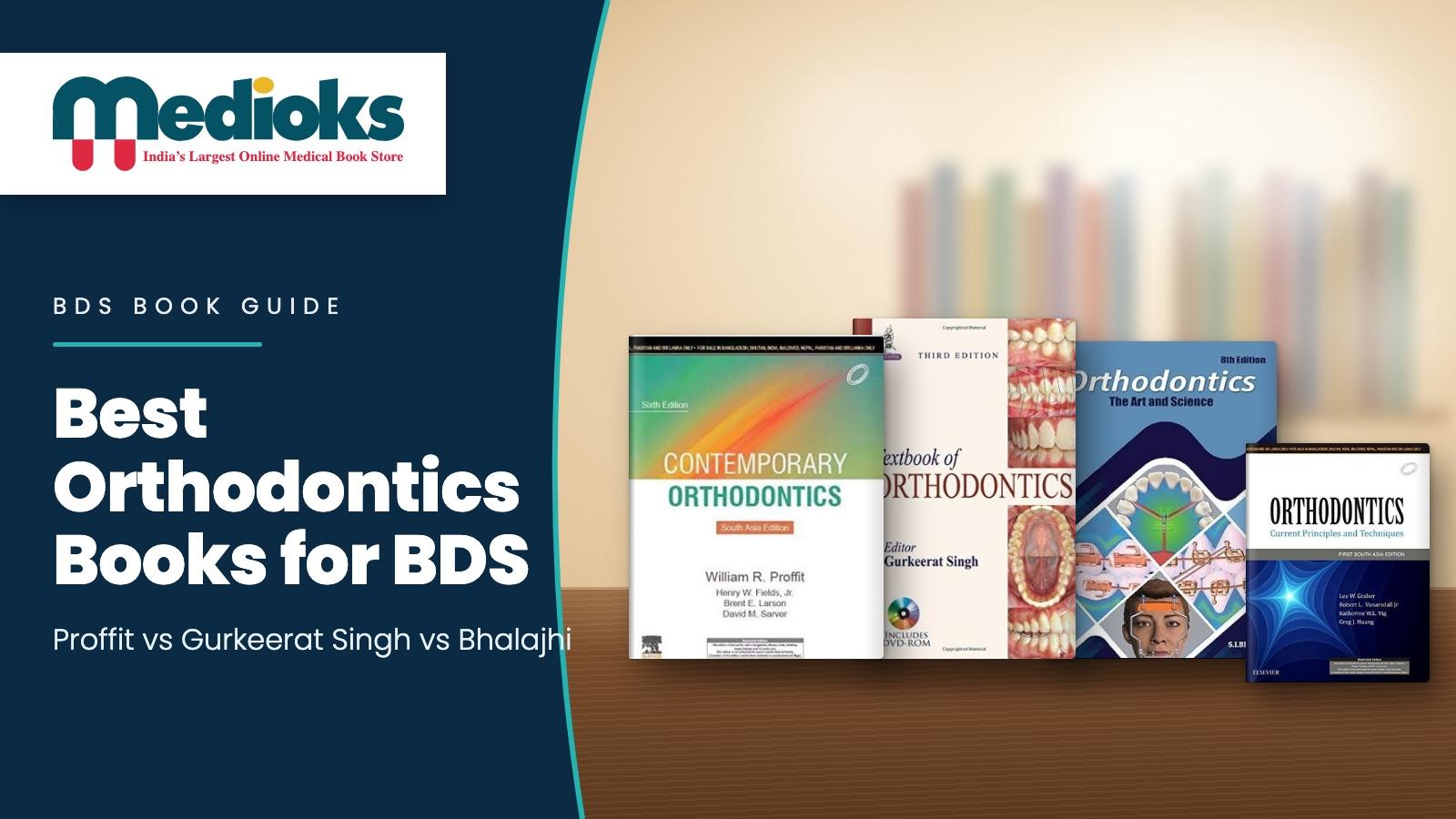
For BDS orthodontics, most Indian students use one Indian textbook, either Gurkeerat Singh’s Textbook of Orthodontics or S.I. Bhalajhi’s Orthodontics: The Art and Science, as their main book. Proffit’s Contemporary Orthodontics is the best-known international text and the usual next step for students who want more depth or plan an MDS.
Orthodontics deals with the growth of the face and jaws, the development of occlusion, malocclusion and its correction with removable, functional and fixed appliances. It’s usually examined in the later BDS years, with preclinical wire-bending exercises earlier on. This guide compares the main books and shows how to study the subject efficiently.
Quick answer
- Main Indian textbooks: Textbook of Orthodontics (Gurkeerat Singh) or Orthodontics: The Art and Science (S.I. Bhalajhi). Choose one.
- International standard: Contemporary Orthodontics (William Proffit and colleagues).
- Postgraduate reference: Orthodontics: Current Principles and Techniques (Graber, Vanarsdall, Vig, Huang).
- Shorter options: Essentials of Orthodontics (Sridhar Premkumar).
- Revision: Mosby’s Orthodontic Review.
Orthodontics books compared
| Book | Author | Level | Best for |
|---|---|---|---|
| Textbook of Orthodontics | Gurkeerat Singh | BDS | Comprehensive Indian coverage with clear diagrams |
| Orthodontics: The Art and Science | S.I. Bhalajhi | BDS | An exam-friendly Indian text popular for university answers |
| Contemporary Orthodontics | William R. Proffit and others | BDS to MDS | Concepts, growth and treatment planning in depth |
| Orthodontics: Current Principles and Techniques | Graber, Vanarsdall, Vig, Huang | MDS | A postgraduate reference |
| Textbook of Orthodontics | Sridhar Premkumar | BDS | Another Indian textbook |
| Essentials of Orthodontics | Sridhar Premkumar | BDS | A shorter book for revision |
| Mosby’s Orthodontic Review | English and others | Revision | Question-style review |
Indian textbooks
Gurkeerat Singh’s Textbook of Orthodontics
Textbook of Orthodontics by Gurkeerat Singh is one of the most widely used orthodontics books in Indian dental colleges. It covers growth and development, etiology and classification of malocclusion, diagnosis, cephalometrics, appliances and treatment of specific malocclusions.
- Strengths: thorough, well illustrated, and suitable for both BDS and early MDS reading.
- Limitations: it’s detailed, so some students find it long for last-minute revision.
Bhalajhi’s Orthodontics: The Art and Science
Orthodontics: The Art and Science by S.I. Bhalajhi is popular because it’s concise and written in a style that suits university exam answers.
- Strengths: easy to read, point-wise, and good for quick revision.
- Limitations: less depth than Gurkeerat Singh or Proffit, so add a larger book for topics you find difficult.
Sridhar Premkumar’s Textbook of Orthodontics and the shorter Essentials of Orthodontics are further Indian options.
Proffit’s Contemporary Orthodontics
Contemporary Orthodontics by William R. Proffit and colleagues is the most widely read orthodontics textbook in the world. Its chapters on growth, the etiology of malocclusion and diagnosis are especially clear.
Use it alongside an Indian textbook when you want to understand a concept properly, or as your main book if you plan an MDS in orthodontics.
Postgraduate and revision books
- Orthodontics: Current Principles and Techniques (Graber, Vanarsdall, Vig and Huang) is a major postgraduate reference. Undergraduates can use it from the library.
- Mosby’s Orthodontic Review uses a question format that suits revision and entrance exam preparation.
- 1001 Tips for Orthodontics and its Secrets is a clinical tips book better suited to postgraduates.
For your other dental subjects, see our complete BDS book list.
What BDS orthodontics covers
| Area | Typical topics |
|---|---|
| Growth and development | Prenatal and postnatal growth, theories of growth, growth of the cranial base, maxilla and mandible |
| Development of occlusion | Development of the dentition, normal occlusion, the six keys of occlusion |
| Malocclusion | Classification (Angle’s and others), etiology, habits |
| Diagnosis | Case history, examination, study models, radiographs, cephalometrics |
| Biomechanics | Tooth movement, tissue response, anchorage |
| Appliances | Removable, functional, fixed and myofunctional appliances, retainers |
| Treatment | Preventive and interceptive orthodontics, management of Class I, II and III malocclusions, retention and relapse |
Angle’s classification and beyond
Angle’s classification is the starting point of most orthodontic diagnosis and a guaranteed exam topic. It’s based on the relationship of the mesiobuccal cusp of the upper first molar to the buccal groove of the lower first molar:
- Class I: normal molar relationship, with crowding, spacing or other problems.
- Class II: the lower molar is distal to the normal relationship. Division 1 usually has proclined upper incisors, and division 2 has retroclined upper central incisors.
- Class III: the lower molar is mesial to the normal relationship.
Know the limitations of Angle’s system as well, because examiners often ask about them, and learn the other classification systems your textbook describes.
Cephalometrics without fear
Many students find cephalometrics difficult at first. A practical approach:
- Learn the common landmarks first, such as sella, nasion, A point, B point, pogonion and menton.
- Learn the main planes, such as the SN plane, Frankfort horizontal and mandibular plane.
- Learn what a few key angles show, for example SNA, SNB and ANB for the jaw relationship.
- Trace real cephalograms in your posting. Tracing makes the landmarks stick.
Your textbook will list normal values used in your department. Learn those rather than memorising every analysis.
Appliances you need to know
- Removable appliances: components such as clasps (including the Adams clasp), springs, bows and the baseplate, and their uses.
- Functional appliances: how they work, their indications in growing patients, and common examples described in your textbook.
- Fixed appliances: brackets, bands, archwires and the basics of how they move teeth.
- Retainers: why retention is needed and the types used.
Biomechanics and anchorage made simple
Biomechanics explains how and why teeth move. When a force is applied to a tooth, the periodontal ligament and bone respond: bone is resorbed on the pressure side and deposited on the tension side. Light, continuous forces generally move teeth more efficiently and with less damage than heavy forces. Your textbook explains the types of tooth movement, such as tipping, bodily movement, intrusion, extrusion and rotation, and the forces each needs.
Anchorage is the resistance to unwanted tooth movement. Every force that moves one tooth has an equal and opposite reaction on other teeth, so treatment plans must control where that reaction goes. Learn the classification of anchorage and the ways it can be reinforced. It’s one of the most frequently asked topics in written exams and vivas.
Orthodontic records and diagnosis
Good diagnosis depends on good records. A standard set usually includes:
- a detailed case history, including medical history, habits and the patient’s main concern,
- a clinical examination of the face, profile, soft tissues, teeth and occlusion,
- study models, which let you measure crowding, spacing and arch form,
- radiographs, such as an orthopantomogram and a lateral cephalogram, and
- extraoral and intraoral photographs.
From these records, you form a problem list and then a treatment plan. Practise writing problem lists for the cases you see in your posting. Examiners value students who can reason from findings to a plan.
Retention and relapse
Teeth tend to move back towards their original positions after treatment. This is why every orthodontic plan includes a retention phase. Learn the reasons for relapse, such as periodontal and gingival fibres, growth and soft tissue pressures, and the types of retainers, both removable and fixed. This topic appears often as a short note.
Preclinical wire-bending exercises
Preclinical orthodontics usually includes wire bending, such as clasps and springs, and fabricating simple removable appliances. These exercises build hand skills and help you understand appliance design. Practise regularly, keep your record book neat with labelled diagrams, and ask your teachers to check your work at each stage.
How to study orthodontics efficiently
- Start with growth and development. It explains why treatment timing matters.
- Draw diagrams of molar relationships, appliance components and cephalometric landmarks. Diagrams earn marks.
- Link each malocclusion to its treatment in a table: features, etiology, diagnosis and treatment options.
- Use clinical cases. Study models and photographs in your posting make concepts concrete.
- Revise with a short book before exams.
Common viva questions
- Define malocclusion and describe Angle’s classification.
- What are the six keys of normal occlusion?
- What is anchorage and how is it classified?
- Describe the components of a removable appliance.
- Name the common habits that cause malocclusion and how they’re managed.
- What is the difference between preventive and interceptive orthodontics?
- Why do teeth relapse after treatment, and how is retention planned?
Oral habits and interceptive orthodontics
Thumb sucking, tongue thrusting, mouth breathing and lip habits can contribute to malocclusion in growing children. Learn how to identify each habit, its effects on the teeth and jaws, and the management options, from counselling to habit-breaking appliances. Interceptive orthodontics, such as space maintenance and correcting crossbites early, links closely with paediatric dentistry, so it’s worth studying the two subjects together.
Making the most of your orthodontics posting
Your clinical posting is where orthodontics starts to make sense. Watch how your teachers take records and explain treatment to patients and parents. Ask to trace cephalograms and analyse study models for the patients you see, and follow at least a few patients over several visits so you can see how appliances are adjusted. Keep a short log of each case, with the diagnosis, the appliance used and the reason for the choice. These notes become excellent revision material before your practical exam.
Gurkeerat Singh, Bhalajhi or Proffit?
| If you… | Choose |
|---|---|
| want one complete Indian textbook | Gurkeerat Singh |
| prefer concise, exam-style answers | Bhalajhi |
| want to understand concepts deeply or plan an MDS | Proffit, alongside an Indian book |
| need fast revision | Essentials of Orthodontics or a review book |
Considering MDS in orthodontics
Orthodontics is one of the most sought-after MDS specialities. If you’re interested, read Proffit seriously during BDS, spend extra time in the orthodontics department, practise cephalometric tracing, and start NEET MDS question practice early. Strong basics in growth, development and biomechanics make postgraduate study much easier.
Frequently asked questions
Which is the best orthodontics book for BDS?
Gurkeerat Singh’s Textbook of Orthodontics and S.I. Bhalajhi’s Orthodontics: The Art and Science are the most common Indian choices. Proffit’s Contemporary Orthodontics is the leading international text.
Is Bhalajhi enough for BDS exams?
Many students pass with Bhalajhi as their main book, especially with good diagrams and previous papers. Use Gurkeerat Singh or Proffit for topics that need more explanation.
Should BDS students buy Proffit?
It’s optional at BDS level, but very useful for understanding growth and diagnosis. It’s strongly recommended if you plan an MDS in orthodontics.
Is Graber needed for BDS?
No. Graber’s book is a postgraduate reference. Use it from the library if you want more depth on a topic.
How do I learn cephalometrics?
Learn a few landmarks, planes and angles first, then trace real cephalograms during your posting. Practice matters more than memorising many analyses.
Which year is orthodontics examined in BDS?
It’s usually examined in the later BDS years, with preclinical work earlier. Check your university’s scheme.
Are wire-bending exercises important?
Yes. They count in practical assessment and build the skills you need for appliance work. Practise regularly.
What is the most important topic in orthodontics?
Growth and development, malocclusion classification and diagnosis are the foundations. Most other topics build on them.
Is orthodontics important for NEET MDS?
Yes, orthodontics is part of the NEET MDS syllabus. Proffit-level understanding plus regular question practice helps.
Can I use one book for both orthodontics and pedodontics?
No, they’re separate subjects with separate textbooks, though topics such as habits and interceptive orthodontics overlap. Read both textbooks for those shared topics.
How should I revise orthodontics before the exam?
Revise growth and development, classification, diagnosis and appliances from your notes and diagrams, then practise previous papers. A short book such as Essentials of Orthodontics helps for the final pass.
The bottom line
Choose one Indian orthodontics textbook, Gurkeerat Singh for completeness or Bhalajhi for concise answers, and use Proffit when you want deeper understanding. Draw diagrams, trace cephalograms and link every malocclusion to its treatment, and you’ll be well prepared for both exams and clinics.
Book recommendations are general guidance. Always follow your university’s syllabus and your faculty’s advice. Editions and availability change, so check the product page for the latest edition. Facts checked on 26 November 2026.