

Best Periodontics Books for BDS: Carranza, Lindhe and Indian Textbooks

admin
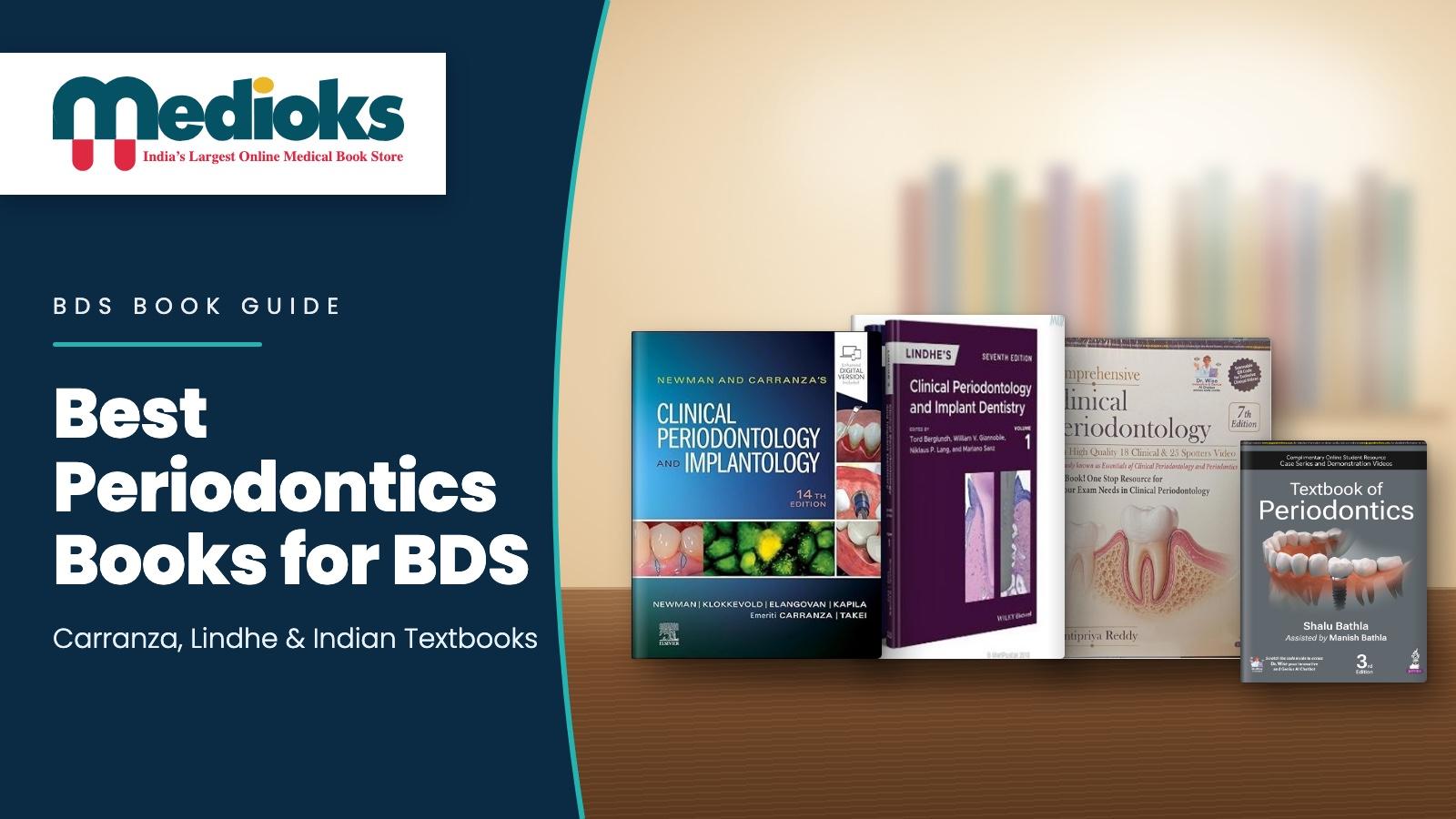
For BDS periodontics, Newman and Carranza’s Clinical Periodontology and Implantology is the standard textbook, and many Indian students pair it with a shorter Indian book such as Shantipriya Reddy’s Comprehensive Clinical Periodontology or Shalu Bathla’s Textbook of Periodontics for exam answers. Lindhe’s Clinical Periodontology and Implant Dentistry is the leading postgraduate reference.
Periodontics, or periodontology, covers the tissues that support the teeth, the diseases that affect them, and their treatment, from scaling and root planing to periodontal surgery and implants. It’s usually examined in the later BDS years, with clinical work on patients throughout your postings. This guide compares the main books and explains how to study the subject.
Quick answer
- Standard textbook: Newman and Carranza’s Clinical Periodontology and Implantology. A South Asia edition is also available.
- Shorter version: Newman and Carranza’s Essentials of Clinical Periodontology.
- Indian textbooks: Comprehensive Clinical Periodontology (Shantipriya Reddy), Textbook of Periodontics (Shalu Bathla), Fundamentals of Periodontology (Rameshwari Singhal).
- Postgraduate reference: Lindhe’s Clinical Periodontology and Implant Dentistry (two volumes).
- Revision: Periodontics Prep Manual for Undergraduates, or Quick Review in Clinical Periodontics.
Periodontics books compared
| Book | Author / editor | Level | Best for |
|---|---|---|---|
| Newman and Carranza’s Clinical Periodontology and Implantology | Michael G. Newman, Perry R. Klokkevold and others | BDS to MDS | The standard, comprehensive textbook |
| Newman and Carranza’s Clinical Periodontology and Implantology (South Asia edition) | Adapted by Dwarakanath | BDS | The same core text in a South Asia edition |
| Newman and Carranza’s Essentials of Clinical Periodontology | Newman and others | BDS | A shorter version of Carranza |
| Lindhe’s Clinical Periodontology and Implant Dentistry | Tord Berglundh, William Giannobile and others | MDS | In-depth reference, two volumes |
| Comprehensive Clinical Periodontology | Shantipriya Reddy | BDS | An exam-friendly Indian textbook |
| Textbook of Periodontics | Shalu Bathla | BDS | Another popular Indian textbook |
| Fundamentals of Periodontology | Rameshwari Singhal | BDS | A concise Indian option |
| Periodontics Prep Manual for Undergraduates | Vivek Bains, Vivek Gupta, Jyoti Bansal | Revision | Exam-focused revision |
Carranza: the standard textbook
Newman and Carranza’s Clinical Periodontology and Implantology is the textbook most dental colleges recommend. It covers the anatomy and biology of the periodontium, the classification and pathogenesis of periodontal disease, diagnosis, non-surgical and surgical treatment, and implant dentistry.
- Strengths: authoritative, up to date with current classification, and useful from BDS through MDS.
- Limitations: it’s very large, so most undergraduates read selected chapters rather than the whole book.
A South Asia edition is also available, and Essentials of Clinical Periodontology is a shorter version written for students who want Carranza’s approach in fewer pages.
Indian textbooks
Many students prefer an Indian textbook as their main exam book because it’s shorter and structured around university question patterns:
- Comprehensive Clinical Periodontology by Shantipriya Reddy is widely used and well illustrated.
- Textbook of Periodontics by Shalu Bathla is another popular choice.
- Fundamentals of Periodontology by Rameshwari Singhal is a concise option.
- Periodontology: A Conceptual Approach by D.S. Kalsi focuses on understanding concepts.
Choose one Indian book and use Carranza for topics that need deeper explanation.
Lindhe: for depth and MDS
Lindhe’s Clinical Periodontology and Implant Dentistry is a two-volume reference used by postgraduates and specialists. It’s excellent on the biology of periodontal disease and implant dentistry. Undergraduates don’t need to own it, but it’s worth consulting in the library if you’re considering an MDS in periodontology.
Revision books
- Periodontics Prep Manual for Undergraduates is designed around exam preparation.
- Quick Review in Clinical Periodontics (S. Gupta) suits fast revision.
- Outline of Periodontics (J.D. Manson) is a classic short text.
For your complete dental reading list, see our BDS book list for all years, and for a closely related subject, our guide to oral pathology books.
What BDS periodontics covers
| Area | Typical topics |
|---|---|
| Normal periodontium | Gingiva, periodontal ligament, cementum, alveolar bone |
| Classification and etiology | Classification of periodontal diseases, dental plaque biofilm, calculus, host response, risk factors |
| Gingival diseases | Plaque-induced gingivitis, non-plaque-induced conditions, gingival enlargement |
| Periodontitis | Pathogenesis, clinical features, staging and grading, periodontal pockets, bone loss |
| Diagnosis | Periodontal charting, probing, radiographs, prognosis, treatment planning |
| Treatment | Plaque control, scaling and root planing, antimicrobials, periodontal surgery, regeneration, maintenance |
| Other topics | Periodontal medicine, implants, periodontal emergencies, occlusal trauma |
The 2017 classification: what students need to know
In 2017, the American Academy of Periodontology and the European Federation of Periodontology introduced a new classification of periodontal and peri-implant diseases, published in 2018. It describes periodontitis using:
- Stages (I to IV), based on severity, complexity and extent, and
- Grades (A, B and C), based on the rate of progression and risk factors such as smoking and diabetes.
It also introduced categories for peri-implant health and disease. Make sure your textbook edition covers this classification, and ask your department whether your university expects the older 1999 classification as well. Examiners often ask you to compare the two.
Periodontal charting step by step
A careful periodontal examination is the foundation of diagnosis and a common practical exam task. A typical sequence:
- Record the medical history, including diabetes, smoking and medications.
- Examine the gingiva: colour, contour, consistency and bleeding.
- Record plaque and bleeding scores using the index your department teaches.
- Measure probing pocket depths and clinical attachment levels at several sites around each tooth.
- Record gingival recession, furcation involvement and tooth mobility.
- Review radiographs for bone loss.
- Reach a diagnosis, including stage and grade for periodontitis, and a prognosis for each tooth.
Phases of periodontal treatment
| Phase | What it includes |
|---|---|
| Systemic phase | Managing medical conditions and risk factors, such as smoking cessation advice and diabetes control |
| Non-surgical (cause-related) phase | Oral hygiene instruction, scaling and root planing, correcting plaque-retentive factors |
| Re-evaluation | Checking the response after healing |
| Surgical phase | Flap surgery, resective and regenerative procedures, mucogingival surgery, where needed |
| Restorative phase | Final restorations and prostheses |
| Maintenance phase | Regular supportive periodontal therapy |
Clinical skills in your periodontics posting
- Instrument handling: learn the correct grasp, fulcrum and adaptation for each scaler and curette.
- Ultrasonic scaling: learn safe use and its limitations.
- Instrument sharpening: sharp instruments work better and are safer.
- Patient education: explain brushing and interdental cleaning in simple words, and check technique at each visit.
- Records: keep accurate charts before and after treatment, so you can show the response.
Periodontal instruments to know
| Instrument | Main use | Exam tip |
|---|---|---|
| Periodontal probe | Measuring pocket depth and attachment levels | Know the markings of the probes used in your department |
| Explorer | Detecting calculus and root surface irregularities | Explain why a fine tip improves tactile sensitivity |
| Sickle scaler | Removing supragingival calculus | Not designed for deep subgingival use |
| Universal curette | Subgingival scaling and root planing | Know how its blade differs from a sickle |
| Area-specific curette | Root planing on specific tooth surfaces | Learn which design suits which surfaces |
| Ultrasonic scaler | Efficient calculus removal with irrigation | Know its contraindications and safety precautions |
Plaque control and patient education
Long-term success in periodontics depends more on the patient’s daily plaque control than on any single procedure. Learn the common brushing techniques described in your textbook and which patients each suits, the use of interdental brushes and floss, and the role of chemical plaque control agents such as chlorhexidine, including their side effects. In the clinic, demonstrate techniques on a model, ask the patient to show you, and check plaque scores at each visit. Motivating patients is a real clinical skill and a frequent viva topic.
An overview of periodontal surgery
Surgery is considered when non-surgical treatment doesn’t resolve deep pockets or when tissues need to be reshaped or regenerated. At BDS level, know the main categories: gingivectomy and gingivoplasty, flap procedures for access and pocket reduction, resective osseous surgery, regenerative procedures such as guided tissue regeneration and bone grafting, and mucogingival surgery for recession and inadequate attached gingiva. Learn the indications, contraindications and basic steps of each, and the post-operative instructions you’d give the patient.
Periodontal medicine
Periodontal disease has known associations with systemic conditions, especially diabetes, where the relationship works in both directions. Associations with cardiovascular disease and adverse pregnancy outcomes are also studied. At BDS level, learn the main associations described in your textbook, and why medical history matters in periodontal treatment. This topic is increasingly asked in exams.
Common viva questions
- Describe the components of the normal periodontium.
- What is the difference between gingivitis and periodontitis?
- Explain staging and grading of periodontitis.
- What is a periodontal pocket and how is it classified?
- Name the instruments used for scaling and root planing and their uses.
- What are the indications for periodontal flap surgery?
- Why is maintenance therapy important?
A simple study plan
- Start with the normal periodontium, because disease only makes sense once you know what’s normal.
- Learn classification and etiology next, then pathogenesis.
- Study diagnosis and treatment alongside your clinical work.
- Before exams: revise from your notes and diagrams and use a prep manual for quick review.
Implants in periodontics
Dental implants are now part of periodontology teaching, including peri-implant health, peri-implant mucositis and peri-implantitis. At BDS level, focus on the basic principles: osseointegration, patient selection, and how to recognise and prevent peri-implant disease. Carranza and Lindhe both cover implants in detail for those who want more.
Considering MDS in periodontology
Periodontology is a popular MDS speciality, combining biology, surgery and implant dentistry. If you’re interested, read Carranza properly during BDS, take extra cases in your posting, and practise NEET MDS questions early. Lindhe becomes a core reference during postgraduate training.
Frequently asked questions
Which is the best periodontics book for BDS?
Newman and Carranza’s Clinical Periodontology and Implantology is the standard. Many students use an Indian textbook, such as Shantipriya Reddy’s or Shalu Bathla’s, as their main exam book alongside it.
Is Carranza necessary for BDS?
It isn’t strictly necessary, but it’s the reference most teachers use. If you don’t buy it, use it from the library for difficult topics.
Is Lindhe needed for undergraduates?
No. Lindhe is a postgraduate reference. It’s useful from the library if you want depth.
Does my textbook need the 2017 classification?
Yes, choose an edition that covers the 2017 AAP/EFP classification, and check whether your university also asks about the older classification.
Which Indian periodontics book is best?
Shantipriya Reddy’s Comprehensive Clinical Periodontology and Shalu Bathla’s Textbook of Periodontics are both widely used. Ask your department which one its teaching follows.
How do I prepare for the periodontics practical exam?
Practise full periodontal charting, instrument identification and handling, and explaining oral hygiene to patients. Know your cases well enough to discuss diagnosis and treatment plans.
What’s the most important periodontics topic?
Classification, etiology and pathogenesis of periodontal disease form the foundation. Treatment topics build on them.
Is periodontics important for NEET MDS?
Yes, periodontology is part of the NEET MDS syllabus, and Carranza is the main reference many aspirants use.
Should I buy the South Asia edition of Carranza?
It’s a practical, usually more affordable option with the same core content. Check the product page for the edition details.
How do I remember the stages and grades of periodontitis?
Make a single table with the criteria for each stage and grade, and apply it to every patient you chart in your posting. Using it on real cases is the fastest way to remember it.
Do I need a separate book for periodontal instruments?
Usually not. Carranza and the Indian textbooks cover instruments well. Handling them in the clinic matters more than an extra book.
The bottom line
Use Carranza as your reference and one Indian textbook as your main exam book, make sure your edition covers the 2017 classification, and practise charting and instrumentation in every clinical session. Add Lindhe only if you’re heading towards an MDS.
Book recommendations are general guidance. Always follow your university’s syllabus and your faculty’s advice. Editions and availability change, so check the product page for the latest edition. Facts checked on 26 November 2026.