

Best Prosthodontics Books for BDS: Complete Dentures, RPD and Crown & Bridge

admin
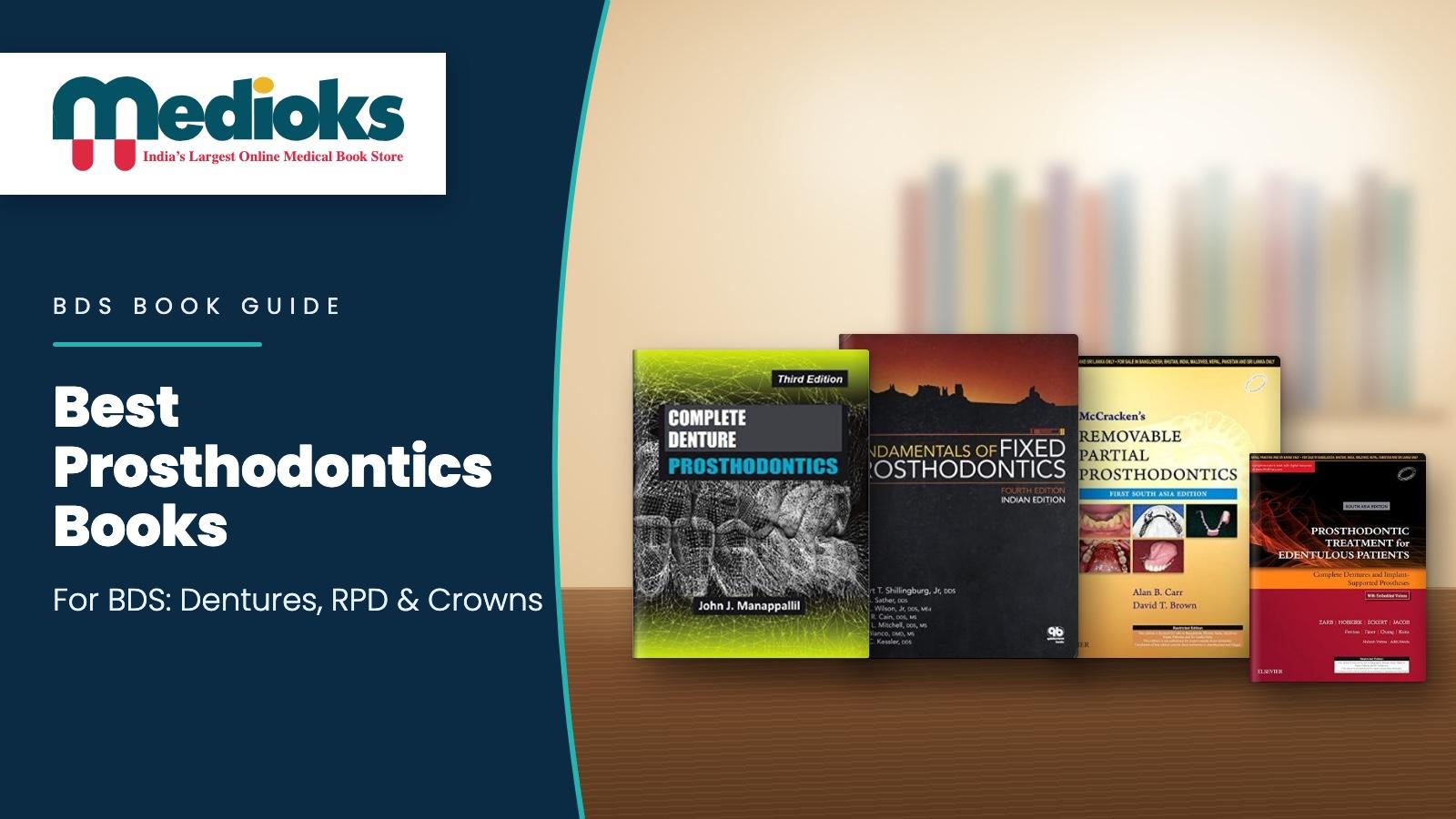
For BDS prosthodontics, most Indian students use one complete denture textbook, such as John Manapallil’s Complete Denture Prosthodontics, together with McCracken’s Removable Partial Prosthodontics for partial dentures and Shillingburg’s Fundamentals of Fixed Prosthodontics for crown and bridge. Add a concise review book or viva guide in the months before your final exam.
Prosthodontics is one of the largest subjects in BDS. You start with preclinical denture work in the early years and finish with complete dentures, removable partial dentures (RPDs) and fixed partial dentures (FPDs) on patients in the final year. The exact year in which the subject is examined depends on your university, so check your scheme. This guide compares the main books for each part of the subject and explains how to use them.
Quick answer
- Complete dentures: Complete Denture Prosthodontics (John Manapallil), or Zarb’s Prosthodontic Treatment for Edentulous Patients for more depth.
- Removable partial dentures: McCracken’s Removable Partial Prosthodontics (Carr and Brown).
- Fixed prosthodontics: Fundamentals of Fixed Prosthodontics (Shillingburg), or Rosenstiel’s Contemporary Fixed Prosthodontics.
- Indian alternatives: Textbook of Removable Partial Prosthodontics (Gupta) and Textbook of Conventional Fixed Partial Dentures (Prabhu).
- Revision and viva: Concise Prosthodontics and Viva in Prosthodontics.
Prosthodontics books compared
| Book | Author | Area | Best for |
|---|---|---|---|
| Complete Denture Prosthodontics | John Manapallil | Complete dentures | The most common Indian complete denture text |
| Prosthodontic Treatment for Edentulous Patients | Zarb, Hobkirk, Eckert, Jacob | Complete dentures | International depth and clinical reasoning |
| McCracken’s Removable Partial Prosthodontics | Carr and others | RPD | The standard RPD textbook |
| Fundamentals of Fixed Prosthodontics | Herbert T. Shillingburg and others | Crown and bridge | Tooth preparation principles and step-by-step technique |
| Contemporary Fixed Prosthodontics | Rosenstiel | Crown and bridge | A comprehensive fixed prosthodontics reference |
| Textbook of Removable Partial Prosthodontics | S. Gupta | RPD | An Indian, exam-oriented RPD book |
| Textbook of Conventional Fixed Partial Dentures | R. Prabhu | Crown and bridge | An Indian FPD text |
| Concise Prosthodontics | Vijay Prakash, Ruchi Gupta | Revision | Quick revision of the whole subject |
Complete denture books
Complete dentures are the core of BDS prosthodontics. You need to understand the anatomy of the edentulous mouth, impressions, jaw relations, teeth arrangement, try-in, insertion and post-insertion problems.
- Complete Denture Prosthodontics by John Manapallil is the book many Indian dental colleges follow. It explains each clinical and laboratory step in the order you’ll perform it.
- Prosthodontic Treatment for Edentulous Patients (Zarb, Hobkirk, Eckert and Jacob) is the classic international text, built on the older Boucher’s textbook. It’s excellent for understanding why each step matters.
- Complete Denture Prosthodontics by Sujit Kumar Das is another Indian option.
- A Primer on Complete Denture Prosthodontics (Chandrasekharan Nair and others) is a shorter introduction for students starting the subject.
Removable partial denture books
RPD questions are common in university exams, especially on Kennedy’s classification, Applegate’s rules, components of an RPD, surveying and design. Two books cover this well:
- McCracken’s Removable Partial Prosthodontics by Alan Carr and colleagues is the standard RPD reference used worldwide. Its design chapters are especially useful.
- Textbook of Removable Partial Prosthodontics by S. Gupta is an Indian alternative written with university exams in mind.
Fixed prosthodontics (crown and bridge) books
- Fundamentals of Fixed Prosthodontics by Herbert T. Shillingburg and colleagues is known for its clear principles of tooth preparation and step-by-step illustrations.
- Contemporary Fixed Prosthodontics by Rosenstiel and colleagues is a larger reference that also covers newer materials and techniques. It’s popular with postgraduates.
- Textbook of Conventional Fixed Partial Dentures by R. Prabhu is an Indian book focused on what undergraduates need.
Revision and viva books
- Concise Prosthodontics (Vijay Prakash and Ruchi Gupta) summarises the subject for fast revision.
- Viva in Prosthodontics (S.H. Soratur) collects the questions examiners commonly ask, with short answers.
For the complete list of books across all BDS years, see our BDS book list for all years.
What BDS prosthodontics covers
| Area | Typical topics |
|---|---|
| Complete dentures | Anatomy of edentulous ridges, impressions, border moulding, jaw relations, articulators, teeth selection and arrangement, try-in, insertion, post-insertion complaints |
| Removable partial dentures | Kennedy classification, Applegate’s rules, major and minor connectors, rests, clasps, indirect retainers, surveying, design |
| Fixed partial dentures | Principles of tooth preparation, abutment selection, pontics, provisional restorations, impressions, cementation |
| Materials | Impression materials, denture base resins, casting alloys, ceramics, luting cements |
| Other topics | Immediate and overdentures, maxillofacial prosthesis basics, dental implants basics, occlusion, TMJ considerations |
Complete denture steps you must know in order
Examiners often ask you to describe the sequence of complete denture fabrication. A clear order to learn:
- Diagnosis and treatment planning: history, examination of the ridges, mucosa, saliva and neuromuscular control.
- Primary impressions and primary casts.
- Special trays and border moulding.
- Secondary (final) impressions and master casts.
- Record bases and occlusal rims.
- Jaw relations: orientation relation (face-bow), vertical relation and centric relation.
- Articulation and teeth selection and arrangement.
- Try-in: checking aesthetics, phonetics, vertical dimension and occlusion.
- Processing in the laboratory.
- Insertion, patient instructions and post-insertion review.
Manapallil’s book follows this sequence, which makes it easy to link theory with what you do in the clinic.
How to approach RPD design questions
RPD design is a frequent long question and a common viva topic. A step-by-step method helps:
- Classify the arch using Kennedy’s classification, applying Applegate’s rules.
- Decide on the support: tooth-supported, tooth and tissue-supported, or mainly tissue-supported.
- Choose the major connector suitable for the arch and the patient.
- Place rests to direct forces along the long axis of the teeth.
- Select direct retainers (clasps) and plan indirect retention where needed.
- Plan guide planes using the surveyor.
- Draw the design neatly, labelling every component.
Practise drawing designs for every Kennedy class. Neat, labelled diagrams earn marks in written exams.
Preclinical prosthodontics: getting the basics right
In the earlier BDS years, preclinical prosthodontics trains you in laboratory skills: making casts, record bases and occlusal rims, and arranging teeth. These skills affect the quality of your final-year clinical work. To do well:
- understand the purpose of each step before you start it,
- keep your instruments and work area clean,
- ask for your teacher’s check at each stage, and
- keep your record book up to date with labelled diagrams.
Dental materials in prosthodontics
Many prosthodontics questions overlap with dental materials. Learn the properties, uses and manipulation of impression materials (alginate, elastomers, zinc oxide eugenol paste, impression compound), gypsum products, denture base resins and their processing errors, and the materials used for crowns and bridges. Comparison tables are an efficient way to revise them.
Clinical tips for your final-year posting
- Take careful histories. A patient’s expectations and previous denture experience often predict how well they’ll adapt.
- Check every step before moving on. Errors in impressions or jaw relations can’t be corrected later.
- Keep good records of every appointment and every adjustment.
- Explain denture care to each patient: cleaning, removing dentures at night if advised, and attending reviews.
- Be patient with post-insertion complaints. Sore spots, looseness and speech problems are common and usually manageable.
Common post-insertion complaints
Managing complaints after a denture is inserted is a favourite exam topic, and you’ll see many of these problems in your clinical posting. Your textbook covers each in detail, but a summary helps:
| Complaint | Common causes to consider |
|---|---|
| Sore spots | Overextended borders, pressure areas on the fitting surface, occlusal errors |
| Loose dentures | Underextended borders, poor peripheral seal, changes in the ridge |
| Difficulty speaking | Incorrect tooth position, palatal contour or vertical dimension |
| Cheek or tongue biting | Teeth arranged too far buccally or lingually, insufficient horizontal overlap |
| Tired jaws or clicking teeth | Excessive vertical dimension of occlusion |
Learn to link each complaint to the step where the error most likely occurred. Examiners like answers that show this reasoning.
Common viva topics in prosthodontics
- Define and explain retention, stability and support in complete dentures.
- Methods of recording vertical and centric jaw relations.
- Kennedy’s classification and Applegate’s rules.
- Components of an RPD and the function of each.
- Principles of tooth preparation for a full crown.
- Types of pontics and their indications.
- Common post-insertion complaints and their causes.
Indian or international books?
Indian textbooks such as Manapallil, Gupta and Prabhu are written around Indian university question patterns and are usually more affordable. International texts such as Zarb, McCracken, Shillingburg and Rosenstiel give deeper explanations and are widely used in MDS training. A practical combination for most students is one Indian or standard text for each part of the subject, plus international books from the library for topics you want to understand better.
A simple study plan
- Early years: preclinical work, dental materials and the anatomy of the edentulous mouth.
- Clinical years: complete dentures first, then RPD design and fixed prosthodontics, reading alongside your patients.
- Before exams: revise sequences, draw RPD designs, and use a concise book and viva guide.
Implants and newer topics
Dental implants, digital impressions and CAD/CAM restorations are increasingly part of modern prosthodontics. At BDS level you usually need the basic principles, such as osseointegration, indications and the components of an implant restoration. Rosenstiel’s and Zarb’s books touch on these topics, and your department will tell you how much depth your university expects.
Planning for MDS in prosthodontics
Prosthodontics and crown and bridge is a popular MDS speciality. If you’re considering it, build a strong base in complete dentures and occlusion, practise laboratory skills, and get comfortable with international texts such as Zarb, McCracken and Rosenstiel. For NEET MDS, combine your textbooks with regular question practice.
Frequently asked questions
Which is the best prosthodontics book for BDS?
Most students use John Manapallil’s Complete Denture Prosthodontics for complete dentures, McCracken’s Removable Partial Prosthodontics for RPDs, and Shillingburg’s Fundamentals of Fixed Prosthodontics for crown and bridge.
Is Manapallil enough for complete dentures?
For most university exams, yes, combined with clinical work and previous papers. Zarb’s book is a good supplement if you want deeper explanations.
Do I need separate books for RPD and FPD?
Many students use one book for each area because they’re quite different. A concise prosthodontics book can cover all three areas for revision.
Shillingburg or Rosenstiel for crown and bridge?
Shillingburg is often preferred by undergraduates for its clear tooth preparation principles. Rosenstiel is larger and more detailed, and is popular with postgraduates.
Which year is prosthodontics examined in BDS?
Preclinical prosthodontics starts in the early years, and the clinical subject is usually examined in the final year. Check your university’s scheme for exact timing.
How do I remember Applegate’s rules?
Learn them alongside drawn examples. Classify several practice arches until applying the rules becomes automatic.
Is a viva book useful?
Yes. A viva book helps you practise short, clear answers to the questions examiners ask most often. Use it after reading the topic in a textbook.
Are implants part of the BDS prosthodontics syllabus?
Basic implant principles are usually included. The depth varies by university, so follow your department’s guidance.
What causes most complete denture failures in the clinic?
Common causes include poor impressions, incorrect jaw relations and unrealistic patient expectations. Careful technique at each step and good communication prevent most problems.
Should I buy Zarb as an undergraduate?
It’s optional. It’s very useful for understanding, and for students who plan an MDS in prosthodontics. Many students use it from the library.
How many prosthodontics books do I really need?
For most students, three or four are enough: one each for complete dentures, RPDs and crown and bridge, plus a concise book for revision. Use your library for larger references.
The bottom line
For BDS prosthodontics, use one complete denture book such as Manapallil, McCracken for removable partial dentures and Shillingburg for crown and bridge. Add a concise review book and a viva guide before your exams, and practise RPD designs and complete denture sequences until they’re second nature.
Book recommendations are general guidance. Always follow your university’s syllabus and your faculty’s advice. Editions and availability change, so check the product page for the latest edition. Facts checked on 26 November 2026.