

Best Pedodontics Books for BDS: Paediatric Dentistry Textbooks Compared

admin
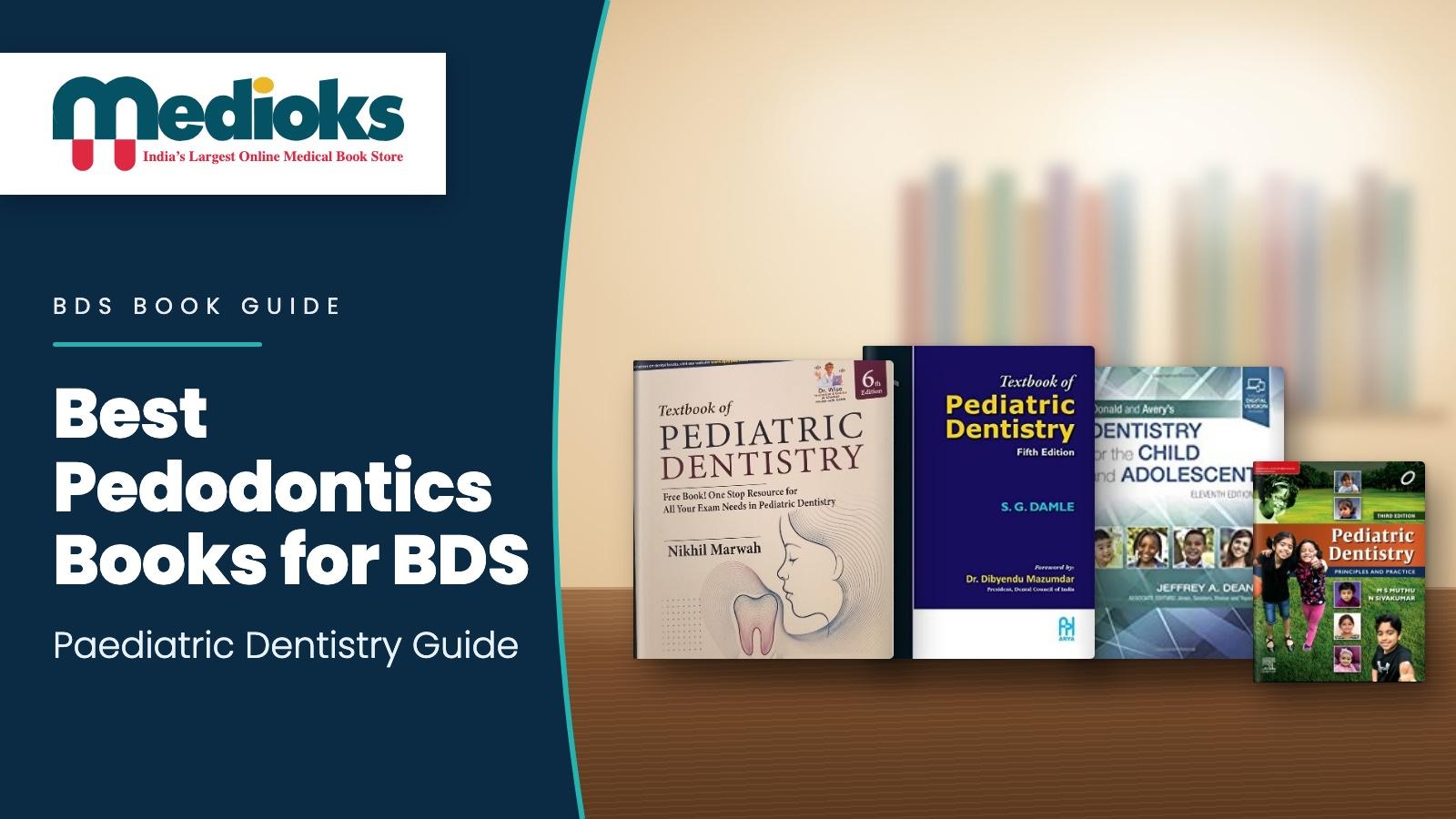
For BDS pedodontics (paediatric and preventive dentistry), most Indian students use one Indian textbook, such as Nikhil Marwah’s or S.G. Damle’s Textbook of Pediatric Dentistry, as their main book. McDonald and Avery’s Dentistry for the Child and Adolescent is the classic international reference, and M.S. Muthu’s Pediatric Dentistry: Principles and Practice is another popular choice.
Pedodontics deals with the oral health of children from infancy through adolescence: growth and development, behaviour management, preventive care, caries management, pulp therapy in primary teeth, space management and dental trauma. It’s usually examined in the later BDS years. This guide compares the main books and explains how to study the subject.
Quick answer
- Main Indian textbooks: Textbook of Pediatric Dentistry by Nikhil Marwah or by S.G. Damle. Choose one.
- Another strong option: Pediatric Dentistry: Principles and Practice (M.S. Muthu, N. Sivakumar).
- International reference: McDonald and Avery’s Dentistry for the Child and Adolescent (also in a South Asia edition).
- More depth: Pediatric Dentistry: Infancy Through Adolescence (Casamassimo, Fields, McTigue and others).
- Quick reference: Handbook of Pediatric Dentistry (Angus Cameron, Richard Widmer).
Pedodontics books compared
| Book | Author / editor | Level | Best for |
|---|---|---|---|
| Textbook of Pediatric Dentistry | Nikhil Marwah | BDS to MDS | Comprehensive Indian coverage |
| Textbook of Pediatric Dentistry | S.G. Damle | BDS | A long-standing Indian textbook |
| Pediatric Dentistry: Principles and Practice | M.S. Muthu, N. Sivakumar | BDS | Clear, well-illustrated Indian text |
| McDonald and Avery’s Dentistry for the Child and Adolescent | Jeffrey A. Dean and others | BDS to MDS | The classic international reference |
| Pediatric Dentistry: Infancy Through Adolescence | Paul S. Casamassimo, Henry W. Fields and others | MDS | In-depth reference |
| Principles and Practice of Pedodontics | Arathi Rao | BDS | A concise Indian option |
| Handbook of Pediatric Dentistry | Angus Cameron, Richard Widmer | Clinical | Quick clinical reference |
Indian textbooks
- Textbook of Pediatric Dentistry by Nikhil Marwah is comprehensive and widely recommended, and it’s also used by many MDS students.
- Textbook of Pediatric Dentistry by S.G. Damle is a long-standing choice in many colleges.
- Pediatric Dentistry: Principles and Practice by M.S. Muthu and N. Sivakumar is known for its clear layout and clinical photographs.
- Principles and Practice of Pedodontics by Arathi Rao is a concise alternative.
Ask your department which book its teaching follows, and choose one as your main text.
International references
- McDonald and Avery’s Dentistry for the Child and Adolescent (Jeffrey A. Dean and colleagues) is the classic international textbook. A South Asia edition is also available.
- Pediatric Dentistry: Infancy Through Adolescence (Casamassimo, Fields, McTigue and others) is a detailed reference, popular in postgraduate training.
- Paediatric Dentistry by Richard Welbury, Monty Duggal and Marie-Thérèse Hosey is a well-regarded UK text.
Clinical and quick-reference books
- Handbook of Pediatric Dentistry by Angus Cameron and Richard Widmer is a compact clinical reference.
- Manual of Pediatric Dentistry by Sridhar Premkumar is a shorter Indian book.
- Essentials of Pediatric Dentistry by K.H. Asnani is useful for revision.
For your other dental subjects, see our complete BDS book list and our guide to orthodontics books, a closely related subject.
What BDS pedodontics covers
| Area | Typical topics |
|---|---|
| Growth and development | General and craniofacial growth, development of the dentition, eruption and shedding |
| Child psychology and behaviour | Child development, behaviour rating scales, non-pharmacological and pharmacological behaviour management |
| Prevention | Dental caries in children, early childhood caries, fluorides, pit and fissure sealants, diet counselling |
| Restorative care | Restorations in primary teeth, stainless steel crowns and other crowns |
| Pulp therapy | Pulp capping, pulpotomy and pulpectomy in primary teeth, management of immature permanent teeth |
| Space management | Space maintainers, interceptive orthodontics, oral habits |
| Other topics | Dental trauma, children with special health care needs, local anaesthesia in children, gingival and periodontal conditions in children |
Behaviour management: the heart of pedodontics
A child who trusts the dentist is much easier to treat, now and in the future. Learn:
- Child development stages and what to expect at each age.
- Behaviour rating scales, such as Frankl’s behaviour rating scale, which examiners often ask about.
- Non-pharmacological techniques, such as tell-show-do, positive reinforcement, distraction, voice control and modelling.
- Communication with parents, including their role in the dental visit.
- Pharmacological options, such as conscious sedation and general anaesthesia, and when they’re considered.
In your clinical posting, watch how experienced paediatric dentists talk to children. It’s one of the best ways to learn.
Early childhood caries and prevention
Early childhood caries is common, and prevention is a major part of paediatric dentistry. Learn the risk factors, such as frequent sugar intake and prolonged bottle feeding; caries risk assessment; and preventive measures including fluoride varnish, fluoride toothpaste in age-appropriate amounts, pit and fissure sealants, and diet counselling. Advice for parents is a frequent exam and viva topic.
Pulp therapy in primary teeth
| Procedure | What it involves |
|---|---|
| Indirect pulp therapy | Leaving a thin layer of affected dentine over the pulp, to avoid exposure, and sealing the tooth |
| Direct pulp capping | Placing a material directly on a small, clean pulp exposure, in selected cases |
| Pulpotomy | Removing the coronal pulp and treating the remaining radicular pulp |
| Pulpectomy | Removing the whole pulp and filling the canals with a resorbable material suitable for primary teeth |
Learn the indications, contraindications, materials and steps for each procedure from your textbook, and follow your department’s protocols, because materials and preferences change with evidence.
Space management and habits
Early loss of primary teeth can lead to loss of space for the permanent teeth. Learn when space maintainers are needed, the common types, both fixed and removable, and how to design and fabricate them. Oral habits such as thumb sucking and tongue thrusting are also covered in pedodontics, with overlap in orthodontics.
Dental trauma in children
Children often injure their front teeth. Learn the classification of dental injuries, the differences in management between primary and permanent teeth, and the emergency management of an avulsed permanent tooth. Current dental trauma guidelines are summarised in your textbook and department protocols. This topic is common in both exams and real practice.
Children with special health care needs
Children with medical, physical or developmental conditions may need adapted dental care. Learn how common conditions affect dental treatment, the importance of prevention for these children, and when treatment under sedation or general anaesthesia is considered. Communication with parents, caregivers and the child’s doctors is essential.
Primary and permanent dentition essentials
Pedodontics depends on knowing the development of the dentition thoroughly. Learn the chronology of calcification, eruption and root completion for primary and permanent teeth; the differences between primary and permanent teeth in morphology, enamel and dentine thickness and pulp size; and the mixed dentition stage, including the leeway space and how the molar relationship changes. These differences explain why cavity preparations, pulp therapy and crowns in primary teeth differ from those in adults.
Local anaesthesia in children
Giving local anaesthesia to a child needs both technique and communication. Learn how to calculate maximum doses by body weight, how to use child-friendly language and topical anaesthesia to reduce anxiety, and how to prevent soft tissue injury after treatment, such as children biting their numb lip. Warn parents about this before the child leaves the clinic.
Crowns for primary teeth
Stainless steel crowns are a durable option for restoring badly broken-down primary molars, especially after pulp therapy. Learn their indications, tooth preparation, crown selection, adaptation and cementation. Your textbook also covers aesthetic options for anterior teeth. Crowns are a common practical exercise and viva topic.
Common viva questions
- What is Frankl’s behaviour rating scale?
- Explain the tell-show-do technique.
- What is early childhood caries and how can it be prevented?
- Differentiate pulpotomy and pulpectomy in primary teeth.
- What are the indications for a space maintainer?
- How would you manage an avulsed permanent incisor?
- What are the eruption dates of primary and permanent teeth?
A simple study plan
- Start with growth, development and eruption, because many other topics depend on them.
- Learn behaviour management before your clinical posting begins.
- Study prevention, restorative care and pulp therapy alongside your clinical work.
- Revise space management, habits and trauma with diagrams and tables.
- Before exams: use a shorter book and previous question papers.
Clinical tips for your posting
- keep appointments short and positive, especially for young children,
- always explain procedures in child-friendly words,
- involve parents appropriately and give clear home-care advice,
- record behaviour and cooperation at each visit, and
- follow your department’s protocols for local anaesthetic doses based on body weight.
Using fluorides safely
Fluoride is the cornerstone of caries prevention in children, but the amount must suit the child’s age and caries risk. Learn the forms of fluoride, such as toothpaste, varnish, gels and community water fluoridation; the age-appropriate amount of toothpaste your textbook recommends; and the signs and prevention of dental fluorosis, which is relevant in parts of India where natural fluoride levels in water are high. Questions on fluoride mechanisms and safety appear often in exams.
Case records in pedodontics
A good paediatric case record includes the child’s medical and dental history, birth and developmental history where relevant, diet and oral hygiene habits, behaviour rating, clinical and radiographic findings, caries risk assessment and a phased treatment plan, usually starting with prevention and urgent care. Writing thorough records helps in practical exams and builds good habits for practice.
Talking to parents
Parents make most decisions about a child’s dental care, so clear communication matters. Explain findings simply, discuss prevention at home, and agree on a realistic treatment plan.
Considering MDS in pedodontics
Paediatric and preventive dentistry is a rewarding MDS speciality for those who enjoy working with children. If you’re interested, read McDonald and Avery and Marwah in depth, spend extra time in the department, and start NEET MDS question practice early.
Frequently asked questions
Which is the best pedodontics book for BDS?
Nikhil Marwah’s and S.G. Damle’s Textbooks of Pediatric Dentistry are the most common Indian choices. M.S. Muthu’s book is another strong option, and McDonald and Avery is the main international reference.
Should BDS students buy McDonald and Avery?
It’s optional at BDS level. The South Asia edition is a practical option if you want an international reference.
Is pedodontics the same as paediatric dentistry?
Yes. The subject is often called Pedodontics and Preventive Dentistry in Indian curricula.
How should I learn eruption dates?
Make a single table for primary and permanent teeth and revise it often. Eruption dates are frequently asked in exams and vivas.
Which topics are most important?
Behaviour management, prevention, pulp therapy in primary teeth, space maintainers and dental trauma are common exam topics.
Is pedodontics important for NEET MDS?
Yes. It’s part of the NEET MDS syllabus. Regular question practice alongside a standard textbook helps.
Do I need a separate book for children with special needs?
Not at BDS level. Your main textbook covers the key principles.
How do pedodontics and orthodontics overlap?
Both cover growth and development, oral habits and interceptive orthodontics. Studying these shared topics from both textbooks gives a fuller picture.
How do I manage an anxious child in my first clinical cases?
Start with simple, non-invasive procedures, explain each step with tell-show-do, praise cooperation, and keep the appointment short. Ask your supervisor for help early if the child becomes distressed.
Is a handbook useful in the clinic?
Yes. A compact handbook such as Cameron and Widmer’s helps you check doses, techniques and protocols quickly. Read the topic in your main textbook afterwards.
The bottom line
For BDS pedodontics, choose one Indian textbook such as Marwah or Damle, use McDonald and Avery for deeper reading, and focus on behaviour management, prevention and pulp therapy. Your clinical posting with children is where the subject really comes alive.
Book recommendations are general guidance. Always follow your university’s syllabus, your department’s clinical protocols and your faculty’s advice. Editions and availability change, so check the product page for the latest edition. Facts checked on 26 November 2026.