

Best Psychiatry Books for MBBS: Is Ahuja Enough?

admin
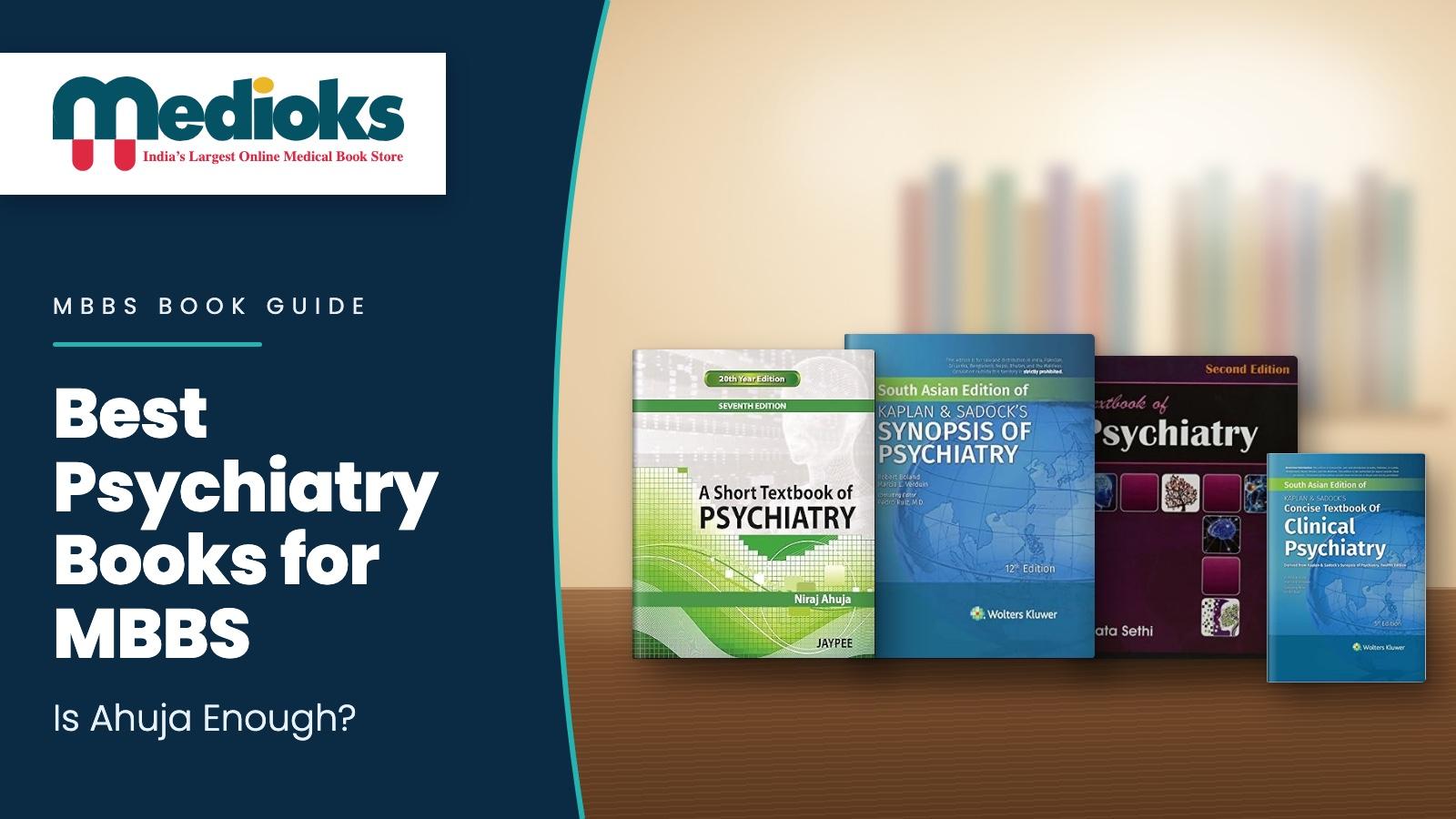
For MBBS psychiatry, A Short Textbook of Psychiatry by Niraj Ahuja is the book most Indian students use, and for university exams it is usually enough. Kaplan & Sadock’s books are the standard references if you want more depth, or if you’re considering psychiatry as a career.
Psychiatry is a short subject in the final MBBS phase, but it matters well beyond the exam. Every doctor meets patients with anxiety, depression, substance use, delirium or psychosis. This guide covers the main books, what to look for in an edition, and how to prepare for the clinical posting.
Quick answer
- Main book for MBBS: A Short Textbook of Psychiatry (Niraj Ahuja).
- Indian alternative: Textbook of Psychiatry (S. Sethi).
- Depth and reference: Kaplan & Sadock’s Synopsis of Psychiatry, or the shorter Kaplan & Sadock’s Concise Textbook of Clinical Psychiatry.
- Postings: the competency-based logbook your college uses.
- PG entrance revision: a short review book, after your main book.
Psychiatry books compared
| Book | Author / editor | Type | Best for |
|---|---|---|---|
| A Short Textbook of Psychiatry | Niraj Ahuja | Main textbook | Concise coverage of the MBBS syllabus |
| Textbook of Psychiatry | S. Sethi | Main textbook | An Indian alternative to Ahuja |
| Kaplan & Sadock’s Synopsis of Psychiatry | Robert Boland, Marcia Verduin, Pedro Ruiz | Reference | In-depth reading and PG study |
| Kaplan & Sadock’s Concise Textbook of Clinical Psychiatry | Robert Boland, Marcia Verduin | Shorter reference | Depth without the full Synopsis |
| New Oxford Textbook of Psychiatry | John R. Geddes, Nancy C. Andreasen and others | Major reference | Postgraduates and specialists |
| Competency Based Logbook in Respiratory Medicine, DVL and Psychiatry | Nitin Tangri | Logbook | Recording competencies during postings |
Ahuja’s Short Textbook of Psychiatry
A Short Textbook of Psychiatry by Niraj Ahuja is popular because it covers the undergraduate syllabus in a compact, readable way. Psychiatry gets limited teaching time in MBBS, so a book you can finish matters.
- Strengths: concise, well organised, and covers classification, the major disorders, psychopharmacology and emergencies.
- Limitations: because it’s short, it gives less detail on psychotherapy and neurobiology. Use a Kaplan & Sadock book if you want more.
- Best for: almost every MBBS student, as the main book.
S. Sethi’s Textbook of Psychiatry is another Indian option, if your faculty recommends it.
Kaplan & Sadock’s books
Kaplan & Sadock’s books are the best-known psychiatry references in the world.
- Kaplan & Sadock’s Synopsis of Psychiatry is comprehensive, and it’s the book many PG aspirants and residents use.
- Kaplan & Sadock’s Concise Textbook of Clinical Psychiatry is a shorter clinical version, which suits undergraduates who want more than Ahuja.
Other books worth knowing
- New Oxford Textbook of Psychiatry is a major specialist reference. Undergraduates don’t need it.
- Competency Based Logbook in Respiratory Medicine, DVL and Psychiatry (Nitin Tangri) helps you record competencies during postings. Check which logbook your college requires.
- One Touch Psychiatry (Dr Prashant Agrawal) is a short review book for PG entrance revision, after you’ve read a main book.
What to check in an edition
Psychiatric classification has changed in recent years. The WHO’s ICD-11 came into effect in 2022, and the American Psychiatric Association published DSM-5-TR the same year. When you choose a book or edition:
- Check whether it describes disorders using current classification systems, or explains the changes from older ones.
- Check that the psychopharmacology chapters cover drugs in current use.
- For Indian law, check whether it covers the Mental Healthcare Act, 2017.
- Ask your faculty which classification your university exam expects.
Making the most of your psychiatry posting
- Practise the mental status examination (MSE) on every patient you see: appearance, behaviour, speech, mood, thought, perception, cognition and insight.
- Write up cases in a fixed format, including history, MSE, diagnosis, differentials and management.
- Learn the common drug groups well: antidepressants, antipsychotics, mood stabilisers and anxiolytics, including their main side effects.
- Recognise emergencies: suicide risk, delirium, alcohol withdrawal, acute psychosis and neuroleptic malignant syndrome.
- Communicate with empathy. History-taking in psychiatry is a skill you’ll use in every speciality.
For your other final-year subjects, see our final year MBBS book guide.
What MBBS psychiatry covers
Psychiatry in MBBS focuses on recognising common mental health conditions, assessing risk, starting basic treatment and knowing when to refer. Most textbooks and question papers cover these areas:
| Area | Typical topics |
|---|---|
| Foundations | Classification of psychiatric disorders, history-taking, the mental status examination, psychopathology (signs and symptoms) |
| Psychotic disorders | Schizophrenia and related disorders, delusional disorder, acute psychosis |
| Mood disorders | Depression, bipolar disorder, suicide risk assessment |
| Anxiety and related disorders | Generalised anxiety, panic disorder, phobias, obsessive-compulsive disorder, stress-related disorders |
| Substance use | Alcohol and other substance use disorders, withdrawal states, de-addiction approaches |
| Organic and neurocognitive disorders | Delirium, dementia |
| Child, adolescent and special topics | Developmental disorders, ADHD, intellectual disability, sleep disorders, sexual health |
| Treatment and law | Psychopharmacology, psychotherapy basics, electroconvulsive therapy, mental health law |
The mental status examination, step by step
The mental status examination (MSE) is to psychiatry what physical examination is to medicine. It describes what you observe and elicit during the interview. A common order is:
- General appearance and behaviour: grooming, eye contact, rapport and psychomotor activity.
- Speech: rate, volume, tone and coherence.
- Mood and affect: mood is what the patient reports, and affect is what you observe.
- Thought: form (how thoughts are connected), stream, and content such as delusions, obsessions or suicidal thoughts.
- Perception: hallucinations and illusions.
- Cognition: orientation, attention, memory, abstraction and general knowledge.
- Insight and judgement: the patient’s understanding of their illness, and their ability to make sound decisions.
Practise writing up the MSE for every patient you see during your posting. It becomes natural quickly, and examiners expect it in case presentations.
Psychopharmacology essentials
Many psychiatry questions, in both university exams and PG entrance, are about drugs. For each group, learn the main examples, uses, important side effects and monitoring needs:
- Antidepressants: SSRIs, SNRIs and older tricyclic antidepressants. Know their side effects and the risks in overdose.
- Antipsychotics: typical and atypical drugs. Know extrapyramidal side effects and metabolic side effects.
- Mood stabilisers: lithium and anticonvulsant mood stabilisers. Know lithium’s need for blood level monitoring and its toxicity signs.
- Anxiolytics and hypnotics: benzodiazepines, with their risk of dependence.
- Drugs for substance use disorders: including the drugs used in alcohol withdrawal and relapse prevention.
Your pharmacology textbook covers mechanisms, and your psychiatry book covers clinical use. Reading the two together saves time.
Psychiatric emergencies every doctor should recognise
- Suicide risk: learn to ask directly and sensitively about suicidal thoughts, plans and previous attempts. Asking doesn’t increase risk.
- Delirium: an acute, fluctuating confusion, usually with a medical cause. It’s common in hospital wards and easily missed.
- Alcohol withdrawal: it can progress to seizures and delirium tremens, so recognising it early matters.
- Acute agitation or psychosis: safety comes first, for the patient and for staff.
- Neuroleptic malignant syndrome and serotonin syndrome: rare but serious drug reactions.
Mental health law in India: what students should know
The Mental Healthcare Act, 2017 governs mental health care in India. At MBBS level, you should understand its broad themes: the rights of persons with mental illness, capacity and consent, advance directives, nominated representatives, admission procedures and the decriminalisation of attempted suicide in most circumstances. Check how deeply your university expects you to know it, because questions vary.
Psychiatry for NEET PG
Psychiatry is a short subject in PG entrance exams, but its questions are often straightforward if you know the classification, the core drugs and the commonly asked eponyms and terms. Most students:
- use Ahuja or their main textbook for concepts,
- revise with a short review book, and
- practise previous-year style questions to learn how topics are tested.
A two-week posting plan
- First days: learn the MSE and observe interviews by your teachers.
- First week: read the major disorders as you see patients: psychosis, depression, anxiety and substance use.
- Second week: take full histories yourself, write up the MSE, and present cases.
- Before the exam: revise psychopharmacology tables and emergencies.
Why psychiatry matters for every doctor
Mental health conditions are common, and many patients first present to doctors outside psychiatry: in general medicine, emergency departments, obstetrics, paediatrics and primary care. Depression often shows up as tiredness or unexplained physical symptoms. Alcohol use disorders show up as liver disease, injuries or withdrawal on a surgical ward. Delirium appears on almost every inpatient ward.
Stigma still keeps many people from seeking help. Doctors who ask about mental health routinely, listen without judgement and know when to refer make a real difference. That’s why psychiatry is worth taking seriously, even though it’s a short subject in the MBBS timetable.
Writing up a psychiatry case
- Identification data and the source of information, such as the patient or a relative.
- Chief complaints with duration, in the informant’s words.
- History of present illness: onset, course, precipitating factors and the effect on daily functioning.
- Past psychiatric and medical history, including previous treatment and response.
- Family history, including mental illness and substance use.
- Personal history: birth and development, education, work, relationships and substance use.
- Premorbid personality: how the person was before the illness.
- Mental status examination and relevant physical examination.
- Diagnosis, differential diagnosis and management plan, including risk assessment.
Looking after your own mental health
Medical training is demanding, and studying psychiatry often makes students reflect on their own stress, sleep and mood. If you’re struggling, talk to someone you trust, use your college’s counselling or mentorship services, or speak to a doctor. Asking for help early is a strength, and it’s the same advice you’ll give your patients.
Frequently asked questions
Which is the best psychiatry book for MBBS?
Niraj Ahuja’s A Short Textbook of Psychiatry is the most common choice. Kaplan & Sadock’s books are the main references for more depth.
Is Ahuja enough for MBBS psychiatry?
For most university exams, yes, when combined with your posting experience and previous question papers.
Should MBBS students buy Kaplan & Sadock?
It’s optional. The Concise Textbook suits students who want more depth. The full Synopsis is mainly for PG aspirants and residents.
Is psychiatry important for NEET PG?
Yes, psychiatry is part of the NEET PG syllabus. Use your main book for concepts and a short review book for MCQ practice. See our NEET PG book guide.
How many marks does psychiatry carry in MBBS?
It varies by university. In many universities, psychiatry is assessed as part of the medicine papers, sometimes with a dedicated section. Check your university’s scheme and previous question papers.
Which topics in psychiatry are asked most often?
Schizophrenia, depression, bipolar disorder, alcohol dependence and withdrawal, anxiety disorders, delirium, and the major drug groups appear frequently. The mental status examination is a common short note and viva topic.
Is Ahuja enough for NEET PG psychiatry?
Many aspirants use Ahuja for concepts and add a review book and question practice for MCQs. Newer classification terms and drug details are worth revising from up-to-date sources.
How should I talk to a patient with a mental illness?
With respect, privacy and patience. Introduce yourself, explain why you’re asking questions, use open questions first, and avoid judgemental language. Your teachers will model this during the posting.
Do I need to know ICD-11 and DSM-5-TR in detail?
MBBS students usually need the broad principles and the main categories, not every criterion. Ask your department which system your university exam follows.
Is psychiatry useful during internship?
Very. During internship you’ll manage delirium, alcohol withdrawal, anxiety and low mood in patients on every ward. A short psychiatry book is worth keeping handy.
The bottom line
Ahuja’s Short Textbook of Psychiatry is enough for most MBBS students. Use a Kaplan & Sadock book for extra depth, check that your edition reflects current classification, and use your posting to practise the mental status examination on real patients.
Book recommendations are general guidance. Always follow your college’s syllabus and your faculty’s advice. Editions and availability change, so check the product page for the latest edition. Facts checked on 26 November 2026.