

Microbiology Study Plan for MBBS: A Complete 30-Day Strategy to Master Medical Microbiology (2026)

Sayanti Chakrabarti
Microbiology is one of the most important subjects in the second year of MBBS because it forms the bridge between basic sciences and clinical medicine. From understanding bacteria, viruses, fungi, parasites, and immunology to learning laboratory diagnosis and antimicrobial resistance, microbiology plays a significant role in becoming a competent doctor.
Despite its importance, many MBBS students find microbiology overwhelming due to the vast syllabus, extensive terminology, numerous organisms, and practical laboratory procedures. Without a structured study plan, students often spend long hours reading but struggle to retain information or perform well in university examinations.
The good news is that microbiology becomes much easier when studied systematically.
This comprehensive Microbiology Study Plan for MBBS provides a step-by-step strategy to help students cover the syllabus efficiently, strengthen conceptual understanding, prepare for practical examinations, and build a solid foundation for NEET PG, INI-CET, FMGE, and NEXT.
Quick Answer
The best microbiology study plan for MBBS includes:
- Studying one major topic every day
- Reading from one standard textbook
- Creating concise notes
- Practicing diagrams and laboratory procedures
- Solving previous-year university questions
- Revising weekly
- Practicing MCQs regularly
A structured 30-day study plan is far more effective than last-minute cramming.
Why You Need a Study Plan for Microbiology
Medical microbiology includes multiple disciplines:
- General Microbiology
- Immunology
- Bacteriology
- Virology
- Mycology
- Parasitology
- Sterilization
- Disinfection
- Hospital Infection Control
- Laboratory Diagnosis
Without planning, students often:
- Read randomly
- Forget earlier chapters
- Skip revision
- Ignore practical preparation
- Panic before examinations
A well-designed study plan improves consistency and long-term retention.
Best Books to Follow
Choose one primary textbook instead of reading multiple books.
Recommended resources include:
Primary Textbook
- Essentials of Medical Microbiology – Apurba Sastry
Reference Book
- Ananthanarayan & Paniker’s Textbook of Microbiology
Practical Resources
- Practical Microbiology Manual
- Color Atlas
- Previous-Year University Questions
Avoid switching between multiple textbooks unnecessarily.
30-Day Microbiology Study Plan
Week 1 – Build Your Foundation
Day 1
- Introduction to Microbiology
- History
- Classification of microorganisms
Day 2
- Sterilization
- Disinfection
- Hospital infection control
Day 3
- Microscopy
- Laboratory equipment
- Culture media
Day 4
- Immunology Basics
- Innate immunity
- Adaptive immunity
Day 5
- Antibodies
- Antigens
- Vaccines
Day 6
- Hypersensitivity
- Autoimmunity
- Immunodeficiency
Day 7
- Revise Week 1
- Solve MCQs
- Practice diagrams
Week 2 – Bacteriology
Day 8
Gram-positive cocci
Day 9
Gram-negative cocci
Day 10
Enterobacteriaceae
Day 11
Mycobacteria
Day 12
Anaerobic bacteria
Day 13
Spirochetes
Day 14
Weekly revision
Focus on:
- Gram staining
- Clinical correlations
- Laboratory diagnosis
Week 3 – Virology, Mycology and Parasitology
Day 15
DNA viruses
Day 16
RNA viruses
Day 17
HIV
Hepatitis
Influenza
Day 18
Medical fungi
Day 19
Protozoa
Day 20
Helminths
Day 21
Weekly revision
Practice:
- Flowcharts
- Organism comparisons
- MCQs
Week 4 – Practicals and Final Revision
Day 22
Gram staining
Day 23
Acid-fast staining
Day 24
Culture media
Day 25
Specimen collection
Day 26
Antibiotic susceptibility testing
Day 27
Previous-year university questions
Day 28
Rapid revision
Day 29
Mock test
Day 30
Final revision
Daily Study Routine
An effective daily schedule may look like this:
30 Minutes
Review yesterday’s topics.
2 Hours
Read new chapter.
30 Minutes
Prepare concise notes.
30 Minutes
Practice diagrams.
30 Minutes
Solve MCQs.
20 Minutes
Revise flashcards.
This routine promotes active learning and reduces forgetting.
How to Make Effective Notes
Instead of copying entire chapters:
Create:
- Flowcharts
- Summary tables
- Clinical correlations
- Mnemonics
- High-yield facts
Short notes become invaluable during final revision.
Importance of Active Recall
Research consistently shows that active recall improves memory.
Instead of rereading chapters:
Ask yourself:
- What causes this disease?
- Which organism is responsible?
- What is the laboratory diagnosis?
- Which stain is used?
- What is the treatment principle?
Testing yourself strengthens long-term retention.
Practice MCQs Every Week
MCQs improve:
- Clinical reasoning
- Speed
- Confidence
- Examination performance
Do not wait until internship to begin MCQ practice.
Focus on Practical Microbiology
Practical marks significantly influence overall performance.
Practice:
- Gram staining
- Ziehl–Neelsen staining
- Culture media
- Sterilization
- Specimen collection
- Biomedical waste disposal
Understanding laboratory procedures also improves theory answers.
High-Yield Topics
Pay special attention to:
Immunology
- Vaccines
- Hypersensitivity
- Immunoglobulins
Bacteriology
- Staphylococcus
- Streptococcus
- Tuberculosis
- Enteric bacteria
Virology
- HIV
- Hepatitis
- Rabies
- Influenza
Mycology
- Candida
- Aspergillus
Parasitology
- Malaria
- Amoebiasis
- Leishmaniasis
These topics appear frequently in university examinations and NEET PG.
Common Mistakes Students Make
Reading Multiple Books
Master one standard textbook.
Memorizing Without Understanding
Conceptual learning is more effective.
Ignoring Practical Classes
Laboratory sessions reinforce theoretical knowledge.
Skipping Revision
Microbiology requires continuous revision.
Studying Only Before Exams
Daily study produces better long-term results than last-minute preparation.
Digital Tools That Improve Learning
Students can also supplement textbook learning using:
- Digital flashcards
- Spaced repetition apps
- Medical MCQ platforms
- Educational videos
- AI-powered study assistants (for concept clarification only)
These tools should complement—not replace—standard medical textbooks.
Where to Buy Genuine MBBS Microbiology Books
Using authentic textbooks ensures:
- Updated medical guidelines
- High-quality illustrations
- Latest editions
- Accurate clinical information
- Better durability
Students should purchase books from trusted medical bookstores specializing in medical education.
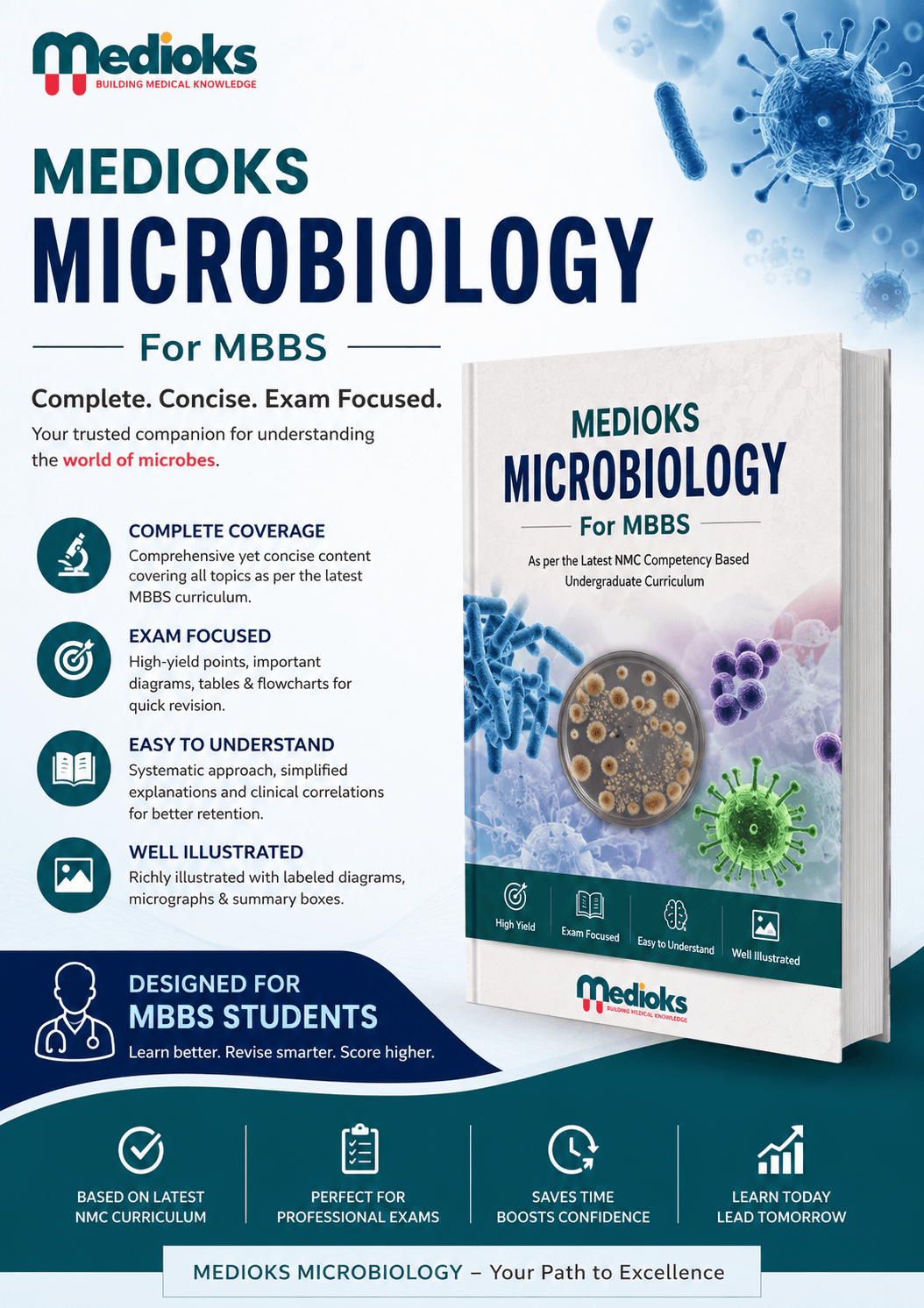
Medioks is one of the trusted online platforms where MBBS students can purchase original microbiology textbooks, practical manuals, color atlases, and complete second-year MBBS book collections from leading publishers. Buying genuine editions ensures accurate content aligned with the latest NMC curriculum.
Frequently Asked Questions
How many days are enough to prepare microbiology for MBBS?
A structured 30-day study plan is sufficient for most students if they study consistently and revise regularly.
Which book is best for microbiology?
Essentials of Medical Microbiology by Apurba Sastry is one of the most recommended books for undergraduate MBBS students.
Should I practice MCQs?
Yes. Weekly MCQ practice improves concept application and prepares students for postgraduate entrance examinations.
Is revision important?
Absolutely. Multiple revisions are essential because microbiology contains a large amount of factual information.
Where can I buy original microbiology books?
Trusted medical bookstores like Medioks provide genuine microbiology textbooks, practical manuals, and second-year MBBS study materials.
Conclusion
Microbiology may initially seem like one of the most information-heavy subjects in MBBS, but with a structured study plan, it becomes highly manageable. Dividing the syllabus into weekly goals, revising regularly, practicing laboratory procedures, and solving MCQs helps students build both conceptual clarity and examination confidence.
The key is consistency—not marathon study sessions before exams. By following a systematic 30-day study plan and using trusted resources like Essentials of Medical Microbiology by Apurba Sastry, practical manuals, and previous-year question papers, students can perform well in university examinations while also laying a strong foundation for NEET PG, INI-CET, FMGE, and NEXT.
For authentic and updated microbiology textbooks, laboratory manuals, and complete second-year MBBS study resources, Medioks remains a reliable destination for medical students across India.