

Best Anaesthesia Books for MBBS Students and Residents: Miller vs Morgan & Mikhail

admin
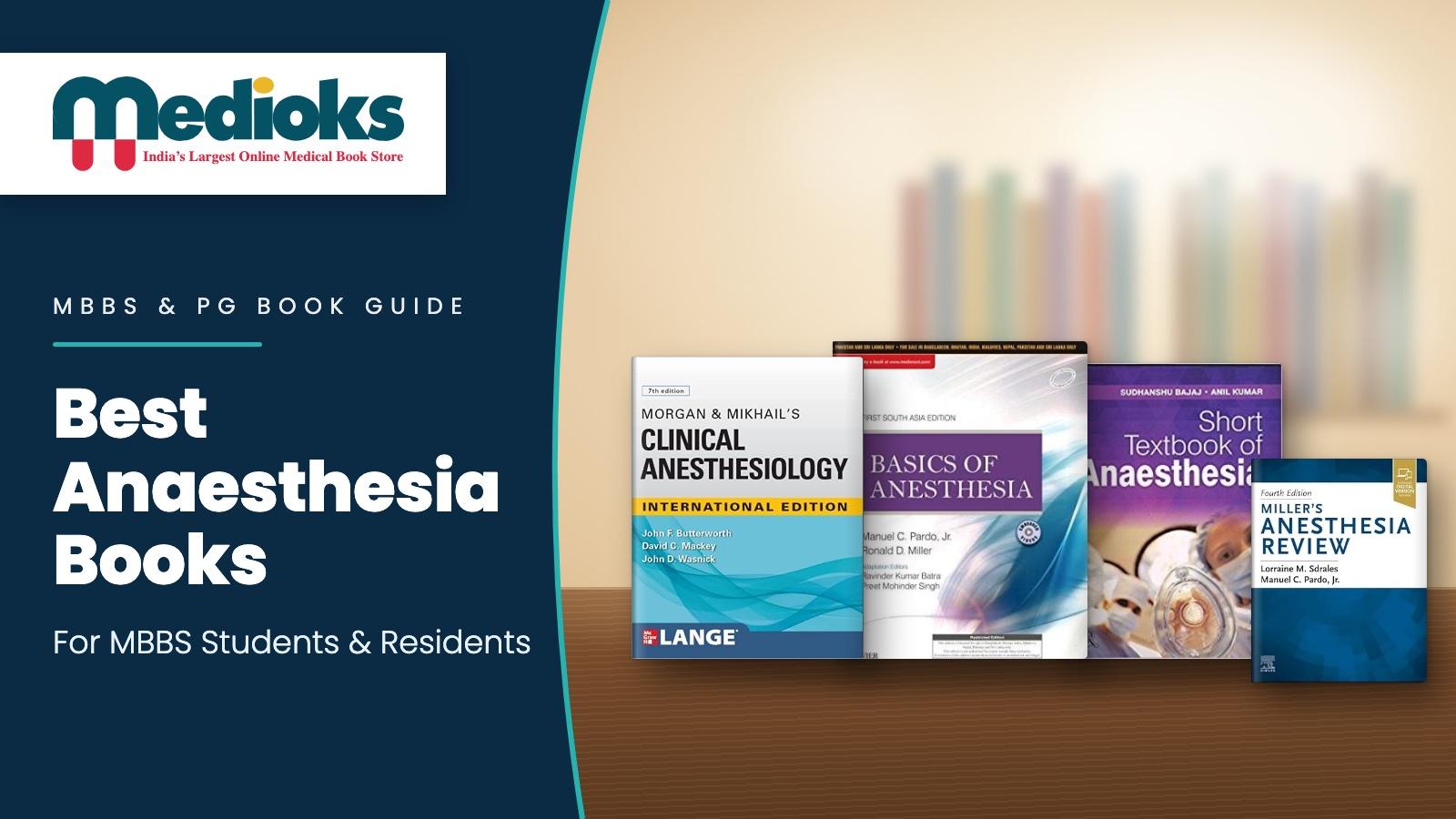
For an MBBS anaesthesiology posting, a short, focused book is enough. A Short Textbook of Anaesthesia or Miller’s Basics of Anesthesia covers what you need. Anaesthesia residents usually build their reading around Morgan & Mikhail’s Clinical Anesthesiology and Miller’s Basics, plus a review book for exams.
Anaesthesiology is part of the final MBBS phase in the NMC’s competency-based curriculum. It’s also a popular PG choice. Undergraduates and residents need very different depth, so this guide covers both groups.
Quick answer
- MBBS students: A Short Textbook of Anaesthesia, or Miller’s Basics of Anesthesia if you want an international text.
- Residents, core textbook: Morgan & Mikhail’s Clinical Anesthesiology.
- Residents, second core text: Miller’s Basics of Anesthesia.
- In theatre: Morgan & Mikhail’s Clinical Anesthesiology Handbook, or a case-based handbook.
- Exam revision: Miller’s Anesthesia Review or Review of Clinical Anesthesia.
Anaesthesia books compared
| Book | Author / editor | Level | Best for |
|---|---|---|---|
| A Short Textbook of Anaesthesia | Sudhanshu Bajaj, Anil Kumar (as listed) | MBBS | A quick, complete overview for the posting and exams |
| Miller’s Basics of Anesthesia | Manuel Pardo, Ronald Miller | MBBS to resident | Clear fundamentals from the Miller family of books |
| Morgan & Mikhail’s Clinical Anesthesiology | John Butterworth, David Mackey, John Wasnick | Resident | A core clinical textbook |
| Morgan & Mikhail’s Clinical Anesthesiology Handbook | Richard D. Urman and others | Resident | Quick reference in theatre |
| Miller’s Anesthesia Review | Lorraine M. Sdrales, Manuel Pardo | Resident | Question-based revision |
| Review of Clinical Anesthesia | Neil Connelly, David G. Silverman | Resident | MCQ practice |
Books for MBBS students
During MBBS you need the essentials: pre-anaesthetic assessment, airway management, the basics of general, spinal and regional anaesthesia, common drugs, monitoring, fluids, pain management and resuscitation.
- A Short Textbook of Anaesthesia covers these topics concisely and is easy to finish during a short posting.
- Miller’s Basics of Anesthesia (Manuel Pardo and Ronald Miller) is a good choice if you want an international text you can keep using if you choose anaesthesia for PG.
Core books for residents
Morgan & Mikhail’s Clinical Anesthesiology
Morgan & Mikhail’s Clinical Anesthesiology (Butterworth, Mackey and Wasnick) is widely used as a core textbook in anaesthesia residency. It links pharmacology and physiology to clinical decisions, which makes it practical for day-to-day work and exams.
Miller’s Basics of Anesthesia
Many residents read Miller’s Basics of Anesthesia alongside Morgan & Mikhail. It’s shorter than the full multi-volume Miller’s Anesthesia, which is a specialist reference best used from the library.
For monitoring in depth, Monitoring in Anesthesia and Critical Care (Anjan Trikha and Preet Mohinder Singh) is a useful Indian text.
Handbooks for the operating theatre
- Morgan & Mikhail’s Clinical Anesthesiology Handbook is a pocket companion to the main textbook.
- Handbook of Clinical Anesthesia: A Case-Based Approach (Dr Chavi Sethi) works through cases the way you meet them in theatre.
- Handbook of Clinical Anesthesia (Barash) is a compact reference based on a major international textbook.
Review books for exams
Use review books after you’ve read the topic in a textbook:
- Miller’s Anesthesia Review (Lorraine M. Sdrales and Manuel Pardo)
- Review of Clinical Anesthesia (Neil Connelly and David G. Silverman)
Planning for the ICU side of anaesthesia? See our guide to ICU and critical care books.
How to learn anaesthesia efficiently
- Learn the pharmacology properly: induction agents, opioids, muscle relaxants, reversal agents and local anaesthetics, including their doses and side effects.
- Link physiology to what you see in theatre. Respiratory and cardiovascular physiology explain most monitoring.
- Practise airway skills on mannequins before you try them on patients, and learn your hospital’s difficult airway protocol.
- Do a pre-anaesthetic check-up on every patient you can. It’s the most common viva topic.
- Keep a case log of the anaesthesia techniques you’ve watched or assisted with.
What you learn in an MBBS anaesthesia posting
An undergraduate anaesthesia posting is short, but it teaches skills every doctor needs, especially in emergencies. During your posting, aim to understand and observe:
- Pre-anaesthetic assessment: history, examination, airway assessment, fasting status and fitness for surgery.
- Airway management: bag-mask ventilation, airway adjuncts and endotracheal intubation, at least on mannequins.
- General anaesthesia: induction, maintenance and recovery, and the drugs used at each stage.
- Regional anaesthesia: the basics of spinal and epidural anaesthesia and nerve blocks.
- Monitoring: what each monitor shows, and what normal values look like.
- Fluids and blood transfusion in the perioperative period.
- Pain management after surgery.
- Resuscitation: basic and advanced life support principles.
The pre-anaesthetic check-up: a structure you can use
The pre-anaesthetic check-up (PAC) is the most common practical and viva topic. A clear structure helps:
- History: the planned surgery, other medical conditions, previous anaesthesia and complications, family history of anaesthetic problems, medications, allergies, smoking and alcohol.
- Examination: general condition, vital signs, cardiovascular and respiratory systems, and the spine if regional anaesthesia is planned.
- Airway assessment: mouth opening, Mallampati class, neck movement, dentition and other predictors of a difficult airway.
- Investigations: based on the patient’s age, health and the surgery, not a fixed list for everyone.
- Risk classification: the ASA physical status classification is widely used.
- Plan: type of anaesthesia, fasting instructions, medication advice and consent.
Core anaesthesia drugs to know
| Group | What to learn |
|---|---|
| Intravenous induction agents | Common agents, their effects on blood pressure, and when each is preferred |
| Inhalational agents | How they’re delivered and what affects their uptake |
| Opioids | Analgesic use during and after surgery, respiratory depression, reversal |
| Muscle relaxants | Depolarising and non-depolarising agents, monitoring and reversal |
| Local anaesthetics | Maximum doses, toxicity signs and the management of toxicity |
| Emergency drugs | The drugs on the emergency trolley and when they’re used |
Doses and protocols change, and they vary by hospital. Always follow your department’s teaching and current guidelines, and use textbooks for principles.
Understanding the monitors in theatre
Standard monitoring during anaesthesia usually includes:
- ECG for heart rate and rhythm,
- non-invasive blood pressure,
- pulse oximetry for oxygen saturation,
- capnography, the carbon dioxide trace, which is one of the most important monitors for confirming tube placement and ventilation, and
- temperature, in longer operations.
Ask the anaesthetist to explain the monitor during a case. Linking what you see on the screen to the patient’s physiology is one of the best ways to learn.
Planning your reading as an anaesthesia resident
Residency reading is a marathon. A sustainable approach:
- First months: focus on basics, such as pharmacology, physiology, equipment and airway, using Morgan & Mikhail or Miller’s Basics.
- Through the first year: read about the cases on each day’s list, and keep a log of what you’ve done.
- Later: sub-specialty reading in obstetric, paediatric, cardiac and neuro-anaesthesia, plus regional anaesthesia and critical care.
- Before exams: use review books and question practice to find and fill gaps.
Skills to practise on mannequins
- bag-mask ventilation with a good seal,
- inserting an oral airway and a supraglottic airway device,
- laryngoscopy and intubation,
- basic life support and chest compressions, and
- setting up and checking an anaesthesia machine, under supervision.
Most medical colleges have a skills lab. Using it regularly makes your first real attempts safer and less stressful.
Regional anaesthesia basics for students
Regional techniques let patients stay awake or lightly sedated while a part of the body is numbed. Students should understand:
- Spinal anaesthesia: a single injection into the cerebrospinal fluid, commonly used for lower abdominal, lower limb and caesarean surgery. Know its common side effects, such as low blood pressure.
- Epidural anaesthesia and analgesia: a catheter in the epidural space, used for surgery and for labour and postoperative pain relief.
- Peripheral nerve blocks: numbing a specific nerve or plexus, often guided by ultrasound.
- Contraindications and complications: such as patient refusal, infection at the site and bleeding disorders.
- Local anaesthetic systemic toxicity: how to recognise it and why maximum doses matter.
Patient safety in the operating theatre
Anaesthesia is a speciality built around safety, and students can learn a lot by watching how a theatre team works:
- The surgical safety checklist: many hospitals use the WHO Surgical Safety Checklist or a local version, with checks before induction, before incision and before the patient leaves theatre.
- Machine and equipment checks before the first case of the day.
- Difficult airway planning: having a plan B and plan C before starting.
- Clear communication between surgeon, anaesthetist and nurses, especially during emergencies.
Anaesthesia as a PG choice: what to know early
Anaesthesiology is a popular PG choice in India, with links to critical care, pain medicine and other sub-specialties. If you’re considering it, spend extra time in theatre during internship, practise airway skills, and build strong foundations in physiology and pharmacology. The books in this guide will serve you from MBBS through residency.
Pain management basics
Anaesthetists play a major role in pain relief, both after surgery and in chronic pain services. Students should understand the principle of multimodal analgesia: combining different drug groups, such as paracetamol, NSAIDs where suitable, opioids and regional techniques, to relieve pain with fewer side effects than any single drug. Learn how pain is assessed with simple scales, and why good pain control helps recovery, breathing and early mobilisation after surgery. Pain management questions appear regularly in both university exams and PG entrance tests.
Theatre emergencies to read about
- difficult or failed intubation,
- anaphylaxis during anaesthesia,
- malignant hyperthermia, which is rare but important,
- high or total spinal anaesthesia, and
- local anaesthetic systemic toxicity.
Most departments have written algorithms for these. Read them during your posting.
Frequently asked questions
Which anaesthesia book is best for MBBS students?
A short textbook such as A Short Textbook of Anaesthesia is usually enough. Miller’s Basics of Anesthesia is a good international alternative.
Morgan & Mikhail or Miller for residents?
Many residents use both. Morgan & Mikhail is often the main clinical text, and Miller’s Basics is the second core book. The full Miller’s Anesthesia is a library reference.
Do MBBS students need to buy Miller’s Anesthesia?
No. The full multi-volume Miller’s Anesthesia is for specialists. Undergraduates should use a short textbook.
Which review book should I use for anaesthesia exams?
Miller’s Anesthesia Review and Review of Clinical Anesthesia are both good for question practice after textbook reading.
Is anaesthesia a good PG option?
Many doctors choose it for its mix of physiology, pharmacology, practical skills and acute care, and for links to critical care and pain medicine. Spend time in theatre and talk to residents before deciding.
Which anaesthesia topics are commonly asked in MBBS exams?
Pre-anaesthetic assessment, airway management, local anaesthetics, spinal anaesthesia, common induction agents and muscle relaxants, and resuscitation are frequent topics. Check your university’s previous papers.
Do I need Miller’s Anesthesia, the full textbook?
Not as a student or early resident. Miller’s Basics of Anesthesia covers the essentials. The full textbook is a specialist reference.
How can I practise intubation as a student?
Use mannequins in your college’s skills lab, and attempt real intubations only under direct supervision during your posting or internship.
What should I read before my first day in theatre?
Read about the pre-anaesthetic check-up, the basic monitors, and the drugs used for induction. Then ask the anaesthetist about the day’s cases before they start.
Is a case-based handbook useful for residents?
Yes. Case-based books such as Dr Chavi Sethi’s Handbook of Clinical Anesthesia mirror the way you meet problems in theatre, which helps with both daily work and viva preparation.
Are anaesthesia drug doses the same in every hospital?
Principles are similar, but protocols and preferred drugs vary between hospitals and change with new evidence. Learn principles from textbooks and follow your department’s current protocols for doses.
The bottom line
MBBS students need one short anaesthesia book for their posting. Residents should build their reading on Morgan & Mikhail and Miller’s Basics, keep a handbook for theatre, and use a review book before exams.
Book recommendations are general guidance. Always follow your college’s syllabus and your department’s advice. Editions and availability change, so check the product page for the latest edition. Facts checked on 26 November 2026.